The Independent Uganda: You get the Truth we Pay the Price


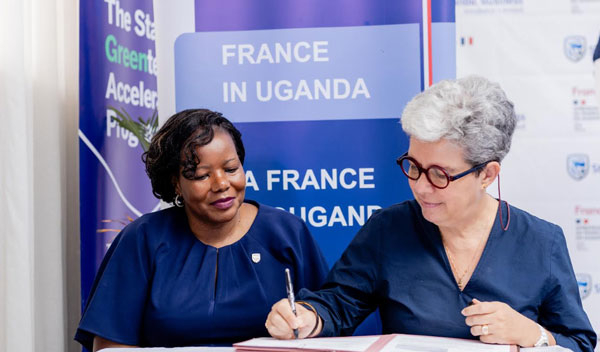
The programme is valued at about Shs2.8bn grant from the French Embassy and Shs400bn co-financing from Stanbic Bank Uganda
Kampala, Uganda | JULIUS BUSINGE | France is expanding support for Uganda’s women and youth-led green businesses, moving beyond project funding towards a longer-term pipeline intended to connect entrepreneurs to finance, markets, technology and French companies.
Virginie Leroy, French Ambassador to Uganda, said the decision to deepen the partnership with Stanbic Business Incubator Limited (SBIL) was based on the existing capacity of the incubator and its focus on women and young people.
“We are not creating a new tool that will die after the project. We are supporting a project that can increase and deepen its impact,” Leroy said at the graduation of 106 entrepreneurs under the Stanbic GreenTech Accelerator and Incubation Programme in Kampala on Sept.18
The programme was launched in 2025 with a €450,000 grant from the Embassy of France, with total investment estimated at about Shs2.9 billion. It targets 200 women and youth-led green enterprises in the Kampala Metropolitan Area and Hoima.
The first cohort has focused on businesses in the green economy, with entrepreneurs receiving support to strengthen business models, pitch to investors, build networks and identify potential markets.
Leroy said the programme was not ending with the graduation, with France signing a new commitment to support another 200 entrepreneurs during the next phase.
“This is just a one-year graduation ceremony for more than 100 entrepreneurs in the green economy,” she said. “Today I signed a new commitment for next year that will enable 200 more entrepreneurs to gain from the programme.”
The next phase will also introduce an international dimension. In November, 10 entrepreneurs from the inaugural cohort will travel to France to engage with French green technology entrepreneurs, exchange experiences and explore potential market opportunities.
Market links
Leroy said the French government wants to support Uganda’s private sector across different stages of business development, including incubation, acceleration, affordable financing and connections between companies.
“The beauty of the Ugandan economy is that the private sector is very vibrant,” she said, adding that France was interested in businesses ranging from small and medium enterprises to major companies.
The partnership also fits into a broader effort to deepen commercial ties between Ugandan and French companies through institutions such as the French Chamber of Commerce in Uganda.
Leroy said the French-Ugandan economic agenda would also focus on green growth, decarbonisation, renewable energy and digitalisation in financial services.
She cited agriculture as an area where digital technology could give farmers access to weather information, commodity prices and buyers, helping them make better commercial decisions.
Mark Ocitti Ongom, chief executive of Stanbic Uganda Holdings Limited (SUHL), said the partnership demonstrated the role of collaboration in supporting sustainable economic growth.
“The Embassy of France is interested in sustainable growth for Uganda. We, on the other hand, call Uganda home and are committed to driving her growth,” Ongom said.
Ongom said Stanbic Bank, the anchor subsidiary of SUHL, had about Shs400 billion available in financing for women and youth, providing a potential financing pathway for entrepreneurs seeking to expand their operations.
Government push
Minister of State for Gender and Culture Mary Kamuli Kuteesa said the private sector initiative complemented government programmes aimed at widening access to capital, skills and markets.
“These are innovative ways to access capital,” Kuteesa said, referring to programmes including the Youth Livelihood Programme, Parish Development Model and GROW.
She also urged Ugandans to support local businesses by purchasing their products, arguing that domestic demand was important for enterprises seeking to grow and create jobs.
“This is a responsibility for everyone. Let’s buy from our local entrepreneurs. Buy Uganda-Build Uganda,” Kuteesa said when asked about government’s strategy to connect SBIL-supported entrepreneurs to its supplier database.
Kuteesa urged the graduates to remain resilient, maintain honesty with customers and continue learning as they develop their businesses.
“Be resilient. Do not give up. Keep going. Keep working harder, smarter. And let’s keep Uganda green and create decent jobs,” she said.
Several beneficiaries who spoke to The Independent said the programme had strengthened their corporate governance capabilities and better positioned their businesses to pursue future growth opportunities.
The programme therefore represents a broader shift from entrepreneurship training towards building connections that can help Uganda’s emerging green businesses become more investment-ready, commercially viable and capable of creating jobs and support Uganda’s green transition.