The Independent Uganda: You get the Truth we Pay the Price


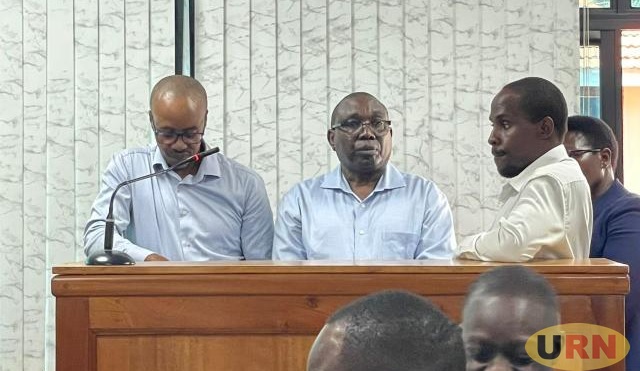
Kampala, Uganda | URN | The Director of Public Prosecutions has been ordered to disclose the exhibits it intends to rely on in the trial of nine Finance Ministry and Bank of Uganda officials accused of manipulating government payment systems in a scheme that allegedly caused losses of about Shs60 billion.
Anti-Corruption Division Judge David Makumbi issued the order on Monday after the prosecution asked for more time to disclose an Auditor General’s report and two statements to the defence. Assistant Director of Public Prosecutions Thomas Jatiko told the court that the prosecution had not yet shared the documents and asked to be allowed to complete the disclosure by September 1, 2026, before the case is fixed for a pre-trial hearing.
The request was opposed by the defence, led by former Deputy Attorney General Mwesigwa Rukutana, who accused the prosecution of delaying the trial despite an earlier court order directing it to make full disclosure by July 13, 2026. Rukutana told the court that the accused had expected the trial to have commenced by now, arguing that continued partial disclosure was prejudicing his clients, who have been interdicted from their jobs and are earning half pay.
He also referred to what he described as orders from the “Supreme Authority” directing that the accused persons should not stand trial but instead be reinstated and that the real culprits be pursued. Rukutana asked the court to take judicial notice of the alleged directive, saying the matter raised fundamental human rights concerns, including the accused persons’ constitutional right to a speedy trial.
“If the Prosecution wants to disobey the Fountain of Honour, it is their business,” Rukutana said, while urging the court to allow the trial to proceed so that his clients could clear their names. Another defence lawyer, Oscar Kambona, said Rule 8 requires the prosecution to file and disclose a list of exhibits in sufficient time to allow the defence to prepare for trial and avoid being ambushed with evidence.
Chief State Attorney Richard Birivimbuka said the prosecution was committed to a speedy trial and was working towards completing the disclosure. Birivimbuka also said the prosecution was unaware of the alleged pronouncements by the “Supreme Authority” referred to by Rukutana and had not been informed about the accused persons’ interdiction. In his ruling, Justice Makumbi said the defence’s concerns were duly noted, adding that the court had expected full disclosure to have been completed by Monday.
The judge said the parties were continuing to receive disclosure in a piecemeal manner, yet full disclosure was necessary to enable the defence to adequately prepare for trial, prevent trial by ambush, protect the right to a fair hearing and promote certainty in the proceedings. Justice Makumbi said any pronouncements from the “Fountain of Honour” concerning the prosecution were expected to come through the office of the Director of Public Prosecutions.
He ordered the prosecution to complete disclosure by September 1 and file a list of exhibits by the following day. The parties were also directed to agree on the facts and documents that can be admitted without requiring formal proof before the case returns to court for plea-taking on October 12, 2026. The judge extended the bail of all nine accused persons until then.
The accused are former Accountant General Lawrence Ssemakula; Jennifer Muhuruzi; Paul Nkalubo Lumala, a systems IT officer; Deborah Dorothy Kusiima, a senior accountant in the Treasury Services Department; Judith Ashaba, an accountant; Bettina Nayebare, a research assistant; Mark Kasiiku, an IT systems officer; Tonny Yawe, an IT senior officer; and Pedison Twesigomwe, an assistant commissioner for accounts at the Ministry of Finance.
The nine face charges arising from allegations that government payment systems were manipulated, resulting in the diversion of funds intended for international lenders. In March 2026, the Magistrates Court committed the accused to the High Court for trial after the DPP sanctioned fresh charges. The group was initially charged in 2024 with 11 counts involving corruption, abuse of office and causing financial loss.
Eight additional counts, including money laundering and electronic fraud, were later added, bringing the total number of charges to 19. According to the prosecution, the case stems from alleged failures by officials in the Accountant General’s Office and Treasury Services Department to establish effective safeguards for public funds. The DPP intends to present evidence that loan repayments to the International Development Association of the World Bank and the African Development Fund of the African Development Bank were fraudulently diverted.
Court documents indicate that payments made on September 12 and September 30, 2024, totalling more than US$14 million, equivalent to about Shs52 billion at the time, were allegedly diverted to foreign companies, including Roadway Company Limited in Tokyo, Japan, and MJS International in London.
The prosecution alleges that electronic payment files generated through the Integrated Financial Management System were altered before being encrypted and transmitted to the Bank of Uganda. It is further alleged that Linux executable scripts were inserted into the system to change the details of the intended beneficiaries to foreign entities.
The prosecution is expected to rely on forensic and IT audit reports, including evidence that administrator-level access was used to manipulate payment files. Investigators also allege that email communications from the Bank of Uganda relating to reconciliation were intercepted and altered to conceal the fraudulent transactions, while server logs were deleted to remove evidence of the altered payment instructions.
The prosecution further alleges that false reconciliation reports were prepared to show that the intended international lenders had received the money. In one instance, more than US$6.6 million allegedly destined for an entity in Poland was intercepted and blocked by the SWIFT messaging system after the World Bank raised a complaint over non-payment of a loan instalment.
The prosecution further contends that despite receiving an internal Bank of Uganda inquiry report highlighting irregularities, Ssemakula and Muhuruzi failed to take corrective measures or initiate disciplinary action, allegedly allowing subsequent fraudulent transactions to occur. The Bank of Uganda reportedly recovered more than US$8.2 million from one of the transfers to MJS International.
However, more than US$6.1 million allegedly paid to Roadway Company Limited and another US$391,720 remain unrecovered, according to the prosecution. The alleged fraud was initially described as a cyberattack on the Bank of Uganda but was later determined by investigators to have involved an internal manipulation of payment systems rather than an external hack.
Following the discovery, the Criminal Investigations Directorate, working with Defence Intelligence and Security, investigated staff from the Bank of Uganda, the Ministry of Finance and the Accountant General’s Office. By the end of 2024, at least 21 staff members from the three institutions had reportedly been interrogated, while their mobile phones and laptops were subjected to forensic examination.
Investigators have also pursued efforts to trace funds transferred to foreign accounts, including in the United Kingdom and Asian countries. The prosecution alleges that more than half of the approximately Shs60 billion was recovered through engagements with banks in the United Kingdom, while efforts to recover funds transferred to Asian countries have been less successful.
Investigators are also pursuing allegations that some of the money sent to Asian countries may have been withdrawn and returned to beneficiaries in Uganda in the form of cash or goods.