The Independent Uganda: You get the Truth we Pay the Price


Kampala, Uganda | URN | The Office of the Directorate of Public Prosecution (ODPP) and Uganda Police Force (UPF) have raised key concerns on the Forensic and Scientific Analytical Bill.
ODPP and UPF have questioned the creation of Government Analytical Laboratory (GAL) as the national referral centre for forensic services and also the excessive power vested in the proposed creation of the Department of Inspection and Legal Services under the Ministry of Internal Affairs.
The bill, which has been presented on the floor of parliament three times so far, aims to introduce a legal framework to regulate forensic and scientific analytical services in Uganda. In the Bill, the Ministry of Internal Affairs claims: “Uganda currently has no comprehensive legal framework governing forensic and scientific analytical services. The lack of a national poison information centre to handle poisoning data and incidents as well as the lack of national referral and data centre have caused weak oversight, lack of standards and quality control and limited sector development.”
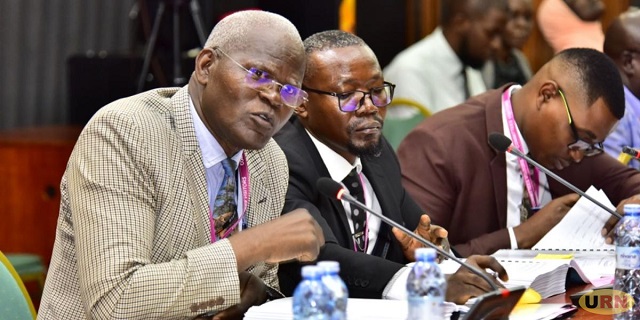
John Baptist Asiimwe, on behalf of the Director of Public Prosecution (DPP) has raised concerns that the Forensic and Scientific Analytical Bill in its current state contravenes several duties of criminal justice institutions as well as other organisations whose mandates are to ensure quality and standard services.
Asiimwe cites Article 212(c) of the Constitution, which states that the main role of the Uganda Police Force (UPF) is to Prevent and detect crime. Asiimwe also cites Section 4(1)(e) of the Police Act which also provides that; Subject to the Constitution, the function of the UPF is to prevent and detect crime in the society.
Under Section 4(3), no person shall arrest, detain or institute criminal proceedings except as provided for under a written law. “In effect, anything to do with law enforcement and investigation is a preserve of the UPF,” Asiimwe states. “In addition, the Identification of Offenders Act Cap 119 provides for the identification of offenders by means of fingerprints, footprints, palm prints, photographs and measurements. Under this law, the function for profiling individuals is for the police and prisons.”
UPF’s Director of Forensic Science Andrew Mubiru, said all their concerns have been contained in the ODPP response which has been shared with Office of the Attorney General and also to the Committee of Defence and Internal Affairs.
“For us, we suggest that there should be a harmonized ground in order not to cripple functions of duties of other key institutions,” Mubiru said.
Under the proposed law, the Department of Inspection and Legal Services (Ministry of Internal Affairs) will regulate forensic services, set standards and protocols, monitor compliance and ethics, inspect laboratories, and license and control laboratories. “The Government Analytical Laboratory will also serve as: Uganda’s National Poison Information Centre, it’s responsibilities include: Managing poisoning incidents, public awareness, research and data collection,” the Bill further reads.
ODPP stresses that the assertion that that there is no legal framework to regulate forensic and scientific analytical services in Uganda is not absolutely correct because some of the elements that fall under forensics are already ring fenced to the police in the Police Act and the Identification of offenders Act. ODPP adds that other elements of clinical forensics (forensic medicine medical-legal) are catered for under the Allied Health Professionals Act, Cap. 2961.
According to Asiimwe, the regulation of scientific analytical services deals with a wide range of science with several components, whose expertise can never be combined in one center. ODPP cites laboratories at UNBS which deals with quality standards of consumer products-regulated under UNBS Act and related regulations; NDA laboratory which deals with quality and efficacy of drugs-National Drug Policy and Authority Act, Cap. 198 and applicable regulations; Minerals (Ministry of Minerals-standards for minerals.
“There are the National Agricultural Research Liberators under NARO, an agency of MAAIF which provides services on food science, soil science, plant science, biological control, and agricultural engineering; NEMA laboratories which deal with assessment and analysis of various environmental parameters, e.g. water, effluent, soil, air quality and noise levels; and UWA laboratories which deal with diagnosis of zoonotic diseases especially in wildlife, and related matters-mainly for purposes of enforcement in wildlife crimes,” Asiimwe states in a written response on behalf to DPP.
Other laboratories ODPP have cited that are crippled by the Forensic and Scientific Analytical Bill include URA laboratories which conducts comprehensive product testing for quality and compliance, the Medical laboratories at different health centres, under Ministry of Health; the NWSC laboratory which monitors water quality; and the Central materials laboratory under the ministry of works and transport for testing the quality and standard of various building materials.
ODPP also names UIRI which also has a materials and non-destructing testing laboratory for materials’ research, quality assurance and advanced inspection techniques under the ministry trade and cooperatives; and the National Building Review Board which has a laboratory under the Directorate of Technical Services to support their investigations unit.
“Therefore, enacting a law that has the potential of confining the numerous functions of various agencies should be handled with a lot of care after wide consultations with the different stakeholders with varying areas of expertise. Lack of a wide spectrum of consultation could result in unintended consequences,” ODPP Asiimwe warns.
ODPP observed that clause 2 of the Bill purports to establish GAL as a department under the Ministry of Internal Affairs yet GAL is already in existence and operational under the same ministry. The ODPP has further noted that over the years GAL has issued numerous forensic reports used in criminal investigations and prosecutions.
ODPP further explains that retaining a close that established GAL could create ambiguity regarding the legal status of the Laboratory and may potentially give rise to legal challenges questioning the validity of the forensic reports previously issued by GAL prior to enactment of the Bill.
Efforts to get a comment from the current Director of Government Analytical Laboratory Kepher Kuchana Kateu were futile as he said he was very busy.
The Attorney General Kiryowa Kiwanuka in response to ODPP has advised that: “Any examination, analysis, report, certificate, opinion or other work undertaken or issued by the Government Analytical Laboratory (GAL) prior to the commencement of this Act shall remain valid and admissible for all legal and official purposes as if it had been carried out under this Act.”
The provision will save any examination, analysis, report, opinion, certificate or other work undertaken or issued by GAL prior to the commencement of the Act.