The Independent Uganda: You get the Truth we Pay the Price


Beyond profits, dfcu quantifies its economic, social and environmental contribution
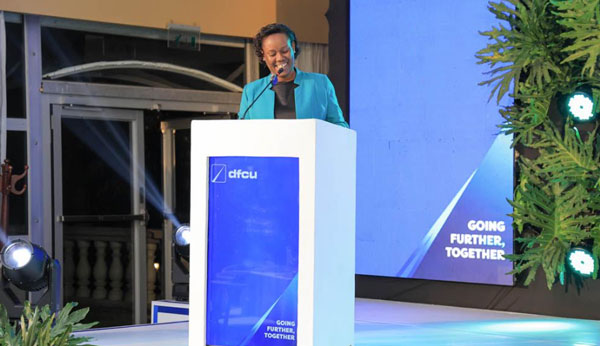
Kampala, Uganda | JULIUS BUSINGE | Serena Kigo, overlooking the tranquil waters of Lake Victoria, provided a fitting venue for dfcu Bank’s inaugural Report to Society 2025, unveiled on October 27. The setting reflected the environmental responsibility underpinning the gathering, where glass water bottles replaced plastic ones, highlighting how everyday choices can contribute to environmental protection.
At the event, dfcu Bank outlined its contribution to Uganda’s economic and social development, highlighting how its financial services, enterprise development programmes and community partnerships have supported businesses, women entrepreneurs, healthcare and environmental conservation.
Launched at Serena Hotel Kigo in Kampala, the report goes beyond documenting activities to examine how the financial institution translates banking into opportunities for individuals, businesses and communities.
For a bank that has operated in Uganda since 1964, the publication also marks an effort to make its wider societal contribution more visible, measurable and open to public scrutiny.
The numbers
dfcu Bank’s inaugural Report to Society 2025 puts figures to its contribution beyond conventional banking, highlighting enterprise financing, women’s economic empowerment, healthcare access and environmental conservation.
The headline figures include 6,527 small and medium-sized enterprises (SMEs) financed in 2025, more than 80,000 women entrepreneurs supported, over 25,000 Ugandans reached through community health interventions and 62,000 trees planted or distributed.
The report also cites Shs 38.08 billion in financing facilitated through dfcu Foundation and a Shs 1 billion commitment to preventive healthcare through a three-year partnership with Rotary Uganda.
These figures provide a starting point for assessing the Bank’s broader contribution. Their long-term significance, however, will depend on whether the initiatives deliver sustained improvements in business growth, household livelihoods, healthcare access and environmental protection.
SME financing
Financing 6,527 SMEs in 2025 highlights dfcu Bank’s role in supporting businesses that drive production, trade, services and employment across Uganda.
Access to financing can help enterprises increase production, enter new markets, purchase equipment and recruit workers. However, capital alone may not guarantee sustainable growth, particularly for businesses lacking technical skills, market connections and reliable supply chains.
dfcu Foundation, which transitioned from a Business Development Centre in 2024, focuses on addressing these challenges through enterprise development, financial inclusion and business partnerships.
James Ssemwanga, Chairperson of dfcu Foundation, said the organisation had supported more than 4,000 enterprises and reached over 80,000 beneficiaries since 2018, most of them women and young people.
“In 2025, we facilitated approximately Shs 38 billion in credit, helping enterprises access formal financial services and invest in growth,” Ssemwanga said.
The Foundation aims to reach more than 100,000 additional beneficiaries between 2025 and 2030.

Its focus is on businesses in the “missing middle”—enterprises that have moved beyond survival but need further support to expand. The Foundation connects SMEs with aggregators, processors, commercial farms and manufacturers to improve market access, strengthen supplier relationships and integrate businesses into wider value chains.
The next measure of success will be whether this support translates into stronger business survival rates, increased revenues, job creation and sustained access to formal financial services.
Women entrepreneurs
Women’s economic empowerment is another significant component of dfcu’s reported contribution. Through its Women in Business programme, the Bank has supported more than 80,000 women entrepreneurs.
The programme promotes women’s participation in economic activity through enterprise development and access to financial services. Growing women-owned businesses can strengthen household incomes, create employment and expand economic opportunities within communities.
However, additional indicators on businesses financed, enterprises expanded and jobs created would help establish the programme’s longer-term impact.
The initiative aligns with Sustainable Development Goal (SDG) 5 on gender equality, SDG 8 on decent work and economic growth, and SDG 10 on reduced inequalities.
Healthcare access
Beyond enterprise financing, dfcu Bank has committed Shs 1 billion to expand preventive healthcare through a three-year partnership with Rotary Uganda.
The report indicates that community health interventions reached more than 25,000 Ugandans, extending the Bank’s contribution to communities where access to essential medical services can be limited.
The medical camps offer outpatient consultations, diagnostic tests, medicines, dental and eye care, health education and referrals. Screenings cover conditions including hypertension, diabetes, HIV, cancer and sickle cell disease.
Recent outreaches have taken place in Jinja, Mbuya, Mutungo, Kasenyi Landing Site and Kamwokya.
The initiative supports SDG 3 on good health and well-being, particularly through preventive care, early detection and referrals for further treatment. Going forward, the number of people screened, conditions detected, patients referred and individuals receiving treatment will help demonstrate its impact.
Tree planting
Environmental conservation also features prominently in the report, with campaign materials indicating that 62,000 trees were planted or distributed in 2025.
The initiative aligns with SDG 13 on climate action and SDG 15 on life on land. However, the number of trees planted or distributed is an activity measure, not a complete assessment of environmental impact. Survival rates, maintenance and the areas restored will be important in determining the programme’s lasting value.
Jimmy D. Mugerwa, Chairman of the Board of Directors of dfcu Limited, the holding company of dfcu Bank, said sustainability should focus on the future being secured for the next generation.
“Sustainability is less about a compliance exercise and more about the future we are building for our children,” Mugerwa said.
The use of glass water bottles instead of plastic at the launch provided a practical example of the environmental considerations highlighted during the event.
For dfcu, the challenge will be to demonstrate that its environmental commitments translate into measurable, lasting benefits.
Beyond profits
Winifred Mary Tarinyeba Kiryabwire, Chairperson of the Board of Directors of dfcu Bank Limited, said the inaugural report was an important step towards strengthening accountability beyond financial performance.
“Our responsibility extends beyond financial performance to the contribution we make to the society that sustains our business,” Kiryabwire said.
For dfcu Limited, the report provides an opportunity to demonstrate how the Group’s banking and foundation activities contribute to Uganda’s economic development.
It also comes amid growing expectations that financial institutions disclose how their decisions affect businesses, livelihoods, communities and the environment, alongside conventional financial results.
Helena Mayanja, Head of Corporate Affairs and Sustainability at dfcu Bank Limited, said the report brings together the institution’s work across enterprise financing, women’s entrepreneurship, community health and environmental initiatives.
“Behind every figure are people, enterprises and communities whose progress matters,” Mayanja said.