The Independent Uganda: You get the Truth we Pay the Price


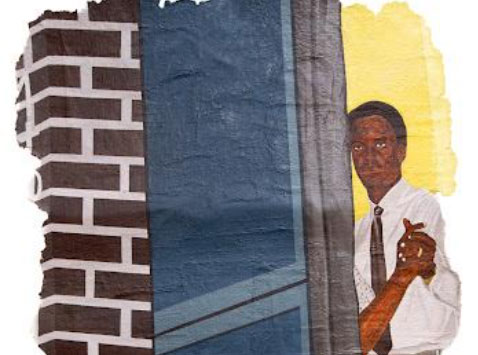
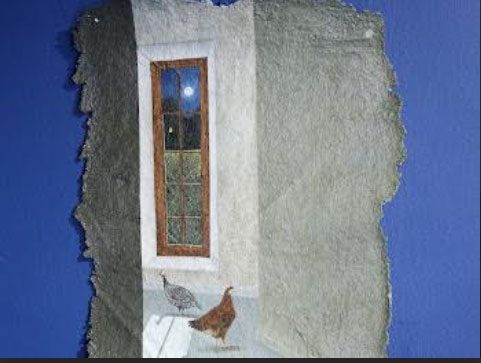
Through a delicate interplay of portraiture, paper mache, allegorical motifs and transitional space, the artist constructs a powerful visual language on what was, what is and what is being transformed.
ARTS | DOMINIC MUWANGUZI | For Brogan Mwesigwa every slight life experience gives him inspiration to create art. Often it can be that random encounter where he sees men excavating a piece of land to pave the way for the construction of a road or a building in his neighborhood or it can be a visit to a family gathering where he gets to meet his extended family and the merrymaking becomes a spark for a new idea. His latest body of work is a reflection of this insatiable hunger to turn almost everything around him into art. Inside Outside, is an inspiration from his personal experiences in his neighbourhood of Bulindo-Kira, a fast-transforming peri-urban neighbourhood located about 20Km from Kampala City. The artist deploys imagery that resonates with what is happening in his locale, where roads are being paved to accommodate the now-increasing traffic of motorists and pedestrians, gardens are being cleared to provide space for the construction of apartment buildings and communal settlements are now being taken over by gated residences. This transitioning from what was, what is now and what is being formed stimulates thought on how much of that memory we can carry into the future.
In his pursuit to capture these moments of erasure, the artist focuses on what lies in between – the liminal zone – and it’s within this space that he suspends his figures to create a powerful visual language of transitioning and preserving memory.
In Lover 3 2025, Brogan depicts a middle-aged gentleman dancing with his partner, but instead of showing the full female figure, the artist depicts only her arm that is firmly embraced by her partner. This composition suggests a married couple sharing a good time as depicted by the dancing symbolism, yet the fact that only a slight image of the woman is captured in the painting suggests a disruption or disarray to this lovely moment. According to the artist, this artwork was inspired by his random observation of a residential house in his neighbourhood that was gazetted for demolition by road constructors. Through his mind’s eye, he saw the confusion and dilemma such demolition would bring to the inhabitants of this household, probably like many others in the locale had done. The idea of displacement that transcends the physical but extends to the emotional and psychological wellbeing of the individuals in such settlements that are invariably embedded with memories of love and affection can be traumatic to the victims.
The artist’s intentional use of imagery in this painting, as with others on display, reveals his depth in understanding subject matter, technique and media. Brogan’s figures on canvas appear in a state of internal conflict, symbolizing the notion of standing in the middle where one has to choose between going forward, going backward or staying in the present.
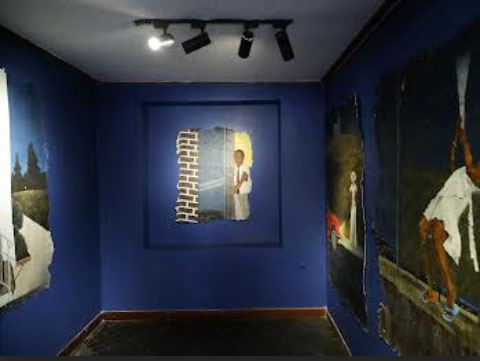
In Lover 3 2025, the gentleman, though enjoying a dance with his partner, stares blankly into the open space a gesture that is symbolic of being confused about what to do next or perhaps worried about the future. A similar state of confusion is visible in Sojourner 2025 where a young woman dressed in trendy outfit stands at the edge of the road, and through her body expression – eyes peering into the dark night and her thin hands clasping her waist in a pose that suggests confusion – she reveals she’s unsure of her next move. Even when a car flashes its headlights to arouse her attention, she remains immobile, illustrating the precarious and confusing state of wellbeing that is brought about by displacement even when it is sometimes well-intentioned.
Through the use of handmade canvases produced from waste paper collected from various offices around the city, Brogan underscores the idea of preserving memory and the aspect of acquiring new identity without necessarily burying the former. The handmade paper he paints on bares traces of its offer life with its irregular shapes that easily make it identifiable as something displaced from another world. Nonetheless, there’s an ambiguous quality with this handmade canvas that fills these artworks with a sense of suspense and uncertainty that prompts the viewer to appreciate them beyond their aesthetic value. These artworks carry the weight of everyday transitioning, whether physical, as depicted by the continuous constructions in Bulindo and the recycling of waste paper into handmade canvas, or psychological, where the citizenry are braced with the challenge of choosing which memories of their past they have to preserve into the future.
This exhibition, showing an excerpt of the larger body of work created by the artist from his residency at Afropocene Studio Lab, is timely in our lives as we’re routinely faced with fast-transforming landscapes in our neighbourhoods that are part of the city’s ambitious program of expansion and development. Yet within this displacement and transitioning, we’re reminded of how much memory of our past lives we’re able to preserve in order to embrace the future or perhaps choose to stay where we are right now.
*****
The exhibition is showing now at the Capsule Gallery by Afropocene located within the compound of Yujo Izakaya Restaurant in Nakasero, next to Nakasero Primary School. Images are courtesy of Afropocene Studio Lab.