The Independent Uganda: You get the Truth we Pay the Price


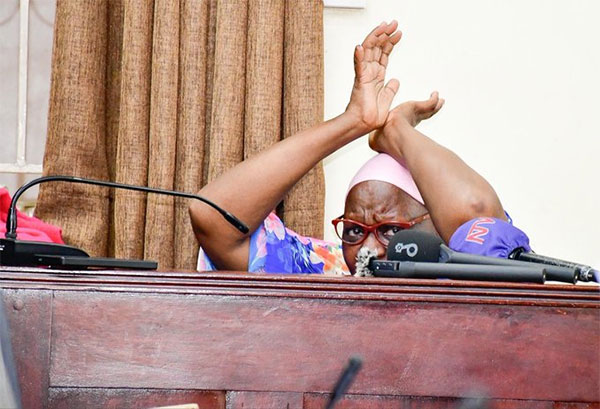
Injuries Suffered by Mrs Molly Katanga Were Defense Injuries, Says One of East Africa’s Leading Orthopedic Surgeons
SPECIAL REPORT | ANTHONY NATIF | As recorded in the case Uganda Vs Molly Katanga and adapted from @TonyNatif on X.
****
This matter returned to the High Court this morning, June 19th, with the defense set to present their third witness. Outside Mrs Katanga herself, this would be the 2nd expert witness.
Friday’s court session was marked by bitter exchanges between both sets of lawyers, accusations of witness intimidation and threats by a state attorney and an impromptu walkout by the presiding judge, who had visibly had enough of the bitter exchanges before her.
But that was all after the defense’s second expert witness, an orthopaedic and trauma surgeon, associate professor and researcher, told Justice Rosette Comfort Kania that before her was a woman who had likely suffered domestic violence and whose injuries were “pathognomonic of defense injuries”.
That difficult “p word” being medical speak for “specifically characteristic or indicative of a particular disease or condition”.
In this case, he explained that “when someone is facing you and trying to hit you, the natural reaction is to cover the sensitive parts, like the eyes and face. The natural defense position that people take is to try to hide their face as much as possible.”
He continued: “The reason we call them defense injuries is that these are injuries acquired when someone is trying to defend themselves.”
While referencing Mrs Katanga’s injuries and deep tissue bleeding, which he’d earlier described, he told Justice Kania, who was staring right at him, that “the reason I call them pathognomonic (very strongly suggestive) of defense injuries is that all the ecchymosis were on the ulnar side of the forearms and the hands, which you usually put on the head as someone is trying to assault you.”
The witness – who, by the judge’s witness protection order, we can only refer to as DW3XXX – stood in the witness stand at just after 10:20 am, spoke with the calm, confident authority of a man who has practiced at the top of his orthopaedic surgery craft for 23 years!
He told Judge Kania that on the morning of 2nd November 2023, he was called to attend to an emergency. This was at IHK.
He saw a lady whose head was covered in heavy bandages. She was under the care of a neurosurgeon.
He was “called to assess her upper limbs”. These he said are “the arms, the forearms and the hands”.
Asked what he observed by Mrs Katanga’s defense attorney, Elison Karuhanga (EK), DW3XXX said, “She had injuries on the palm, fingers, wrist area and on the forearm”. These injuries were on both sides, the left and right forelimbs.
EK: Did you observe any other injuries?
DW3XXX: I said she had a heavy bandage on the head.
EK: So, Doctor, after you assessed her injuries, what did you do?
DW3XXX: We agreed with my colleagues that the patient should as urgently as possible be taken to the theatre for management of the injuries that she had.
EK: Was there an order in which you (different sets of specialists) would work on her?
DW3XXX: Because of the urgency of the bleeding on the scalp that I came to understand, that bleeding was the most urgent. So, the first part was for him (the neurosurgeon) to arrest the bleeding on the scalp and stitch the wounds, and then I come in to perform a procedure on the upper limbs.
EK: Can you tell this court about the surgery you performed?
DW3XXX: You don’t want to know about the diagnosis I made before I go to the surgery?
EK: please tell us the diagnosis
DW3XXX: In medicine, in order for us to come to the conclusion of what injuries the patient has got, we inspect, we palpate. Then after assessing, we do X-rays to see the status of the bones and joints.
Mr Muwaganya: My Lord, is he giving us hypothetical scenarios or is he telling us what he did?
DW3XXX: I’m telling you what I did and how I make my decisions as a professional.
He then said with the help of X-rays and theater assessment after the (blood) soiled dressings had been removed, he assessed her injuries.
In a report to Dr Moses Byaruhanga, he noted that Mrs Katanga presented with scalp bleeding and lacerations, painful wrists and hands following domestic violence.
UgandaVsMollyKatanga
Injuries Suffered by Mrs Molly Katanga Were Defense Injuries: Says One of East Africa’s Leading Orthopedic Surgeons
Yesterday’s court session was marked by bitter exchanges between both sets of lawyers, accusations of witness intimidation and threats by a… https://t.co/DihHsfFMq0 pic.twitter.com/3T7M3bq7Kt
— Anthony Natif (@TonyNatif) June 20, 2026
VIDEO