 The Independent Uganda: You get the Truth we Pay the Price


Transition to Muhoozi’s UPDF generation nearly complete
Kampala, Uganda | IAN KATUSIIME | Nineteen generals of the Uganda People’s Defence Forces (UPDF) retired from active service on August 20 in what is likely one of the army’s biggest senior-level retirements in recent years. It also marked the end of the Bush War generation that brought President Yoweri Museveni to power forty years ago.
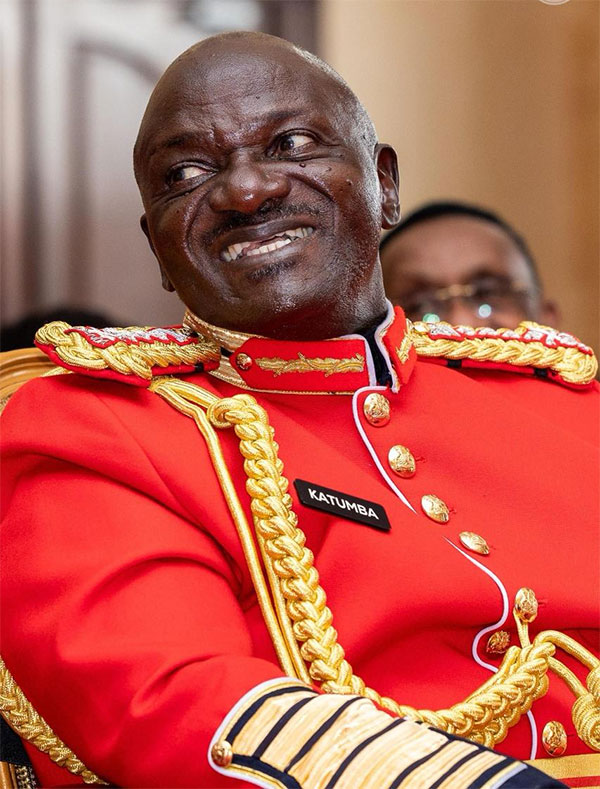
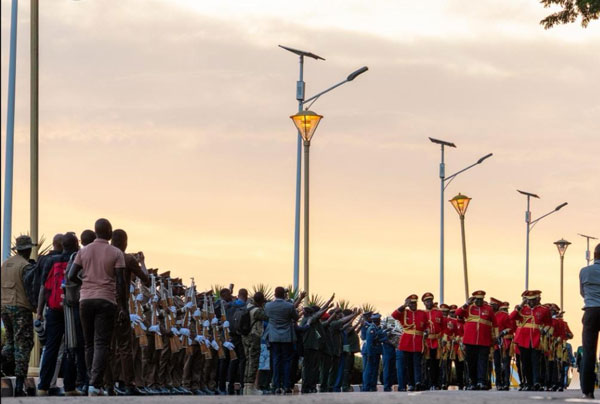
Presided over by President Museveni, the commander-in-chief, the ceremony brought together some of the UPDF’s most prominent military figures, including Gen. Katumba Wamala, Lt Gen. Otema Awany, Lt Gen. Charles Angina, Maj. Gen. Abel Kandiho, Maj. Gen. Geoffrey Katsigazi and Maj. Gen. Leopold Kyanda, who donned their red ceremonial uniforms for the final time as serving officers.
“I congratulate the retiring generals for the great contribution they have made to the UPDF. The army and the NRM have been able to build peace and security in Uganda because of many factors, including our ideology of patriotism, modern military technology and the strength of our national economy,” Museveni said at the event.
The emotional ceremony, attended by the generals’ families, marked the end of decades of military service for a generation of officers who have shaped the UPDF and Uganda’s security establishment.
The significance of the generals leaving the UPDF is in the wars that made them, according to military observers.
Some of the retiring officers belong to a generation whose military careers began in the Uganda National Liberation Army (UNLA), the army that was formed after the overthrow of former president Idi Amin in 1979.
Others joined the National Resistance Army (NRA), Museveni’s rebel group that fought a five-year guerilla war against Obote’s second government. When the NRA captured power in 1986, it was subsequently transformed into the UPDF.
Gen. Katumba joined the UNLA in 1979 and as he retired, it was the end of a military career that lasted 47 years. He is the longest-serving member of the retiring cohort.
At the same ceremony, Museveni praised the generals and singled out Katumba who he said helped Gen Salim Saleh, Museveni’sbrother to escape from Moroto prison. The president said Katumba was involved in the UPDF attack on the Sudanese border town of Kaya in 1997.
Katumba and others rose through the ranks as Uganda moved from a country recovering from years of internal conflict to a regional military power increasingly willing to project force beyond its borders.
The retiring generation took part in many battles in the 1990s when Uganda’s military was not as advanced as it is today as they fought the Lord’s Resistance Army (LRA) and sought to stabilize the nation in the early years of the Museveni era.
Their transformation was forged on battlefields. Ugandan forces fought the LRA insurgency for years, intervened in the Democratic Republic of Congo, deployed extensively in Somalia under the African Union mission, and maintained a substantial military presence in South Sudan.
“We are now celebrating retiring generals. In the past, they would die or go into exile,” Museveni said.
Each operation tested and reshaped the army’s command structures, doctrine and leadership. But they have also deployed in the Central African Republic and Equatorial Guinea.
They were campaigns in which they commanded troops, made operational decisions and accumulated the experience that eventually carried them to the highest levels of the military hierarchy.
The result is a generation of commanders with an unusually long record of operational experience. Some have spent virtually their entire adult lives inside an army that has rarely been without a significant external or internal security operation.
The Longest-Serving Generation
Military scholars say the Bush War generals are the longest-serving generation. The longevity of the Katumba group has been hailed as its defining characteristic. Katumba, a former Chief of Defence Forces, has served as minister for a while. Before that, he was UPDF Commander of Land Forces. Katumba was also Inspector General of Police from 2001-2005.
Angina served as deputy CDF while Otema Awany was Commander of Reserve Forces. Kandiho was head of Chieftaincy of Military Intelligence while Katsigazi was deputy IGP in recent years. Kyanda was UPDF Chief of Staff in his last posting.
Unlike militaries where senior commanders routinely rotate out of service after relatively short periods, Uganda has retained some of its most experienced officers for decades, allowing institutional knowledge accumulated during the NRA bush war and subsequent conflicts to remain concentrated within the senior command.
That continuity has advantages according to political and military theorists. The UPDF’s ability to conduct prolonged operations in Somalia, South Sudan and the DRC has depended partly on commanders who understand the army’s history, culture and operational methods.
But it has also produced an unusually powerful and enduring military establishment.
The retirement of 19 generals therefore raises a question beyond their individual careers: is the UPDF finally moving from the generation that fought Uganda’s wars of the 1980s and 1990s to a new generation whose experience has been shaped by a very different kind of warfare?
A week earlier, the generals were formally seen off by CDF Gen. Muhoozi Kainerugaba, President Museveni’s son, underscoring the generational transition underway in the UPDF. Under Muhoozi, the army is increasingly being shaped by a younger generation of officers—many of whom were born after Museveni came to power and have known no other commander-in-chief.
Some analysts have long pointed to tensions between the old guard of the Museveni era—officers whose authority was forged in the bush war—and a younger generation that has risen under Gen. Muhoozi. Muhoozi himself joined the UPDF in the late 1990s and graduated from Sandhurst in 2000, before rising through the ranks and eventually becoming CDF. His generation now occupies much of the army’s senior command, marking a significant shift from the officers who fought alongside Museveni in the NRA bush war.
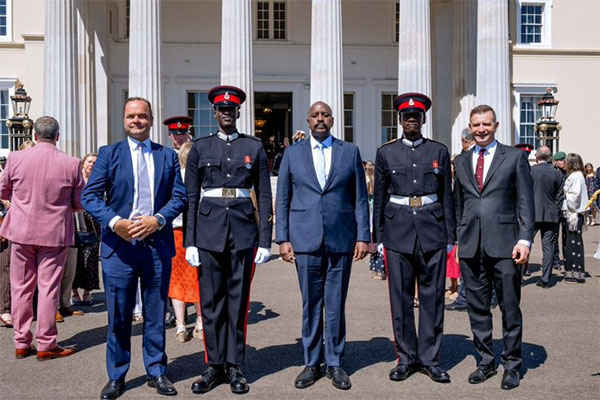
The transition has now acquired a distinctly dynastic dimension. In August, Muhoozi’s son, Second Lieutenant Ruhamya Kainerugaba, graduated from Sandhurst and was commissioned into the UPDF—following the same path his father took 26 years earlier. His entry makes him the third generation of the Museveni family to enter Uganda’s military establishment, adding another layer to an army undergoing profound generational change.
It very crucial to understand that, Uganda’s political stability has been profoundly impacted by the Army. Having the next generation of military leadership is an attested fact that Uganda will remain peaceful politically. The re-establishment of the Chwezi dynasty is a key component of assured stability and prosperity.
Democratic dictatorships have been instrumental in ensuring that Uganda remains peaceful economically and socially. Having people assume that they can select any leader of their choice, even when they’re not guaranteed with a fair vote process is what it entails in this.
Viva UPDF. Viva Uganda. Viva PLU. Viva Chwezi Dynasty.