The Independent Uganda: You get the Truth we Pay the Price


Moroto, Uganda | THE INDEPENDENT | For decades, Karamoja stood on the margins of Uganda’s political and economic life, defined more by insecurity, underdevelopment, and state neglect than by opportunity.
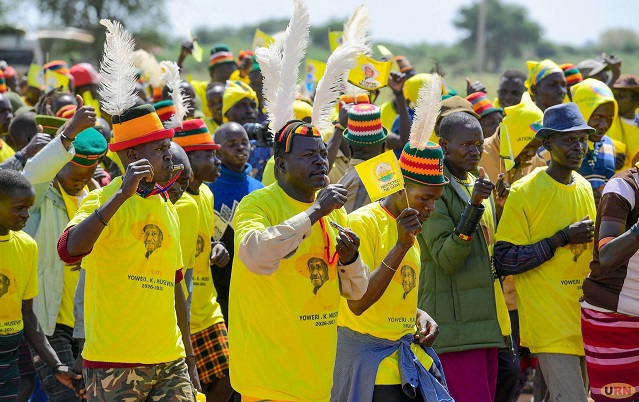
Today, the sub-region remains one of President Yoweri Kaguta Museveni’s strongest political bastions, a reality reaffirmed by the results of the recently concluded general elections.
President Museveni secured an overwhelming victory across all nine districts of Karamoja, posting margins rarely seen elsewhere in the country.
Amudat district delivered the highest support at 97 percent, while even the lowest-performing district, Abim, returned 85.43 percent in his favour. To many residents, the outcome was less about party loyalty and more about history, peace, and visible state presence.
Community elders say Karamoja’s support for the National Resistance Movement (NRM) is rooted in a shared memory of long-standing marginalisation.
Jackson Angella, an elder from Moroto district, recalls a time when access to basic services was almost nonexistent. He says that during the colonial era and in the years that followed, the entire region depended on a single health facility, Moroto Hospital, while formal education was limited to one school in Lotome Sub-county, in what is now Napak district.
That, he argues, began to change under the NRM administration. Angella credits the government with expanding health centres, increasing the number of primary and secondary schools, and addressing one of the region’s most sensitive issues, like land ownership.
Under the 1995 Constitution, he says, the Karamojong were granted stronger land rights, easing long-standing tensions between communities and state institutions.
Whereas government entities once controlled the vast majority of land in the region, Angella notes that a significant portion has since been returned to local communities.
He adds that Karamoja is now experiencing rapid infrastructural growth, including the establishment of factories, expansion of education facilities, and improved security, developments he says were unthinkable in earlier decades.
For many residents, these gains explain their continued support for President Museveni. Yet beneath the electoral dominance, there are signs of unease.
Julius Abura, a resident of Kambizi Ward in Moroto Municipality, attributes NRM’s electoral strength to its deep-rooted party structures, which stretch from the village level to national leadership. However, he warns that unfulfilled promises could gradually erode that support.
Chief among the concerns is water scarcity, a persistent problem in the semi-arid region. Abura says residents have repeatedly been promised dams and long-term water solutions, particularly for livestock, but many of these pledges remain unrealised.
For some, loyalty to the ruling party is also shaped by familiarity and caution rather than satisfaction. Esther Nakoru, a resident of Moroto, says she has lived her entire life under NRM rule and has grown accustomed to Museveni’s leadership.
While she admits to occasional curiosity about alternative leaders, she says uncertainty about what change might bring makes her hesitant.
Local leaders aligned with the ruling party argue that continuity remains essential. Ismail Mohammed, the outgoing mayor of Moroto Municipality, credits President Museveni with restoring peace to a region once plagued by armed cattle rustling and insecurity.
He says government interventions in security and water provision for livestock have laid the foundation for economic transformation.
Mohammed believes residents continue to vote for Museveni not only to protect the gains already made, but also in anticipation of development benefits comparable to those enjoyed by other regions of the country.
The opposition, however, disputes the narrative of unshakable NRM dominance. Ernest Ayen, the National Unity Platform (NUP) coordinator for Karamoja, argues that political attitudes in the region are slowly changing.
He accuses the ruling party of maintaining control through intimidation, threats, and an uneven political playing field, claiming that under freer conditions, opposition parties would have performed far better.
Despite structural and logistical challenges, opposition figures say they are laying the groundwork for the future.
Hellen Kiyai, a former Forum for Democratic Change (FDC) candidate for Moroto District Woman Member of Parliament, says her campaign revealed a growing appetite for change, particularly among younger voters.
Although she lost the race, Kiyai says many residents responded positively to opposition messages, even if fear and low voter turnout limited their ability to translate that support into votes. She remains optimistic that political competition in Karamoja will intensify ahead of the 2031 elections.
For now, Karamoja remains firmly in President Museveni’s corner, but beneath the landslide margins lies a more complex story of gratitude, unmet expectations, and a slow, cautious political awakening.
****
URN