 The Independent Uganda: You get the Truth we Pay the Price


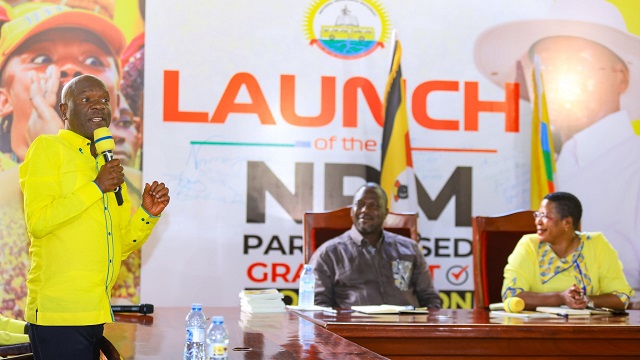
Kampala, Uganda | JULIUS BUSINGE | Uganda’s political battlefield was jolted Wednesday after Mawokota South legislator Yusuf Nsibambi formally defected from the opposition Forum for Democratic Change (FDC) to the ruling National Resistance Movement, a move analysts say deepens the widening cracks inside the country’s opposition ranks.
Nsibambi was officially unveiled at the NRM headquarters in Kampala after being received by the party’s Second National Vice Chairperson (Female), Anita Among, who welcomed him into what she described as a movement committed to protecting Uganda’s achievements and national stability.
Party Secretary General Richard Todwong also urged the veteran politician to persuade more opposition legislators to cross over, declaring that the ruling party remains open to all leaders willing to work within its structures.
The dramatic defection follows a recent high-level State House meeting in which Nsibambi led a delegation of opposition politicians to meet President Yoweri Museveni, an engagement that immediately triggered sharp reactions across opposition circles.
Opposition leaders warned at the time that such direct negotiations with the President risked weakening collective opposition bargaining power and could fracture already strained alliances.
Senior figures within the opposition, including leaders allied to the FDC, criticized Nsibambi’s engagement with Museveni, arguing that unilateral talks without broad consultation undermined internal cohesion and handed political advantage to the ruling establishment at a time when opposition parties were attempting to rebuild after a bruising electoral cycle.
Nsibambi’s shift is particularly symbolic because he previously worked closely with long-time opposition strongman Kizza Besigye in earlier opposition mobilization campaigns, where he was considered one of the senior figures helping coordinate political resistance in central Uganda.
His departure therefore represents not only an individual political recalibration but also a psychological blow to a camp already struggling with defections, internal divisions and post- election uncertainty.
The defection also reinforces a growing narrative promoted by the ruling establishment that Uganda’s opposition is steadily losing strategic ground.
Museveni and senior NRM figures have repeatedly argued that continued fragmentation within opposition parties will render them increasingly ineffective over the coming decade, with ruling party strategists openly projecting a future political landscape in which the opposition could become drastically weakened before the 2032 electoral cycle.
Political observers say Nsibambi’s move — coming shortly after his State House engagement alongside other opposition politicians — signals the beginning of a new phase of political absorption in which experienced opposition figures are being drawn into the ruling party’s orbit, potentially accelerating further crossovers and reshaping the balance of power ahead of the next round of national contests.


I wonder what he was saying on the microphone. Some quotes or excerpts from his speech would have been interesting.