The Independent Uganda: You get the Truth we Pay the Price


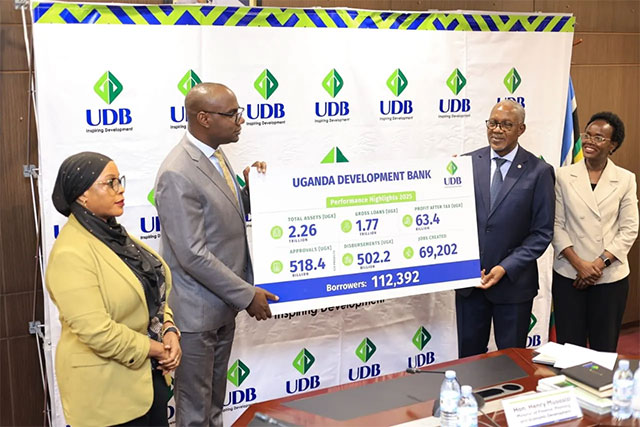
The lender approved Shs518.4 billion in new financing for 120 projects across Uganda and disbursed Shs502.2 billion
NEWS ANALYSIS | JULIUS BUSINGE | Uganda Development Bank (UDB) is expanding its role as a source of long-term capital for businesses, with increased lending helping companies create jobs, raise production and strengthen their contribution to the economy.
The state-owned development finance institution disbursed Shs502.2 billion ($133 million) in 2025, a 29% increase from the previous year. Its total assets grew by 27% to Shs2.26 trillion, from Shs1.78 trillion in 2024.
The bank’s net loans and advances to customers rose to Shs1.63 trillion, while post-tax profit increased 9.7% to Shs63.4 billion.
But UDB says its impact should not be measured by its balance sheet alone. Businesses supported by the bank created and sustained 69,202 jobs during the year, a 24.6% increase. The companies generated annual production worth Shs6.26 trillion and profits exceeding Shs1.16 trillion.
The results were announced on 13 August at UDB’s annual general meeting at the Ministry of Finance, Planning and Economic Development.
UDB Managing Director Patricia Ojangole said the bank’s growing financial strength was allowing it to provide capital to businesses that commercial lenders may not always be able or willing to finance over the long term.
“Development finance delivers its greatest value when it unlocks opportunities that commercial markets alone cannot provide,” Ms Ojangole said.
She said UDB’s investments were intended to strengthen productive enterprises, create jobs, increase value addition and improve incomes.
Lending to productive sectors
UDB approved Shs518.4 billion in new financing for 120 projects across Uganda and disbursed Shs502.2 billion.
The funding supported businesses seeking to expand production, modernise operations, adopt technology and improve their competitiveness in domestic and export markets.
Almost two-thirds of UDB’s financing went to agriculture, agro-industrialisation and manufacturing.
That focus reflects the bank’s mandate to support productive sectors that can help Uganda move from a predominantly commodity-based economy towards greater processing and manufacturing.
Agriculture remains a major source of employment, but limited processing means much of Uganda’s agricultural output is sold with relatively little value added.
UDB’s lending is aimed at helping businesses invest in processing equipment, production facilities and technology, allowing them to move further up the value chain.
Manufacturing is similarly important to Uganda’s plans to increase domestic production and reduce dependence on imported goods.
The bank’s active customer base increased to 689 enterprises operating in 105 districts.
The number of direct borrowers also increased to 112,392.
UDB said the expansion was helping extend development finance beyond Uganda’s main commercial centres.
For businesses making long-term investments, access to affordable capital can be critical. Buying machinery, constructing production facilities or expanding processing capacity often requires significant upfront investment, with returns taking years to materialise.
That is where development finance institutions seek to fill a gap left by conventional commercial lending.
Jobs, production and taxes
Employment was among the clearest indicators of UDB’s development impact. The 69,202 jobs created and sustained by UDB-supported enterprises represented a 24.6% increase from the previous year.
The bank said the employment generated was contributing to more stable household incomes and greater economic participation, particularly among young people.
The enterprises also generated annual production valued at Shs6.26 trillion.
Their profits exceeded Shs1.16 trillion, providing companies with greater capacity to reinvest, acquire technology and expand their operations.
The businesses also became a larger source of government revenue.
Tax contributions from UDB-supported enterprises increased by 22.5% to Shs387 billion.
That is significant for a government seeking to strengthen domestic revenue mobilisation and reduce reliance on external financing.
The figures also illustrate the wider economic effects of development finance. A loan to one company can translate into employment, purchases from local suppliers, increased production and tax payments.
UDB says that is the rationale for directing capital towards businesses with the potential to generate wider economic benefits.
More exports and foreign exchange
Foreign exchange earnings generated by enterprises supported by UDB rose to Shs1.84 trillion in 2025, from Shs1.11 trillion previously.
The bank said the increase reflected growing competitiveness among Ugandan companies in regional and international markets.
Uganda has sought to increase exports and reduce its dependence on unprocessed commodities. Expanding the number of companies capable of producing processed and manufactured goods for external markets is central to that ambition.
Higher export earnings also provide additional foreign currency, supporting Uganda’s external position.
The growth in foreign exchange earnings therefore gives another indication of the potential impact of UDB’s financing beyond the companies receiving the loans.
UDB’s own financial position strengthened during the year. Total assets increased by 27% to Shs2.26 trillion, supported by increased government capitalisation and financing from development partners.
Total equity rose 24.8% to Shs1.89 trillion, while net loans and advances grew to Shs1.63 trillion.
The bank’s Shs63.4 billion post-tax profit was 9.7% higher than in 2024.
UDB said the stronger financial position would improve its capacity to finance larger and more transformational investments with longer-term economic and social benefits.
The bank said its operations remained robust, supported by prudent risk management, targeted technology adoption, human-capital optimisation and portfolio management.
Those measures allowed it to expand financing while maintaining operational efficiency, it said.
For a development bank, financial sustainability is particularly important. Unlike a conventional commercial lender, UDB is expected to pursue projects with broader economic and social benefits, including investments whose returns may take longer to materialise.
Maintaining a strong balance sheet allows it to continue lending without compromising its ability to absorb risks.
UDB’s financial performance and governance also attracted recognition from rating agencies and development finance institutions.
Fitch Ratings assigned the bank an AA+ (Uga) national rating and a B long-term foreign-currency issuer default rating.
UDB described the national rating as the highest available on Uganda’s national scale.
The Association of African Development Finance Institutions retained UDB’s A+ rating, the highest category under its assessment framework.
The bank also received international recognition for its sustainability work.
It won the Outstanding Business Sustainability Achievement Award at the 2025 Karlsruhe Sustainable Finance Awards in Germany, following four consecutive years in which it had been recognised as Sustainability Leader of the Year, from 2021 to 2024.
UDB retained Level 5 certification under the Sustainability Standards and Certification Initiative Version 2, the highest level under the certification process.
Ms Ojangole was also named Banker of the Year at the Africa Banker Awards 2025 for her leadership and contribution to UDB’s performance and development impact.
Building a pipeline of investment
UDB’s ambitions extend beyond traditional lending. During the year, it hosted the inaugural Uganda Development Finance Summit, bringing together more than 500 policymakers, business leaders and local and international development partners.
The summit focused on the challenges facing development finance and opportunities to mobilise more capital for productive investment.
The bank also launched the Reshaping Industry for Sustainable Economy, or RISE, initiative with key stakeholders.
The platform is designed to turn development challenges into viable, investment-ready and fundable projects.
That reflects a broader challenge for development finance in Uganda: finding enough commercially viable projects capable of absorbing large amounts of long-term capital.
UDB also strengthened partnerships with bilateral and multilateral development institutions to expand its funding base and increase its capacity to finance priority sectors.
Government expectations
Finance Minister Henry Musasizi praised UDB for turning government capital into measurable economic outcomes.
He said the bank’s investments were helping expand industry, promote value addition and strengthen the private sector.
Mr Musasizi said UDB’s work was contributing to Uganda’s National Development Plan IV and the government’s Ten-Fold Growth Strategy.
UDB Board Chairman Geoffrey Kihuguru said the bank would continue to focus on prudent stewardship of its assets and capital while maintaining operational efficiency.
The bank’s performance came against a favourable economic backdrop.
Uganda’s economy grew by 6.3% in 2025, supported by agriculture, industry and services, while inflation declined to 3.3%.
The combination of stronger economic growth and lower inflation created a more supportive environment for businesses and investment.
But the challenge for UDB is now to ensure that the rapid expansion of its balance sheet continues to generate measurable economic returns.
Its 2025 figures provide evidence that the money is reaching productive businesses. Those companies are employing tens of thousands of people, generating billions of shillings in tax revenue, increasing production and earning more foreign exchange.
For Uganda, the broader question is whether such gains can be sustained at a scale large enough to transform the structure of the economy.
For UDB, the answer will depend on its ability to balance two objectives: remaining financially strong enough to lend for the long term while continuing to direct capital towards sectors capable of generating jobs, exports and higher-value production.
Its latest results suggest that, for now, the development bank is growing into that role.