 The Independent Uganda: You get the Truth we Pay the Price


COMMENT | NNANDA KIZITO SSERUWAGI | After President Museveni captured power in 1986, Uganda adopted a “no party” or what was commonly known as the “movement” political system. Under this system, political parties were banned from campaigning, sponsoring candidates or holding rallies. President Museveni and the NRM argued that the pre-1986 multi-party politics had been marred by dangerous sectarian divisions, which had plunged Uganda into political instability. Parties then had been mobilised and organised primarily around religion (Catholic vs. Protestant) and ethnic/regional identity. Therefore, Museveni argued that allowing parties to campaign again would immediately re-ignite these divisions and regress the country into chaos. He presented the “Movement” system as a broad-based, non-sectarian, and merit-based alternative.
In 1995, a new constitution was promulgated. It committed to holding presidential and parliamentary elections but continued the no-party system. The first direct presidential elections since 1980 were held in 1996, with Museveni winning 74.2% of the ballots cast against Paul Ssemogerere of the Democratic Party and others.
In a referendum held in 2005, Ugandans approved a return to multiparty politics.
In election after election held since 1995, Ugandan opposition parties and their presidential candidates have lost, with some poll results more disappointing than others. Their losing has been as consistent as their post-mortem analysis for explaining the losses: rigging.
The claim that opposition presidential candidates lose elections because Museveni cheats them is a very convenient, even involuntary excuse that they hang on to mask their more fundamental organisational dysfunctions. This is one of the significant dents on the long-term viability of the Ugandan opposition as a credible alternative to Museveni’s NRM.
The inability of Uganda’s opposition to appreciate that the biggest elephant in their room is voter apathy rather than rigging shows a glaring strategic weakness in their ability to self-correct and reorganise.
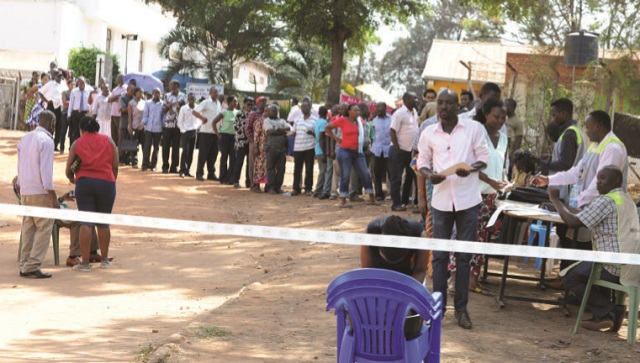
The rates of voter turnout in presidential elections routinely hover between 55% and 65%. Therefore, roughly 35% to 45% of registered voters simply stay home or attend to their work on the voting day.
Even then, a critical observation of the dynamics of low voter turnout in Uganda’s general elections reveals that it is usually a result of low voter turnout in opposition strongholds. Historically, the opposition’s fort has been Greater Kampala, including Kampala City, Wakiso and Mukono Districts. These areas normally register over two million voters. However, of these, only about 800,000 (40%) show up to vote. This sequence is repeated across majority of the major urban areas in the country with the opposition’s electoral base.
Conversely, Museveni normally registers higher voter turnout in his strongholds, with around 90% and even 100% (haha) in some areas.
So, how does the opposition expect to win presidential elections when voter turnout is lowest in areas which theoretically constitute the biggest numbers of their supporters?
Isn’t it self-destructive to deny this glaring fact and forever hang onto the claim that opposition losses can only be explained by vote rigging?
And I do not want to present low voter turnout as just a problem for the opposition, but it is also a big opportunity that they have persistently failed to seize. The fact that their assumed supporters do not show up to vote should long have charged them to mount aggressive voter mobilisation campaigns and even conduct serious analyses into why citizens are disengaged from voting. Of course, their immediate response could be that there are so many unfair disadvantages stacked against them. They have fewer financial resources for campaigning, and are sometimes restricted by the police from holding rallies, etc.
Opposition parties worldwide must strategise to win an election on an unlevelled playing field, because incumbents always have bigger advantages with all state resources at their disposal. It is not even uncommon for incumbent governments in Africa to lose power to the opposition despite all the unfair advantages of incumbency.
Therefore, to win an election anywhere is to overcome unfree and unfair electoral conditions. Museveni himself would not be president if he thought that the Obote government, which had a standing national army and was entrenched with all the instruments of the state, was asymmetrically stacked against his nucleus of 27 guns. He didn’t complain. He strategised.
Rather than strategise by truly assessing their continuous electoral failures, the opposition has maintained a predictable post-election ritual of claiming vote rigging. For instance, after the 2021 general elections, almost no opposition leader publicly dealt with the uncomfortable question of asking what happened to the 43% of registered voters who did not show up to vote, since voter turnout was at 57%. All they did was to allege rigging. This reveals a troubling lack of introspection.
But it is not difficult to understand why opposition parties are quick to claim electoral fraud, because it serves multiple functions for them, even if it blocks their ability to conduct genuine self-reflection. The major role it plays is that it absolves the opposition leadership from taking responsibility for their poor performance since claiming electoral fraud creates an external scapegoat and milks for them international sympathy. It also dims the light on examining whether their manifestos resonated with voters, or whether they conducted an effective campaign strategy or even whether their leaders inspired confidence in the electorate.
The rigging narrative also eternally preserves the self-image of opposition parties as popular movements whose loss is only a result of an unfair playing field. This claim may be true, but it is not the whole truth, and unfortunately, it goes without question because it is impossible to disprove. It is rather a self-fulfilling prophecy – that they lose because it is impossible to win under the prevailing circumstances.
Additionally, allegations of fraud are profitable ventures for fundraising from international donors and other foreign actors who often buy into the rigging claims due to their biases about Africa being uncivilised and therefore in need of financial support for “democratic resilience” programs for its opposition parties.
Claiming rigging is also a greasy allegation for the media to carry and circulate, thus buying relevance for the opposition long after the election has ended. This is because objective issues like voter turnout are generally boring and unsensational for the media, so both the media and opposition parties are in a marriage of convenience in perpetuating this narrative.
In the end, the opposition’s fixation with vote theft prevents them from fundamentally dealing with the task of persuading millions of potential voters who stay away from voting.
Nobody seems to be reaching out to this substantial middle ground of Uganda’s electorate. It is characterised by many citizens who may be dissatisfied with the NRM but are not necessarily convinced by the available alternative of opposition candidates.
It seems that both the opposition and NRM in this election are mostly appealing to their already existing supporters who have a strong partisan attachment.
However, millions of Ugandans are open to being convinced. This is apparent from how volatile the by-elections for members of parliament and local councils are, where dramatic swings often happen from one party to another, proving that voters are not immovably fixed in their preferences.
If everything stays as it has been, Museveni and the NRM are assured of a clean victory. And certainly, the opposition has not invested a thread of thought to understand voter psychology and build trust and confidence that could steadily expand their base. So, they will lose again.
****
 The writer is a Ugandan thinking about Uganda.


Your article is a bit shallow because it doesn’t provide concrete approaches that can convince the more than 43+% potential voters to participate in the electoral processes, thus giving Tibuhaburwa M7 a lee way to runaway with “victory after victory”!
Instead you go on blaming the opposition endlessly for failing to “assess reasons” why many Ugandan voters chose to stay home rather than go to the polling locations to cast their votes to “determine” who is their next leaders!
You also generically assert that it’s not uncommon in Africa for incumbents to lose elections to the opposition; you do not give a simple one or two examples of African incumbent presidents who have lost an election to the opposition inspite of their firm grip on instruments of coercion like the army and Police, the national treasury and, penalized state institutions. Ghanna and Senegal in west Africa, Zambia and Malawi in southern Africa are some of the best examples where incumbents lost the election outcomes to the opposition, BUT non of them had their president with a firm grip on instruments of coercion and other state machinery!