The Independent Uganda: You get the Truth we Pay the Price


Globally, citizens often display their national flags at homes, offices, and public spaces as expressions of
pride. Uganda is no exception
COMMENT | JULIUS BUSINGE | As Uganda journeys toward the January 15 general elections, the national flag has once again taken centre stage in public debate—raising questions not only about law and politics, but also about patriotism, restraint, and national conscience.
In the mid-2000s, I served as the Political Affairs Leader at St. Edward’s Secondary School- Bukuumi, a position I earned through a competitive student election in which I emerged victorious over four contenders. Among the responsibilities entrusted to me by our then head teacher, Bro. Deodati Aganyira—who has since retired as headmaster of St. Mary’s College Kisubi—were two tasks that shaped my understanding of leadership and patriotism. Every weekday morning, I was to raise the national flag, and whenever rain threatened, I was to lower it. As he handed me the flag from his office, he looked at me firmly and said words that still echo in my mind today: “Protect our flag because it is our national pride.”
“On Mondays—our general assembly days—I would raise the national flag as close to 1,000 students sang the Uganda National Anthem, a moment that deepened my reverence for the flag and reinforced its meaning as a symbol of unity, discipline, and national pride.”
That lesson has never left me. The flag of Uganda is not merely a combination of colours stitched together. It carries deep meaning: black for the African people, yellow for the sunshine that blesses our land, red for the brotherhood that binds us, and the grey crowned crane, standing on one leg, symbolising peace and steady progress. It represents our shared story, our resilience, and our collective destiny.
Our laws recognise this sacred symbolism. The National Flag and Armorial Ensigns Act of 1962, enacted at independence, establish the flag as a protected national symbol. It prohibits acts that insult, ridicule, or demean it, and it regulates how the flag may be used, especially in public and commercial spaces. This is not about stifling expression but about preserving dignity. The Constitution of the Republic of Uganda reinforces this responsibility by obligating every citizen to respect national symbols. Patriotism, therefore, is not emotional rhetoric; it is a civic duty grounded in law and conscience.
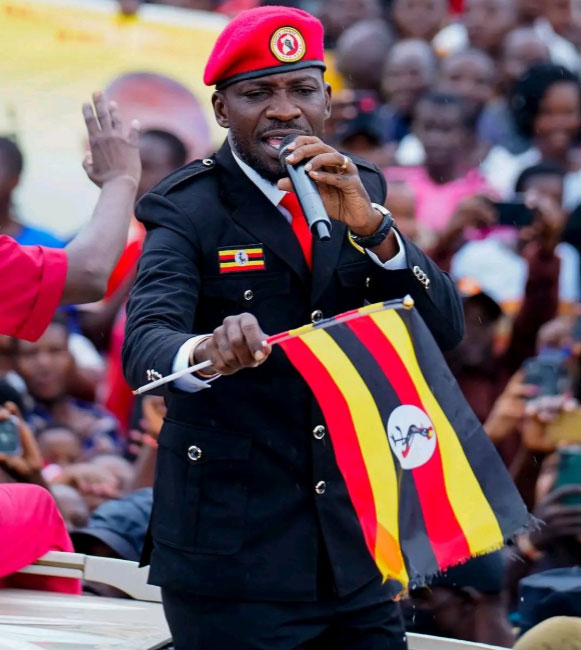
It is within this legal and moral framework that the current debate must be understood. Since the start of the ongoing political campaigns, the National Unity Platform (NUP) has prominently used the national flag at its rallies, stepping away from its official symbol, the umbrella. Supporters view this as a call to national consciousness and unity. Critics, particularly supporters of the ruling National Resistance Movement (NRM), interpret this as politicisation of a protected national symbol.
Globally, citizens often display their national flags at homes, offices, and public spaces as expressions of pride. Uganda is no exception.
A few days before Christmas, one of my friends accidentally plucked the flag I had kept in my car for several weeks, and it was blown away by the wind. I shed tears, feeling that I had strayed from the advice my former head teacher had given me when I served as a political leader at school. I had to search far and wide, from all over, until I finally got another one.
However, the challenge arises when national symbols are pulled into emotionally charged political contests. That is when wisdom, restraint, and good faith must guide both leaders and supporters.
The Chief of Defence Forces, General Muhoozi Kainerugaba (who is also President Yoweri Museveni’s son), publicly warned that anyone misusing the national flag would face legal consequences. His statement was widely interpreted as a caution to those displaying the flag during opposition activities. To some, this was a lawful reminder; to others, it appeared as a political signal in a highly sensitive environment.
In response, National Unity Platform leader Robert Kyagulanyi, popularly known as Bobi Wine, defended the use of the flag by his supporters, describing it as an expression of patriotism and love for country. He argued that citizens should not be criminalised for embracing a national symbol and that the flag belongs to all Ugandans, regardless of political affiliation.
The Uganda Police Force has also reminded the public that the use of the national flag is regulated by law. According to police leadership, anyone intending to use the flag in organised activities must seek authorisation, and misuse could attract legal consequences. While the intention may be to preserve order and respect for national symbols, critics argue that selective enforcement or poor communication risks deepening political mistrust.

At this critical moment, wisdom is required on all sides. To those opposing the use of the national flag during political rallies, it is important to remember that patriotism cannot be monopolised. The flag belongs to every Ugandan, regardless of political belief. Disagreement should not turn into hostility, and the law should be applied fairly, consistently, and without political bias.
To those using the national flag during political activities, restraint and responsibility are equally essential. The flag must never be used to provoke, incite division, or undermine its dignity. Those who raise it must do so with clean hands, clear intentions, and respect for the law, understanding that national symbols carry weight beyond political messaging.
As Uganda approaches the January 15 general elections, the moment calls for maturity, mutual respect, and national unity. The flag should not divide us; it should remind us of who we are and what binds us together. Protecting it means safeguarding our shared identity, respecting the rule of law, and choosing dialogue over hostility.
To protect the flag is to protect Uganda itself—its values, its people, and its future.
*****
 Julius Businge is a journalist based in Kampala. This opinion was first published in THE INDEPENDENT magaazine.