The Independent Uganda: You get the Truth we Pay the Price


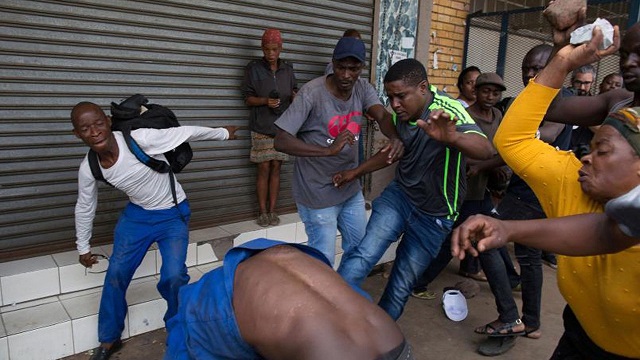
COMMENT | OBED K KATUREEBE | South Africans are at it again. Just weeks ago, there was outrage coming from South African cities, especially Johannesburg. A group of South Africans attacked fellow Africans, accusing them of many ills, including “taking their jobs” in that huge and powerful economy on the continent!
Some people, even some leaders on the continent ascribed the attacks to some incredible cause called ‘xenophobia’, defined as, ‘hatred or fear of that which is perceived foreign or strange.’
A few years back, similar incidents happened in South Sudan against Ugandans in Juba. The accusation was that Ugandans were monopolising businesses in Juba, while South Sudanese were wallowing in poverty!
The Ugandan government was forced to evacuate many of its citizens, under security escort, back to Uganda, and the economic situation in Juba got worse for the very people that wanted Ugandans out. Why? Because South Sudan had not yet stabilized to build an economy that could afford opportunities for all. Throwing out “foreigners” who were actually making a contribution to the economic welfare of all Jubans and South Sudanese were superficial causes of the economic woes in South Sudan.
The issue can’t be “foreigners!” Monopoly capital, in the hands of the minority Whites in South Africa, is the principle cause of economic exclusion and disparity of the majority Black people in South Africa and not just foreigners from other African countries, many of whom are in casual economic activity.
So, one could pose a question: What is the problem? Having been a close observer of an ideologically founded, revolutionary leadership in Uganda and enriched with some knowledge of our colonial and post-colonial history, I have come to think and believe that our main problem, our fundamental challenge, is lack of a common-user “telescope” to look into our strategic future together; lack of common tools of analysis, to correctly identify the causes and effects of what our challenges are today. Call it lack of a common radar to guide us on our collectively desired destination.
We have a common history of colonialism, neocolonialism and imperialist interference and exploitation in all our socioeconomic and political life, as a result of which we lack a common ideology that should give us common values.
It is to this effect that President Yoweri Museveni has always decried the challenge of ideological disorientation among us, especially our leadership, which is the reason why often we end up pulling in different, opposite and contradictory directions on matters where we all as a people ought to pull together, fight together and advance together for our strategic survival; especially in the capitalistic economic environment of “man eat man” and profit before humanity. We need to emphasize the mindset change of our society in regard to modernization of their methods of production and productivity for better survival.
Indeed, Julius Malema, who is the founder and leader of Economic Freedom Fighters, a communist and Black nationalist political party, castigated the bankruptcy his fellow Black countrymen had demonstrated. He wondered if chasing away fellow Africans, all of whom were self-employed, was solving the problems of unemployment in South Africa.
Therefore, Africans from rich countries or even the poor ones need a national ideology, developed and popularized to all the citizenry, around which to harness all our energies so that our superficial differences in form (tribes, religion, political persuasion etc), do not form points of fissure but points of strength, which we love to call “unity in diversity”.
To this effect, President Museveni and his comrade senior National Resistance Movement leaders came up with an ideology based on the four pillars of patriotism, Pan-Africanism, socioeconomic transformation and democracy. For now, this forms the foundation of the National Resistance Movement ideology, around which it has managed the socioeconomic and political affairs of Uganda.
Pan-Africanism is the ideological concept whereby members of the continent working together for their strategic security experts become guarantors of their own strategic survival. These have been united and strong for centuries; they would love to have the naturally resourced and resourceful Africa continue to be fragmented, balkanized and hence breakable into even smaller “chewable pieces” in the mouth of their united, stronger politico-economic jaws!
At the foundation level, all producers of industrial or agricultural goods can only survive, grow and develop in a larger market where businesses prosper. When businesses prosper, economies grow, and then as leaders, we can talk of prosperity and socioeconomic transformation becoming a reality, not a mere slogan.
Therefore, strategic security, collective bargaining power and a larger market for goods and services at a sub-regional, regional and continental level become an imperative for a Pan-Africanist ideological posture. To this effect, Pan-Africanism and socioeconomic transformation are more or less Siamese twins, each being a necessary part of the other’s equation.
For now, let’s celebrate the achievements we have so far, after the struggles that culminated in our political independence, as we forge ahead to build the ideological radar that will guide Africa in whatever policies we design for our sustainably prosperous future!
***
 The writer works with Uganda Media Centre