 The Independent Uganda: You get the Truth we Pay the Price



Budongo, Uganda | NEWS CORRESPONDENT | Across the scenic Murchison Landscape of Western Uganda, the northern Albertine Rift is celebrated for its outstanding biodiversity richness. The region harbors an astounding ecological community, accounting for 52% of Africa’s bird species, 39% of its mammal species, 19% of its amphibian species, 14% of its reptile species, and 14% of its plant species.
This tropical haven supports several iconic primate species, including blue monkeys, red-tailed monkeys, vervet monkeys, black-and-white colobus monkeys, olive baboons, and the flagship endangered Eastern Chimpanzee.
However, this rich natural landscape faces severe environmental pressure. Rapid agricultural expansion and new oil developments have heavily fragmented what was once a continuous forest belt into isolated patches across community and private land. The core protected reserves of Bugoma and Budongo have lost the natural connecting vegetation essential for wildlife to move freely.
The scale of this habitat destruction across both Central Forest Reserves and private or communal forests is staggering. Between 1986 and 2002 alone, an estimated 110 square kilometers of forest was cleared within 15 kilometers of Bugoma Forest Reserve, while approximately 90 square kilometers were lost within 15 kilometers of Budongo Forest Reserve.
Historically, the central challenge facing conservation initiatives in this landscape has been the absence of sustainable, long-term financing mechanisms capable of sustaining restoration efforts beyond initial donor seed funding.
Uganda’s remaining population of approximately 5,000 eastern chimpanzees, primarily confined to these northern Albertine Rift forests, bears the brunt of this isolation. While resilient chimpanzee troops continue to traverse agricultural lands between forest patches, re-establishing continuous habitat pathways between Bugoma and Budongo is critical to prevent genetic isolation and ensure the long-term survival of the species.
ECOTRUST tackling fragmentation
To tackle fragmentation on a landscape scale, the Environmental Conservation Trust of Uganda (ECOTRUST) and its partners are executing a comprehensive corridor restoration program across the Budongo-Bugoma landscape. The initiative aims to conserve over 50,000 hectares of natural forest by securing and restoring critical ecological linkages across Kikuube, Hoima, and Masindi districts.
Under ECOTRUST’s leadership, the Northern Albertine Rift Conservation Group (NARC-G) developed an overarching investment plan targeting key forest blocks necessary for corridor functionality. Initially launched via the Corridor Restoration Fund (CRF) in 2020 with foundational support from the World Land Trust, ECOTRUST mobilized additional resources in 2022 from IUCN Netherlands and Total Energies to implement the plan.
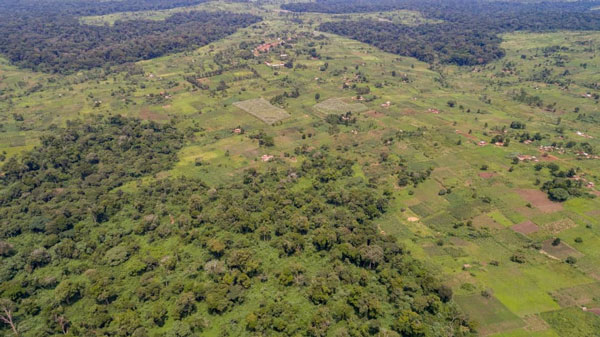
Forest restoration on the ground combines communal tree planting via Communal Land Associations and Community Wetland Associations with smallholder farm re-afforestation. On the critical Bugoma, Wambabya Bugambe linkage alone, over 2,000 local farmers and forest owners have actively planted 60 hectares of native forest patches.
To guarantee permanent corridor continuity, more than 100 households voluntarily offered portions of their private land along the Kasoma Kanwyaborongo river system. Formal trust deeds are currently being negotiated to hold this land in trust for the community, safeguarding tenure security and securing additional land under trusteeship backed by expansion funding from IUCN Netherlands.
Beyond safeguarding animal migration, restoring connectivity protects Western Uganda’s nature-based economy. Budongo Forest Reserve remains an international tourist destination famed for habituated chimpanzee tracking in the Kaniyo-Pabidi sector, birding, and eco-tourism. Protecting this contiguous forest network ensures that eco-tourism revenue continues to flow back into local communities.
To secure long-term financial sustainability and move beyond traditional short-term grants, ECOTRUST supported by the Darwin Initiative and in partnership with the International Institute for Environment and Development (IIED) has pioneered an innovative bio credits-based incentive mechanism.
This community-designed, owned, and led initiative creates a direct, long-term income stream to reward local conservation action. Operating under the Plan Vivo Biodiversity Standard (PV Nature), biodiversity certificates generate payments tied directly to verified restoration outcomes, where a single certificate represents a 1% verified increase in biodiversity per hectare per year.
Performance is measured through rigorous field monitoring of core bio-indicators, specifically birds, primates, and plant diversity, alongside human threat metrics. Issued certificates are owned directly by the community and participating landholders, including Indigenous Peoples and Local Communities (IPLCs).
By pairing structured land trusteeships with direct biodiversity credit returns, ECOTRUST and its NARC-G partners are establishing a self-sustaining model for tropical landscape management, guaranteeing that Uganda’s eastern chimpanzees can move safely through a flourishing, connected ecosystem for generations to come.



You would think someone would have checked to make sure you used the correct species for the main picture for tour article. While the baboons pictured areisted as a primate species, they definitely aren’t rhe Chimpanzees you claimed. Ans not multiple other media outlets have ran your story with this glaring mistake.
Do better, maybe?
Hi Joy?
Thank you for pointing out this glaring factual error. I have contacted the Online Editor to correct the misleading image that has accompanied the story. Thank you for reading The Independent articles. We shall do better, going forward.