The Independent Uganda: You get the Truth we Pay the Price


The man with a regional foot-print who changed Kenya without ever ruling it
NEWS ANALYSIS | THE INDEPENDENT & AGENCIES | Raila Amollo Odinga, who has died at the age of 80, was something of a paradox in the post-independence politics of Kenya, the East African region, and the African continent.
A leader who repeatedly ran for president, he never won – in part due to the 2007 election being manipulated in favour of Mwai Kibaki. Despite this, Odinga will be remembered as a figure who profoundly shaped national, regional, and continental politics as much as any president.
Following Raila’s death, that is the view of four distinguished political observers: Justin Willis, a Professor of History, Durham University; Gabrielle Lynch, a Professor of Comparative Politics, University of Warwick; Karuti Kanyinga, a Research Professor, Institute for Development Studies (IDS), University of Nairobi, and Nic Cheeseman, a Professor of Democracy, University of Birmingham.
The four scholars published their views in the online journal, The Conversation, on October 17. Their views were among many analyses, opinions, and eulogies expressed after Raila’s passing.
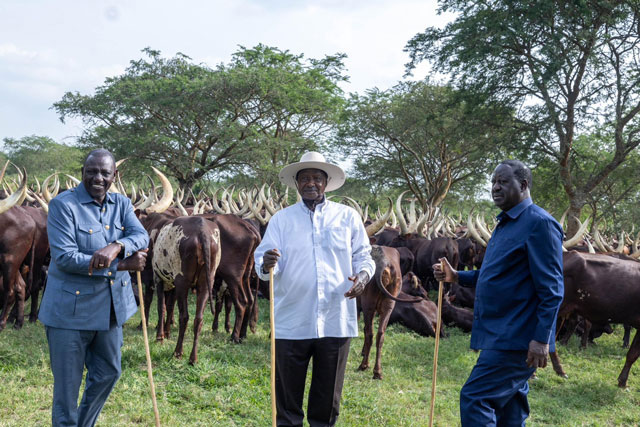
President Yoweri Kaguta Museveni also joined the tributes to the late Rt. Hon. Raila Amolo Odinga, the former Prime Minister of Kenya, describing him as a freedom fighter and a strong voice for Pan-Africanism.
In a message issued on Oct.16, President Museveni emphasized what united him and Raila and also spoke about Raila’s father, Jaramogi Oginga Odinga, Kenya’s first Vice President.
“Ideologically speaking, they have been with the patriotic and Pan-Africanist orientation. I have shared ideas with both of them. Their sentiments have been for the unity of Kenya, East Africa and Africa, including always supporting the struggles for the realisation of our dream for the East African Federation,” Museveni said.
Museveni approach was smart; by focusing on what unites, he easily covered their differences. Museveni could also have spoken about their similar approach to politics as the art of the possible, as articulated by Otto Von Bismarck, the former Chancellor of the German empire from 1871 to 1890. Both Museveni and Raila appear to approach politics as a matter of pragmatism, not idealism.
In a famous case reported extensively in the media, especially by The Observer newspaper, Museveni as far back as 2012 accused Raila of working to frustrate Uganda’s candidate for the speakership of the East African Legislative Assembly (EALA).
At the time, Margaret Zziwa was challenging Dora Byamukama for the EALA speakership seat which was open only to a Uganda as dictated by the rotational model of the body.
Museveni refused to publicly pick a side but the government side became convinced that he tacitly supported Byabakama’s candidature. So the then-Speaker of Parliament, Rebecca Kadaga and Prime Minister Amama Mbabazi, vigorously lobbied for Byabakama but she was apparently unpopular in Arusha and Nantongo Zziwa won the speakership. In a famous showdown, Museveni accused Mike Mukula, who was one of Zziwa’s key campaigners, of using money provided by Raila to influence the race.
Mukula had also expressed interest in contesting for the presidency in 2016. This was also the time of the famous whistleblowing website; WikiLeaks, which revealed that Mukula has told former U.S. ambassador to Uganda, Jerry Lanier, that Museveni was grooming his son, then-Col Muhoozi Kainerugaba, to succeed him. The year before, Mukula had placed himself in Museveni’s bad-books when he hosted Raila for his victory celebrations after winning the Soroti municipality seat.
So, the Observer reported, in a meeting at his Rwakitura country home, Museveni reportedly accused Mukula of being Raila’s Trojan horse in Arusha.
“I have intelligence reports that you received money from Raila to bribe delegates at Arusha. This is the same money Francis Babu used to bribe delegates from other East African countries to support the bid of his wife,” Museveni reportedly said.
The Observer reported at Raila wanted to humiliate Uganda or, for that matter, Museveni but did not say why. In any case, the push-and-pull between Zziwa and Byabakama was a diplomatic embarrassment to Uganda.
But as pragmatists, President Museveni and Raila continued to work together politically.
Raila and Museveni met again in May 2022 ahead of the Kenyan election of on August 9, 2022 that Ruto won. Raila then led his Azimio la Umoja Coalition into sustained street protests across Kenyan cities against what Raila said was a rigged election.
But when Raila on February 15, 2024 declared his interest in the African Union Commission (AUC) chairmanship, Museveni hosted his Kenyan counterpart William Ruto and Raila to endorse his candidature.
Born into influence
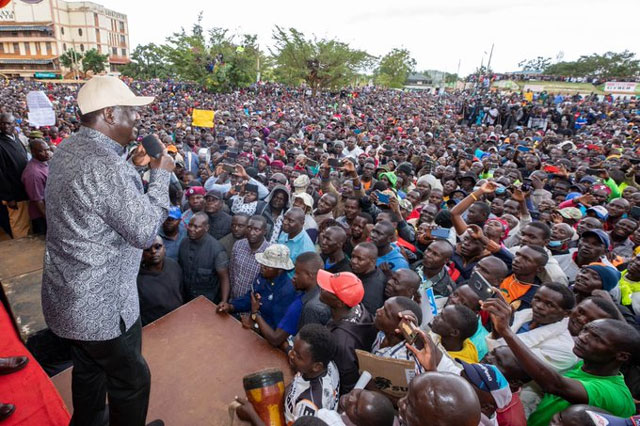
The son of a famous anti-colonial leader, Raila was born into influence. Yet he became bitterly critical of Kenya’s enduring political and economic inequalities, speaking out on behalf of the county’s “have nots”, which earned him a place in the hearts of millions.
He was a fiercely nationalist politician who mobilised support across ethnic lines. But he was also the dominant leader of the Luo community – one of the country’s larger ethnic groups mainly based in Western Kenya – whose voters formed the core of his support.
Having self-identified as a revolutionary, Raila later proved to be committed to institutional reform and democratisation. His greatest legacy is the 2010 constitution, which attempted to devolve power away from the “imperial presidency”, which he campaigned for over many years.
This was not the end of the contradictions. A leader who often spoke about economic development and deprivation, his agenda was typically more focused on political change. Raila did so in part because he believed that rights and freedoms would anchor nation-building and development.
The distinguished political professors: Justin Willis, Gabrielle Lynch, Karuti Kanyinga, and Nic Cheeseman, write in their essay that Raila “embodied Kenya’s political contradictions, so the impact of his life and death will be debated”.
Early years
Born in western Kenya on 7 January 1945, Raila – who came to be popularly known as Baba (father) – was the son of Jaramogi Oginga Odinga, the redoubtable community mobiliser who was a thorn in the side of the colonial state. Oginga famously insisted that he and other nationalists would make no deals with the British until Jomo Kenyatta was released.
When Kenyatta became prime minister in 1963, and later president in 1964, Oginga became Kenya’s first vice-president and minister of home affairs. However, he fell out with Kenyatta in 1966 over the government’s failure to overturn colonial inequalities. This meant that the Oginga family was excluded from the country’s powerful political elite. Oginga spent the following decades in and out of detention.
Raila Odinga spent his early years in Kenya before leaving in 1962 to study in East Germany. Returning in 1970, he became a university lecturer. Later, he joined the government standards agency – a job he lost abruptly in 1982 when he was linked to a failed coup against Daniel arap Moi. Charged with treason, he was detained until 1988, when he became active in the growing opposition to Moi’s rule. He was detained twice more during the turbulent years of protest that followed and fled briefly to Sweden.
Odinga returned before Kenya’s 1992 elections, the first multi-party polls since the 1960s, siding with his father when the opposition split. Aided by that division and state manipulation, Moi won, but Odinga’s role confirmed his status as a major political figure.
Blazing his own trail
When Oginga died in 1994, Raila sought to take over his father’s party but, defeated, left to form his own. He ran for president in 1997, which Moi again won against a divided opposition.
When Moi did not seek re-election in 2002, it seemed Odinga’s moment had come. However, after briefly supporting Raila as his successor Moi ultimately decided to back Uhuru Kenyatta, son of Jomo. In response, Raila threw his weight behind Mwai Kibaki, a move which was critical to Kibaki’s victory in 2002.
Raila’s support for Kibaki was conditional on major constitutional and political reforms. Yet where Raila had expected widespread constitutional reforms to devolve power away from the executive, Kibaki offered limited changes. Refusing to simply prop up the administration, Raila successfully campaigned against the government’s flawed draft constitution in the 2005 referendum.
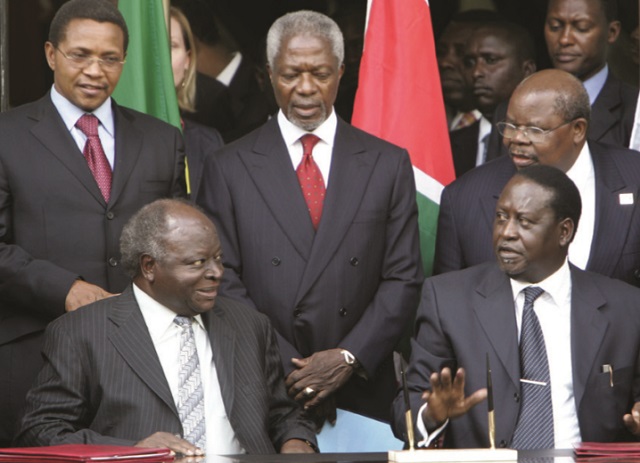
Once again, Raila seemed on the brink of power: he led a broad coalition into the 2007 elections on a promise of fundamental change. Early results put him ahead of Kibaki in the elections – but then Kibaki was declared the winner in a hasty process that raised widespread suspicions of malpractice and triggered Kenya’s greatest crisis, including ethnic clashes and state repression.
A power-sharing deal brought the violence to an end and made Raila prime minister in a government of national unity. He focused his energy on political reform and constitutional changes, as well as other long standing concerns. In August 2010 a referendum approved a new constitution that devolved power to Kenya’s 47 counties. The constitution also reformed key institutions including the judiciary and electoral commission and expanded citizens’ rights.
A contested final act
The 2010 constitution remains Raila’s signal achievement. Certainly, it created the potential for the country to forge a new and more democratic future.
Yet in its aftermath he struggled to find an equally compelling narrative. Constitutional reform had been a long-standing demand that allowed him to mobilise opposition around the promise of a new Kenya. Without this single over-arching “cause”, Raila’s ability to sustain mass mobilisation became more fragile.
Furthermore, the progressive constitution did not prevent the continuation of older political logics. It proved no barrier against the rise to the presidency of Uhuru Kenyatta and his then deputy, William Ruto, who had faced charges of crimes against humanity at the International Criminal Court.
Raila faced increasingly difficult choices, particularly after repeated presidential defeats in 2013, 2017 and 2022 amid allegations of electoral manipulation.
These losses convinced some that he would never win the presidency – and not only because of the use of state power to deny him. That recognition, coupled with advancing age and ill health, led Raila to make compromises once unthinkable, revealing an increasingly pragmatic reasoning in his later years. This was starkly illustrated after the 2017 elections, when – having claimed he was rigged out and led mass protests – Raila struck the “handshake” deal with Kenyatta in March 2018. This was framed as nation-building but viewed by some as a betrayal.
The handshake led Raila to stand as Kenyatta’s preferred candidate in the 2022 elections. This backing proved doubly damaging, however. On the one hand, it undermined Raila’s opposition credentials and lowered turnout in his Nyanza strongholds. On the other, it meant that his loss could not be blamed on a “deep state” conspiring against him.
The difficulties that followed were magnified when, after suggesting the 2022 results had been manipulated by those around Ruto, Raila agreed to prop up Ruto’s struggling government in March 2025. The formation of what was billed as a “broad-based” administration was presented as nation-building, but critics saw it differently. Coming after mass youth-led protests – first against tax increases and later against corruption, state repression, and Ruto’s leadership – Raila appeared to some to side with power against the people he once represented.
Not flawless, but consequential
These turns complicate how history, and Kenyans, will remember him – not as a flawless icon, but as a deeply consequential and sometimes contradictory figure. Yet those with longer memories will also understand what led Raila there.
Imprisoned and tortured under Moi, sold out by Kibaki, and denied victory in 2007, Raila endured more than a lifetime’s share of misfortune and betrayal. He made his own choices, but rarely under conditions of his own making, and arguably did more than any other Kenyan to make the country’s political system more responsive to its people.
His absence will generate a political vacuum that other leaders will struggle to fill. Ruto was banking on Raila’s support to win the 2027 elections. He will now have to work harder to put together a winning coalition. Meanwhile those leaders who coalesced around Raila – including those who depended on him for their positions – will need to decide how they can most effectively mobilise in his absence.
As they do so, Kenya’s leaders will all be operating in his shadow, and in a context in which the country’s marginalised people and communities will feel even less represented by those in power.