 The Independent Uganda: You get the Truth we Pay the Price



COMMENT | ANDREW PI BESI | In western Uganda lies Kasese — home to the country’s highest peak, Margherita Peak, the crowning summit of Mount Stanley within the majestic Rwenzori Mountains. That our highest point bears the name of an Italian queen is perhaps history’s subtle reminder that even geography was once subject to foreign administration.
The mountain itself is named after Henry Morton Stanley, the celebrated Welsh-American explorer who gained global fame traversing Africa in search of David Livingstone. Stanley did not merely traverse Africa; he also performed the more enduring colonial act of renaming it. In his 1878 publication, he branded our ancient continent as the “Dark Continent” in need of European enlightenment and civilisation.
This marked Stanley as the diligent field officer of the European colonial empire. Sponsored by Belgium’s Leopold II, and operating under the convenient banner of the International Africa Association, he mapped territories later claimed as the Congo Free State — an unfortunate irony because, “Free,” in this context, referred chiefly to the freedom with which colonial terror could be administered on hapless Africans.
Elsewhere, between 1878 and 1880, a newly unified Italy cast its imperial eyes toward the Horn of Africa, only to encounter an inconvenient reality: the ancient African monarchy of Ethiopia. Under Yohannes IV and later Menelik II, the Ethiopian monarchy mobilised its society — not merely its army — and decisively repelled European ambition at the Battle of Adwa in 1896.
Adwa’s lesson was simple and enduring: a state anchored in genuine public legitimacy becomes nearly impossible to subdue.
But history, like satire, has a long memory — and Africa’s present moment suggests that some of its most important lessons risk being politely forgotten.
The new theatre of old habits
Across the continent, critics increasingly warn that some leaders appear to have forgotten the Ethiopian lesson: genuine citizen support, freely given rather than forcibly managed, remains the strongest defence of sovereignty.
In Cameroon, the extraordinarily long rule of Paul Biya is often cited by observers as a symbol of how prolonged political dominance can gradually weaken institutional vitality and civic participation. Stability without renewal, history shows, can quietly harden into stagnation.
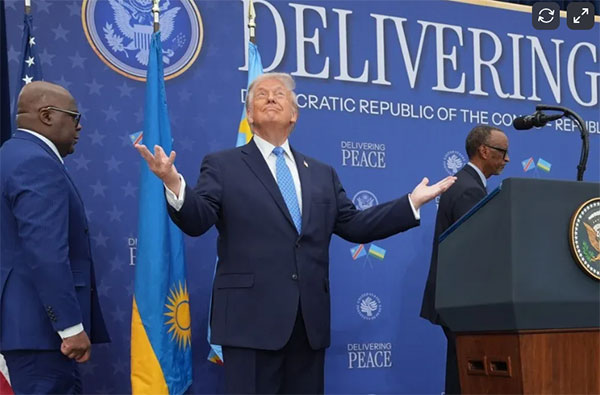
In Leopold’s former colony, now renamed Democratic Republic of the Congo, successive leaders since the brutal murder of Patrice Lumumba have failed to learn that external security guarantees tied to mineral wealth cannot substitute for resolving the underlying drivers of instability.
These drivers of instability include the unresolved concerns of vulnerable communities, especially the Congolese Tutsis, and the enduring regional tensions shaped by the legitimate security concerns of neighbouring Rwanda, which frames its actions as protection against armed genocidal forces operating with state support from Congolese territory. To trade national wealth for external protection while neglecting internal political settlement and regional trust-building risks deepening dependency rather than strengthening sovereignty — securing contracts, perhaps, but not peace. The satire of history is that where colonial agents once relied on collaborating chiefs, modern power sometimes finds willing partners in politically insecure elites.
The marketplace of loyalty
Here in Uganda, the recent political trajectory of figures such as Norbert Mao, Yusuf Nsibambi, and countless others, whose shifting alignments critics interpret as part of a broader pattern of political co-option, has stirred debate about the growing practice of absorbing and extravagantly rewarding opposition voices into the orbit of the ruling National Resistance Movement Organisation.
The deeper concern is not individual choice. Politics, after all, permits realignment. The concern is systemic: when political actors are perceived as commodities rather than representatives, public trust erodes, and political consciousness weakens, resulting in external patronage, institutional decay, civic disengagement, and the gradual hollowing out of national purpose. A movement once animated by revolutionary energy is now slowly dissolved into administrative machinery.
Africa, a continent with a reputation for producing liberation movements, now produces managerial politics — efficient at maintaining power, but less effective at mobilising citizens.
And where political consciousness declines, Ideological disorientation flourishes. Sovereignty becomes negotiable.
Forgetting Adwa
The tragedy is not merely political — it is philosophical.
Menelik II’s victory was not simply a military achievement; it was a demonstration of the power of voluntary national unity. Citizens fought because the state reflected their collective will. Legitimacy, not coercion, proved the ultimate defence.
By contrast, a state that must purchase loyalty, suppress dissent, or outsource its security quietly advertises its vulnerability. It recreates the very conditions that once invited Leopold II and imperial intervention.
Colonialism succeeded not only because Europe was strong, but also because Africa was divided.
The danger today is therefore not simply external manoeuvre — restyled and rebranded though it may be — but internal complacency. A political class detached from its citizens inadvertently prepares the ground upon which new forms of domination take root.
The final irony
Africa’s mountains still stand.
Its colonial borders remain.
Its flags still fly.
But the true defence of our ancient continent has never been geography, treaties, or rhetoric. It has always been the bond between state and society — the quiet but formidable power of citizens who believe their country belongs to them.
Empires once conquered Africa through maps and guns. History suggests they return through influence and invitation.
The question, therefore, is not whether new colonial manoeuvres exist. The question is whether Africa still remembers how it once defeated them.
*****
By Andrew “Pi” Besi | On X: @BesiAndrew

educate us on the influence of religion!!!!!
thanks for this information