The Independent Uganda: You get the Truth we Pay the Price


With the octogenarian at the helm for another five years, the country now faces the challenges and expectations that come with enduring continuity
Kampala, Uganda | RONALD MUSOKE | By the morning of Jan. 16, eighteen hours after Ugandans cast their votes for the presidency, the atmosphere at the National Tally Centre in Lweeza-Lubowa, on Kampala’s southern outskirts, had shifted from anticipation to tense unease.
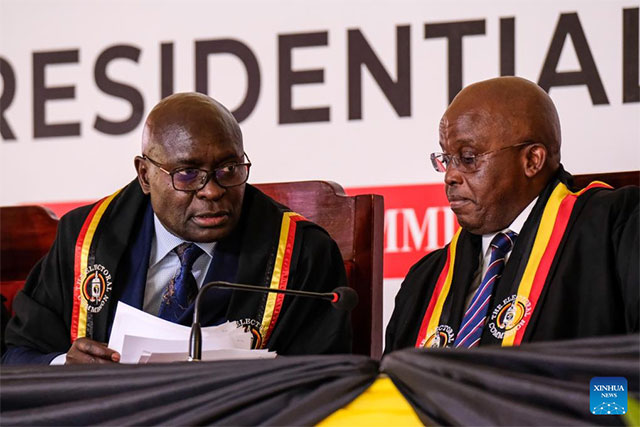
Results from across the country were beginning to trickle in, but they arrived stripped of the usual detail that lends credibility to the count. Figures read by Justice Simon Byabakama, the Chairperson of the Electoral Commission, appeared on screens without clear indication of which polling stations had reported, which districts were included, or what proportion of the national vote had been tallied.
For local and international observers, political party agents, diplomats, journalists and civil society representatives gathered at the centre, the problem was not a lack of numbers. It was the absence of narrative–no visible journey from polling station to district to the national total. As the Electoral Commission continued to present cumulative figures, many observers at the Tally Centre struggled to understand what exactly they were witnessing.
It was in this moment; before the final declaration, before the legal formalities, before the certificates, that questions about transparency, credibility, and trust surfaced most sharply. Anthony Asiimwe, the Vice President of the Uganda Law Society and an accredited election observer, gave voice to the growing frustration.
“As an observer, I must say I’m not getting what I expected to have seen,” he told local broadcaster, NTV Uganda. “For me it’s a bit disappointing from the Chairperson of the Electoral Commission to come and just read for people figures.”
Asiimwe’s concern was not partisan. It was procedural. “We don’t know where the figures are coming from, we don’t know what they represent, from where,” he said. “There’s no detail that you can attach to the result he’s giving us.”
Around him, similar questions circulated quietly. Which districts had fully declared? Which polling stations were outstanding? How were party agents verifying what was being announced? The Electoral Commission appeared confident, but to many watching, the process felt abstracted, mediated by technology but disconnected from the paper trail that has historically grounded Uganda’s elections, at least since 1996.
“Right now, I believe you and I, we don’t know where those things have come from,” Asiimwe said. “And I think this affects the issue of transparency and the credibility of what they are sharing with us.”
He questioned the purpose of convening observers and the media at a national tally centre if they were not being walked through the process. “The essence of us being here, and the essence of the observers and the media being in this place, loses meaning,” he said. “It leaves more questions than answers.”
More significantly, Asiimwe warned that such opacity carried legal consequences. “That alone is a legal issue,” he said. “Because candidates are likely to contest these results. And when they do, one of the things they will ask is; where are the declaration forms?” As Jan.16 unfolded, it became clear that the story of Uganda’s 2026 election would not be written only in votes cast, but in how those votes were presented, explained, and trusted.
Anxiety on the ground
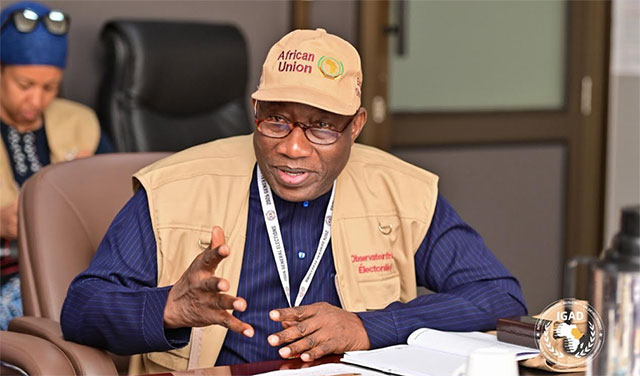
The uncertainty at the National Tally Centre was mirrored across the country in different ways. At district tally centres, delays in declaring results, particularly for Members of Parliament, began to generate tension. Crispin Kaheru, a member of the Uganda Human Rights Commission who also doubled as an observer, described an atmosphere thick with anxiety.
“Results were being declared at districts for the Members of Parliament,” he told local broadcaster, NBS, “but that process was taking a bit of time, and it was generating a lot of stress.”
Crowds gathered as expectations rose. In places such as Butambala, Mukono, and Luweero in South-central Uganda, there were reports of attempts to disrupt the process as supporters of competing candidates waited for outcomes. Kaheru pointed to a familiar electoral pattern; the refusal by some candidates to accept defeat.
“That is not politics,” he said. “It’s basically sour grappling.” Still, he acknowledged that the 2026 election showed improvements compared to previous cycles. “If you compare the previous elections and this election,” he said, “I don’t think the delay in delivery of polling materials… was as concerning as we have seen in previous elections.”
Security agencies, he added, had largely exercised restraint, though investigations into reported violations—including incidents involving journalists—were ongoing. The election, Kaheru suggested, was not without flaws, but neither was it spiraling into chaos.
Voting as habit, not persuasion
From the observer community came a broader critique; one that looked beyond tallying procedures to the nature of political choice itself. An electoral observer from the Global Peace Centre argued that the election results reflected entrenched voting habits more than the persuasive power of campaign messages.
“Most of the voting patterns were predetermined,” he said. “In particular places, people vote particular colours.” This reality, he suggested, limited the impact of political messaging and policy debate.
“We also need good citizens,” he said. “There is no community which can produce good leaders unless that community itself is good.” In this reading, Uganda’s election was less a contest of ideas than a reaffirmation of political identities—stable, predictable, and resistant to change.
“Cooked” results and opposition rejection
For the National Unity Platform (NUP), the main opponent of the ruling National Resistance Movement (NRM) in the 2026 general elections, doubts about procedure quickly hardened into outright rejection.
Benjamin Katana, the National Treasurer of NUP, dismissed the results being displayed at the National Tally Centre as illegitimate. “The results being shown at the National Tally Centre were just cooked,” he said. “They don’t reflect the outcome of the voting exercise.”
Katana accused the Electoral Commission of presenting figures that differed from Declaration of Results (DR) forms in the possession of party agents. “This for us, is shameful and theft by the Electoral Commission,” he said, alleging collusion with the ruling party. According to him, the percentages being displayed had been pre-arranged.
His message to the public was unequivocal: the results should not be taken seriously. By the end of Jan. 16, Uganda’s election narrative had split into parallel realities; an institutional process steadily advancing toward conclusion, and a political discourse increasingly animated by disbelief and mistrust.
Technology as explanation
Faced with mounting criticism, the Electoral Commission turned to technology to explain its process. An IT technical officer was asked by Byabakama, the EC Chairperson, to display the Election Results Visualization System (ERVS), a digital platform designed to aggregate results from district tally centres and present them visually at the national level.
“This ERVS is the one which helps us visualise results right from the national level up to the polling station,” the official explained to the observers camped at the National Tally Centre. “So that at the end of the day… we are able to see the results that finally aggregate to what the Chair (person) is reading.”
Large screens mounted strategically at the Tally Centre displayed colour-coded maps showing leading candidates by district. Dashboards broke down turnout, registered voters, valid and invalid ballots, and the number of polling stations reporting.
The system allowed users to drill down—from national totals to regions such as Lango in northern Uganda, then to districts like Dokolo, and finally to individual polling stations. “At least we are able to visualize a candidate who is leading,” the presenter said, “and you can do this for your area of interest, for your polling station of interest.”
For the Electoral Commission, the ERVS was evidence of transparency. For skeptics, it was a substitute for, rather than a replacement of, visible verification.
Law, machines, and the register
With pressure mounting, Justice Simon Byabakama later addressed one of the election’s most contentious operational issues; the inconsistent performance of the Biometric Voter Verification Kits (BVVK) the government had spent billions of shillings to procure ahead of the polls. “In some areas they worked perfectly well, in others they did not,” he said.
The Commission, he explained, had faced a choice; to either delay voting until the machines were fixed or revert to the National Voters Register. “What is paramount?” he asked. “Is it to establish what could have gone wrong with the machines? Or to afford the power of the people of Uganda under Article 1 priority?”
The decision to rely on the register, he insisted, was lawful. “The BVVK was to assist,” he said. “It was not replacing the register.” On the electronic transmission of results, Byabakama dismissed suspicions about the presentation of results. “We are not here to hide anything,” he said.
The Declaration
When the Electoral Commission finally moved on Jan.17 to declare the final results, the tone shifted from defensive to ceremonial. Justice Byabakama framed the moment within Uganda’s constitutional history, noting that the election came nearly three decades after the promulgation of the 1995 Constitution.
“The 15th of January therefore, was the epitome of the actualization of that power,” he said, referring to Article 1, which vests all power in the people of Uganda.
He thanked Ugandans for participating peacefully and commended institutions involved in the process—government agencies, political parties, civil society, the media, security forces, observers, and religious leaders.
“We call upon all Ugandans to keep up this conduct during the period following the declaration of results this afternoon of the various elections that are going to be held in the future, especially the local government elections, starting with the concluded presidential and parliamentary elections,” he said. “I urge all candidates, the agents, their supporters to put Uganda first in all their decision making and actions before, during and after elections.”
“Where any stakeholder may not be satisfied with any processes leading to the elections or the outcome of the state elections, we want to encourage you that there are adequate laws in this land that provide the avenue for addressing any such concerns or grievances.”
Then came the presidential results.
Breakdown of Votes Received for each presidential candidate
| Presidential Candidate | Political Party | Total No. Of Votes Received | Percentage of Total No. Of Valid Votes Counted |
| Bulira Frank Kabinga | Revolutionary People’s Party (RPP) | 45,959 | 0.41% |
| Kasibante Robert | National Peasants Party (NPP) | 33,440 | 0.30% |
| Kyagulanyi Robert | National Unity Platform (NUP) | 2,741,238 | 24.72% |
| Mabirizi Joseph | Conservative Party (CP) | 23,458 | 0.21% |
| Mugisha Gregory Muntuyera | Alliance for National Transformation (ANT) | 59,276 | 0.53% |
| Munyagwa Mubarak Serunga | Common Man’s Party (CMP) | 31,666 | 0.29% |
| Nandala Mafabi James Nathan | Forum for Democratic Change (FDC) | 209,039 | 1.88% |
| Yoweri Kaguta Museveni | National Resistance Movement (NRM) | 7,946,772 | 71.65% |
Source: Electoral Commission
Voter Turn-out
Byabakama said a total of 11,366,201 votes were cast, representing 52.50% of registered voters (21,649,067). 275,353 ballots were declared invalid. With more than half of all valid votes, the incumbent, Yoweri Kaguta Museveni, was declared duly elected President. This was President Museveni’s seventh straight victory via the ballot.
Pastor Joseph Sserwadda a member of the Inter-Religious Council of Uganda (IRCU) led a 10-minute prayer prior to the declaration of results.
He said. “The devil tried to cause chaos but your guardian angels prevailed.” He thanked God for peace, for restraint by security forces, and for the fallback to paper registers when technology failed. “We pray for acceptance of these results,” he said.
“Thank you, Lord, that all our presidential candidates have traversed the breadth of this nation in a diversity of landscapes, through highlands and valleys and flatlands. None has reported any incidents of roadside attacks nor banditry activities.”
“We look back at the campaigns and remember the crowds, the music, the excitement, the campaign speeches, the promises, the speedy drives, and in some instances, the slippery roads of the countryside. Through it all, you have been with us. It has been you.”
“And since last evening (Jan.16), as the results started to tickle from different parts of the nation, causing anguish and excitement at the same time, as it became clear who was winning and who was losing, we now ask that you put your able and strong hand on Uganda again. You have helped us before. Lord, help us again.”
“…We pray for more wisdom, to consolidate all the campaign manifestos in one document, so that no good idea is left unutilized, just because the promoter did not win or wasn’t on this or the other side.
“As we look to the future, the aspirations of our people, most of them young, cannot be shoved to the sides. The hopes of the older ones cannot be pushed away. Those unable to fend or speak for themselves have their eyes on us, Lord. Help Uganda retain its position as the power of Africa. Lord, we are a young nation, and we ask that heaven help us, most of us young people, to enjoy the next season.”
“May the aspirations of the people take precedence in the affairs of our state and nation. And may you, our God, take preeminence over all, in all, above all, and with us. In the name of Jesus Christ, our God and Saviour.”
Vindication and confidence
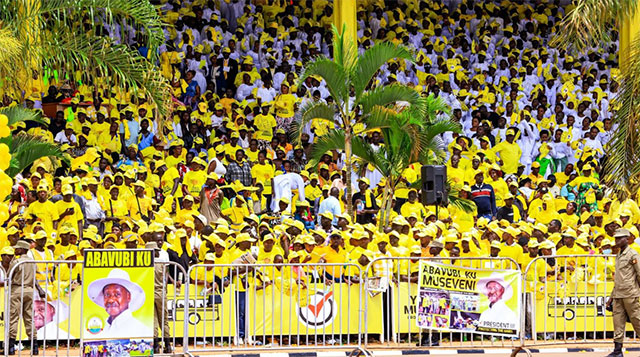
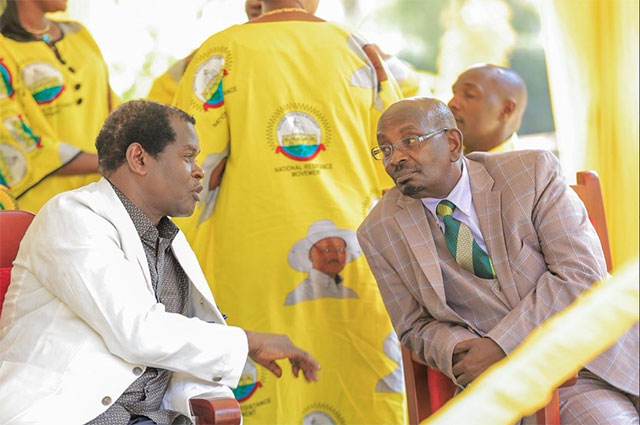
For the National Resistance Movement, the declaration confirmed months of preparation. “We were prepared as a party,” said the NRM Secretary General Richard Todwong. He pointed to internal voter registration drives and grassroots mobilisation. “In the last general election (2021), we got about 6 something million votes,” he said. “Now we have gone up to about 7.8 million votes.”
On turnout, Todwong was blunt. “For national elections, we have never exceeded 60% voter turnout,” he said, pointing to structural and economic realities.
He acknowledged that some NRM candidates had lost parliamentary races, arguing that individual merit still outweighed party loyalty. “We haven’t yet matured enough to understand a multi-party-political dispensation,” he said.
Victory at the country home
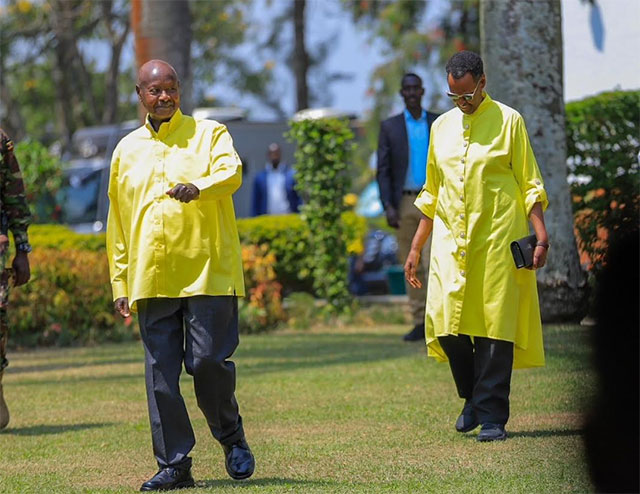
On Jan. 18, at his Rwakitura country home in Kiruhura District, President Museveni received his certificate of election surrounded by his NRM party stalwarts including; Moses Kigongo, the NRM First Vice Chairman; Jessica Alupo, the Vice President; Anita Annet Among, the Speaker of Parliament and NRM Second Vice President-Female and Robinah Nabbanja, the Prime Minister.
The mood was assured, almost instructional. The opposition, the president-elect said, had been “lucky.” “Because 10 million of my people did not turn up (to vote).”
He credited peace, stability, and programmes such as the Parish Development Model (PDM) and skilling hubs for renewed unity, particularly in regions once scarred by conflict and civil war.
“If all our members turned up,” he said, “there would be no opposition in Uganda.” Museveni spoke at length about poverty, calling it “the gate for all these other problems.”
“The medicine for poverty is these funds,” he said, describing PDM as a “silver bullet.” He warned against corruption, indiscipline, and what he described as destabilizing elements. “Either peacefully or unpeacefully,” he said, “we shall maintain peace in Uganda.”
Looking ahead, he outlined his government priorities: ending poverty in the remaining households, investing oil revenues in infrastructure and science education, expanding regional markets, and enforcing discipline among leaders. “We must end poverty in our homes,” he said. “Because it is that poverty which opens the gate for all these other problems.”
Continuity and its demands
Uganda’s 2026 presidential election ended with a decisive numerical victory for the incumbent, an institutionally defended process, vocal opposition rejection, and persistent observer unease. The numbers are settled. The certificate has been issued. President Museveni has extended his rule with ease. What now confronts the country is what that continuity demands; of institutions, of citizens, and of a political system that continues to deliver certainty at the top while leaving questions unresolved at the bottom of Ugandan society.