The Independent Uganda: You get the Truth we Pay the Price


Kampala, Uganda | URN | President Yoweri Museveni has ruled out the transportation of petroleum products across Lake Victoria, warning that an accident involving a fuel vessel could contaminate one of Uganda’s most important freshwater resources.
Museveni said Uganda should instead rely on pipelines and railways to move petroleum products, pointing to the route of the East African Crude Oil Pipeline (EACOP) as an example of the approach he considers safer.
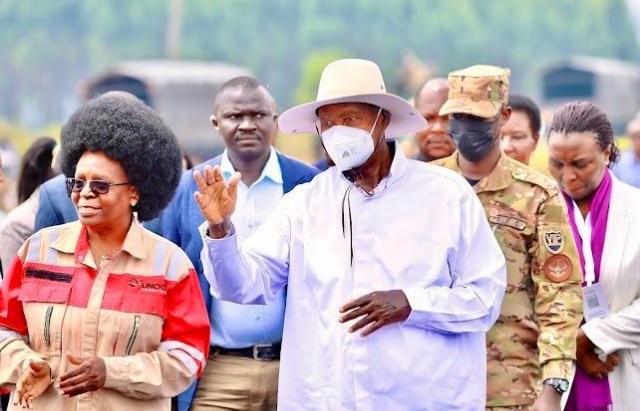
He made the remarks on Thursday while presiding over the groundbreaking of the 320-million-litre Kampala Storage Terminal at Namwabula in Mpigi District.
Museveni said proposals to connect the new terminal to existing petroleum infrastructure at Kawuku could involve transporting fuel across Lake Victoria.He rejected the idea.
“I’m not comfortable with that water that was transporting petroleum over water over Lake Victoria, our fresh water. Suppose you get an accident. I told them I have never liked that idea.”
Museveni then linked his objection to the decision to route EACOP around Lake Victoria.
The 1,443-kilometre pipeline is being developed to transport Uganda’s crude oil from Hoima through Tanzania to the export terminal at Tanga. The selected route does not cross Lake Victoria.
Museveni said Uganda deliberately avoided putting the crude oil pipeline under the lake because of the potential consequences of an accident.
“That’s why the East African crude pipeline had to go around the lake through Zungu Kaziwa. To put it under the lake is very, very dangerous,” he warned.
He said the same principle should guide the transportation of refined petroleum products.
“So for me, I think the safer is pipeline and railway, the two. So we need to sort that one out.”
The remarks place Lake Victoria once again at the centre of Uganda’s petroleum transportation debate, years after the government promoted the use of the lake to move imported fuel into the country.
In 2016, Museveni met investors from Mahathi Infra Services who proposed transporting petroleum products from Kisumu in Kenya to Uganda using oil tankers on Lake Victoria.
The company also proposed a strategic storage terminal to receive the fuel.
The Lake Victoria fuel logistics project subsequently became part of Uganda’s petroleum supply infrastructure.
As recently as May 2026, the Ministry of Energy said the government had partnered with Lake Victoria Logistics, formerly Mahathi Infra, to diversify petroleum supply routes and improve the efficiency of fuel transportation into Uganda.
The facility at Kawuku has a storage capacity of 70 million litres.
Museveni’s latest remarks therefore raise questions about the future role of Lake Victoria in Uganda’s petroleum supply chain.
The President’s position is particularly significant because Uganda is simultaneously building infrastructure intended to reduce its dependence on road transport and external supply routes.
The Kampala Storage Terminal will have capacity for 320 million litres of petroleum products.
Permanent Secretary in the Ministry of Energy and Mineral Development Irene Pauline Batebe said the facility is intended to strengthen Uganda’s strategic petroleum reserves and protect the country from external supply disruptions.
“Limited in-country storage often leaves a nation exposed to external shocks. Adequate strategic reserves like what you are doing at the groundbreaking today are extremely essential.”
Batebe said Uganda currently has about 159.7 million litres of petroleum storage capacity.
This includes 30 million litres at the UNOC facility in Jinja, 70 million litres at the Mahathi facility in Kawuku and about 60 million litres held by oil marketing companies.Uganda consumes approximately 240 million litres of petroleum products each month.
The new Mpigi terminal will therefore provide storage equivalent to about 30 days of current national consumption.“We are consuming 240 million litres per month, so by deploying this facility we will ideally have added a 30-day strategic storage facility.
But Museveni said even this additional capacity was not enough for a country seeking genuine protection against international supply disruptions.
“But me, I see this is not how countries should run. You have heard that in a month we use 240 million litres of these products. But up to now, the storage in Jinja was only 30 million. The one we are going to build here will be 320 million litres. But I think this is not enough.”
Museveni said Uganda should build larger strategic reserves that could be used when international petroleum supplies are disrupted.
He cited countries such as China, which he said can rely on reserves while international political crises are resolved.
The President also argued that Uganda’s long-term petroleum infrastructure should increasingly shift from road transport to pipelines and railways.
He said the planned refined petroleum products pipeline from Hoima to the Kampala storage terminal would eventually allow products from Uganda’s refinery to be transported directly to Mpigi.
“The clear plan here is the finished products pipeline from Hoima to Borova. Once the refinery is working in Hoima, it will pump the products in the pipeline up to here,” he stated.
Museveni said the Mpigi terminal could then serve as a distribution hub for Kampala, north-western Tanzania and eastern Democratic Republic of Congo.
This would reduce the need to transport large volumes of fuel by truck and, according to Museveni, reduce pressure on Uganda’s roads.
The President’s remarks also came as he criticised Uganda’s historical petroleum procurement arrangements.
Museveni said Uganda had for years been purchasing petroleum products through middlemen in Kenya instead of dealing directly with refiners and bulk suppliers.
He said the shift to the current supply arrangement involving UNOC and Vitol had reduced the premiums paid for petroleum products.
Energy Minister Monica Musenero Masanza told Museveni that the premium on diesel had fallen from 118 US dollars per metric tonne under the previous arrangement to 83 dollars.
For petrol, she said the premium had fallen from 97.50 dollars to 61.50 dollars, while the premium for aviation fuel had fallen from 114.25 dollars to 79.25 dollars.
Museveni questioned why officials had failed to identify the alleged inefficiencies in the former system.
“So you wonder, the commissioners for all those years. What were they commissioning? Did they know the word or what?,” asked Museveni
Batebe said the Kampala terminal is part of the government’s wider petroleum-security strategy under the Fourth National Development Plan.The Ministry plans to develop project-readiness activities for additional strategic storage terminals in Hoima, Mbarara, Gulu, Arua, Mbale and Soroti.
She said UNOC and Vitol have been given until September 2028 to complete the Kampala facility.Meanwhile, Uganda’s broader petroleum infrastructure is increasingly being tied to Tanzania.
The two countries are developing the Tanga Energy Hub, which is expected to include petroleum storage, refining, logistics, trading and distribution infrastructure. The partnership builds on EACOP and Uganda’s planned refinery.
The immediate question for Museveni is how Uganda can move petroleum products without exposing its freshwater resources to the consequences of a major spill.
His reference to EACOP is significant: the pipeline that will carry Uganda’s crude to the Indian Ocean was deliberately routed away from Lake Victoria, while the country has simultaneously maintained infrastructure for transporting imported refined fuel across the lake.