The Independent Uganda: You get the Truth we Pay the Price


Kampala, Uganda | THE INDEPENDENT | In the wake of President Yoweri Museveni’s decisive re-election in January 2026, where he secured more than 71 percent of the vote and extended his four-decade rule, political focus is shifting to the leadership of the 12th Parliament, scheduled to convene in May.
While the ruling National Resistance Movement (NRM) maintains firm control of Parliament, the race for Speaker is exposing both internal party maneuvering and fragile political alliances.
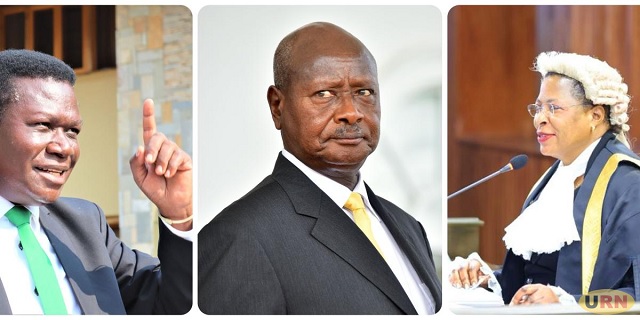
Democratic Party (DP) president and Justice Minister Norbert Mao has declared interest in the position, setting up a potential challenge to incumbent Speaker Anita Annet Among.
At the same time, the NRM’s Central Executive Committee (CEC), where Among is a member, has reportedly endorsed her to contest for another term as Speaker when Parliament votes later this year.
The same meeting is said to have endorsed her deputy, Thomas Tayebwa, to retain the post of Deputy Speaker—signaling the ruling party’s preference for continuity at the top of Parliament.
Despite the reported endorsements, the contest is not without complications. Lydia Wanyoto Mutende, an NRM member and former CEC official, has also expressed interest in contesting against Among, introducing an internal challenge within the ruling party.
Mao’s move has further exposed political tensions, not only within the broader governing alliance but also within his own support base. Lawmakers from the Acholi Parliamentary Group (APG) have publicly opposed his bid, instead throwing their weight behind Among, an unusually open rejection that highlights the role of regional loyalty, party survival, and power politics in northern Uganda.
Mao, the MP-elect for Laroo–Pece Division in Gulu City, announced on February 3 that he was consulting widely on a possible speakership bid.
Returning to Parliament after nearly two decades—having previously served in the 6th and 7th Parliaments—he presented himself as a consensus builder in a polarized legislature.
“In DP, people lie about us, but we do not tell lies,” Mao said, dismissing speculation about his intentions. He drew a distinction between executive and legislative authority, adding: “Between the President and the Speaker, which position is more powerful? You all know I have an ambition to be President of Uganda, and I have never abandoned it.”
Mao has framed his bid as part of a broader national project. Citing his upbringing across regions and his fluency in both Bantu and Nilotic languages, he described himself as a “pragmatic nationalist” with “nobody’s blood on my hands.”
He argued that Uganda needs to move away from what he called “the old politics of snakes and ladders,” and that the DP could help bridge deep political divisions.
He insisted the idea of contesting for Speaker did not originate from him. “The talk did not start with me,” Mao said. “But when there is goodwill around your name, neither you nor your party can ignore it.” He linked his interest to public dissatisfaction with Parliament, arguing that Ugandans want “institutional power, not personal power.”
Mao acknowledged that any viable bid would require engagement with the NRM leadership, including President Museveni, given the ruling party’s overwhelming majority.
“The Speaker is for Uganda, not for oneself,” he said, warning against turning parliamentary leadership contests into national divisions. That message has failed to convince his Acholi colleagues.
Martin Ojara Mapenduzi, the MP for Bardege–Layibi Division, praised Among’s leadership of the 11th Parliament, describing it as “united and people-centred,” and pledged full support for her re-election.
MP-elect Anywar Ricky Richard of Agago West echoed the sentiment, crediting Among with steering cross-party legislation efficiently. APG chairperson Anthony Akol, the MP-elect for Kilak North, emphasized the importance of continuity.
“I have seen how she started and how she has grown. The 12th Parliament will be better under her leadership,” he said.
Among the Bukedea District Woman MP and NRM’s second national vice chairperson, assumed the speakership in March 2022 following the death of Jacob Oulanyah.
Oulanyah, an Acholi leader and former Speaker, was also a longtime friend of Mao from their days at Makerere University Law School.
Her unopposed re-election in Bukedea has further strengthened her position within the ruling party.
For Mao, the speakership race is also shaped by the July 2022 cooperation agreement between the DP and the NRM, under which the DP pledged parliamentary support to the government in exchange for inclusion in governance, an arrangement that led to Mao’s appointment as Justice Minister.
Reports of quiet disagreements within Cabinet over whether Among and Tayebwa should be endorsed unopposed point to internal negotiations within the NRM, despite the party’s public posture of unity.
Under Parliament’s Rules of Procedure, the Speaker is elected from among Members of Parliament, with a secret ballot held if the position is contested.
While the process is formally democratic, party discipline has historically played a decisive role in NRM-dominated Parliaments.
Since 1986, the office of the Speaker has increasingly operated in close alignment with the executive, often prioritizing political stability over legislative independence.
From Edward Ssekandi’s technocratic leadership, through Rebecca Kadaga’s assertive style, to Anita Among’s emphasis on a “people-centred” Parliament, Speakers have largely functioned within boundaries set by State House.
While Mao’s reformist message and Wanyoto’s internal challenge test that tradition, President Museveni’s landslide victory and the NRM’s numerical strength in the 12th Parliament heavily favour Among’s re-election.
Whether these challenges gain momentum or are quietly neutralized, the speakership contest has laid bare the fragile nature of political alliances as Uganda enters a new parliamentary term, raising broader questions about independence, accountability, and the future direction of the country’s legislature.
****
URN