The Independent Uganda: You get the Truth we Pay the Price


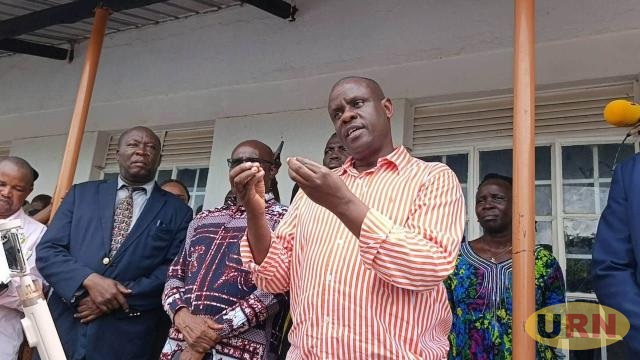
Kitgum, Uganda | URN | Church of Uganda Archbishop Stephen Kazimba Mugalu has urged the government to allow parents to support the development of schools where such contributions are agreed upon by parents and school governing bodies, warning that a blanket restriction could leave some institutions struggling to provide basic services.
Archbishop Kazimba made the remarks at the headquarters of Kitgum Diocese during a farewell event ahead of his retirement in August 2027, as a growing dispute over school fees and Parents-Teachers Association (PTA) contributions continues to pit government against some head teachers and school administrators.
His intervention comes amid an ongoing countrywide campaign by Minister of State for Local Government Balaam Barugahara, who has been moving through districts challenging what he describes as illegal charges in government-aided schools.
Barugahara has warned head teachers against imposing additional fees on learners in government-aided schools and has ordered investigations and action against officials accused of violating government policy.
In Bududa, for example, the Ministry of Local Government said the minister found learners being charged as much as 150,000 shillings at Bududa Secondary School, despite the institution being government-aided.
The ministry said the school had 44 teachers, but only 36 were on the government payroll, with the school privately employing the remainder. The campaign has triggered tensions in several parts of the country. At Kaliro High School in eastern Uganda, parents, school administrators and religious leaders recently held an emergency meeting following disagreements over fees.
Parents complained that high charges were forcing some children out of school, while school administrators argued that the money was needed to meet costs not covered by government funding.
The dispute has also exposed a difficult question at the heart of the controversy: how government-aided schools should meet expenses when government funding does not cover all their staffing and operational needs. It is this gap that Archbishop Kazimba says should be addressed through dialogue rather than restrictions and arrests.
“I would like the government to allow some parents to have responsibility for their children. We have some schools that don’t have a thing. And now the parents through the board of governors will meet and contribute something to support the school,” he said.
Kazimba said he was concerned about reports of head teachers being arrested over contributions that had been agreed upon by parents and school governing bodies. He urged government officials to first engage parents, teachers and school administrators before taking action against head teachers. “Let us learn to discuss together and put things right,” he said. The Archbishop warned that creating an environment in which teachers and head teachers constantly fear arrest could discourage them from taking decisions needed to keep schools functioning.
“Every teacher is fearing. Every head teacher is fearing arrest. Let us learn to discuss together and put things right,” he said.
Kazimba said improving education should not be left to government or school administrators alone, arguing that parents, teachers, school leaders and governing bodies all have responsibilities towards children. “A parent, you have a role. A teacher has a role. A chairperson has a role. All of us must do something. Let us work as a team,” he said. His comments come against a legal and policy framework that prohibits charges for education in institutions implementing UPE and UPPET.
However, the Education Act provides an exception allowing management of such schools to receive voluntary contributions from parents and well-wishers for emergencies or urgent matters concerning a school. It also prohibits schools from sending pupils or students away or denying them education because they have failed to make such contributions. The distinction between compulsory charges and voluntary contributions is at the centre of the current dispute. The government has maintained that parents should not be compelled to pay additional charges for education in government-aided schools.
The State House Education Desk has separately warned administrators of government-supported schools against illegal charges, saying such fees undermine the UPE and USE programmes and can prevent children from poor households from accessing education. Barugahara’s campaign has brought the issue into sharper focus. In Bududa, the minister’s intervention over school charges was followed by an attempted arrest of a head teacher, according to reports, although students reportedly blocked officials from taking him away. The Ministry of Local Government has meanwhile continued to publicise cases of alleged excessive charges. During a visit to Bugiri on September 25, Barugahara questioned, among other charges, 110,000 shillings being demanded from students at Nabukalu Secondary School.
But school administrators and some education leaders argue that simply stopping parents from contributing without increasing government support could create another problem.
Head teachers recently told the Equal Opportunities Commission that inadequate government funding has left some government-aided schools struggling with understaffing, ageing infrastructure, utilities, maintenance and other operational costs.
They argued that reducing fees without addressing those gaps could make it difficult to maintain education standards. Similar concerns have emerged in Busoga, where parents, school administrators and religious leaders have called for government ministries to harmonise their position on school financing.
Responding to Archbishop Kazimba’s remarks, State Minister for Water and Environment Beatrice Atim Anywar called for greater harmony between parents and teachers, saying disputes within schools could ultimately affect children’s academic performance. “We need that harmony between the parents and the teachers to make our children successfully perform at school,” Anywar said. Anywar urged the Archbishop to continue advocating dialogue after his retirement, saying the relationship between parents, teachers and school administrators needed to be strengthened.
The emerging dispute therefore goes beyond the question of whether parents should pay school fees.
It is increasingly about who should finance the gap between what government promises to provide in government-aided schools and what schools say they actually need to function.