 The Independent Uganda: You get the Truth we Pay the Price



East African airlines are using algorithms to make pricing decisions leaving a question: when the price on the screen changes, how much of that decision belongs to a human revenue manager and how much belongs to a machine?
NEWS ANALYSIS | IAN KATUSIIME | At midday on September 9, a Kenya Airways ticket from Entebbe to Guangzhou, China cost $1,208. Five hours later, the same economy-class itinerary cost $1,209. The following day, it was still $1,209.
The difference was just one dollar. But the experiment was designed to answer a much bigger question: when Kenya Airways uses artificial intelligence to help set fares, what exactly is happening behind the price passengers see on their screens?
The ticket, booked online for an October 11 departure and October 20 return, involved a stop at Nairobi’s Jomo Kenyatta International Airport and a technical stop in Bangkok. The itinerary was unchanged. So was the passenger’s destination, travel dates and cabin.
Only the price had moved — barely. Airline fares have always been dynamic. Airlines constantly adjust prices according to demand, capacity, competition, seasonality and booking patterns.
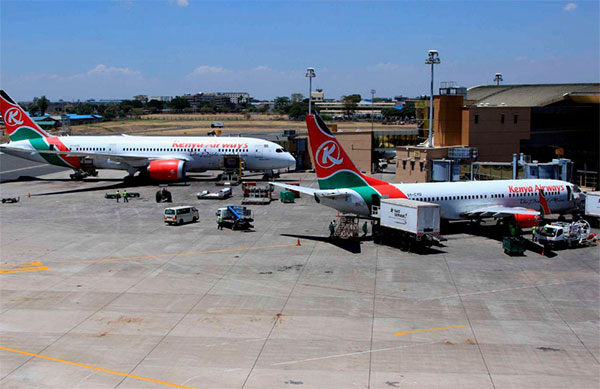
But Kenya Airways has now introduced something new into that process: artificial intelligence. In May, Kenya Airways began using Jupiter 5.0, an AI-powered pricing platform developed by FlyNava Technologies, to interpret market signals, simulate pricing scenarios and support the airline’s pricing decisions.
That raises a question increasingly relevant to African travellers: when the price on the screen changes, how much of that decision belongs to a human revenue manager — and how much belongs to a machine?
“Jupiter 5.0 will help us manage pricing complexity with both speed and discipline,” said Hellen Mathuka, Chief Strategy and Innovation Officer, Kenya Airways in an official statement.
Mathuka said the AI tool enables faster decisions while improving oversight and accountability across the pricing process, and responding to dynamic market conditions in a way that supports stronger customer value.
Mathuka did not respond to questions from The Independent on the extent to which its recommendations can be implemented without human intervention.
We also asked what safeguards, audit mechanisms and human oversight Kenya Airways has established to ensure that algorithmic pricing remains transparent, accurate and accountable to passengers.
Ethiopian Airlines adopted Sabre’s AI-powered dynamic pricing technology in November 2025. SabreMosaic Airline Retailing, allows the carrier to adjust fares and ancillary offers in real time across its distribution channels, including global distribution systems (GDS).
The platform uses Sabre’s market data and AI engine to help Ethiopian personalise offers and respond more dynamically to changes in demand and market conditions.
“With SabreMosaic, Ethiopian Airlines will introduce new products and fare bundles more rapidly, apply AI-driven dynamic pricing for greater revenue precision and deliver tailored offers to travellers instantly,” said Roshan Mendis, Sabre’s Chief Commercial Officer.
Kenya Airways and Ethiopian Airlines are both bringing AI into the business of deciding what travellers are offered, but they are approaching it somewhat differently. Kenya Airways is using Jupiter 5.0 primarily as an AI-powered pricing tool — a system that analyses market signals, tests pricing scenarios and helps the airline decide and execute fares.
Ethiopian Airlines is going a step further with SabreMosaic, which combines dynamic pricing with a broader system for building and tailoring the entire offer presented to a traveller, including fare bundles and extras such as baggage or seat selection.
Airline industry analysts say both systems are designed to respond to changing market conditions in real time, raising a new question for passengers: as airlines increasingly let algorithms shape the offers on their screens, how much of the price they see is determined by the market, how much by the airline — and how much by the machine?
While KQ and ET have moved up the AI value chain in ticket pricing, newer carriers like Uganda Airlines still rely on standard airline reservation and revenue management systems rather than proprietary or standalone AI engines for dynamic ticket pricing.
Uganda Airlines uses industry-standard booking and distribution tools such as Amadeus for flight booking and management, real-time pricing and availability.
Amadeus is one of the world’s biggest travel-technology companies, providing systems used by more than 430 airlines.
Ancient aviation technology
But its scale is also one of its biggest technological constraints. Parts of the airline industry’s global IT infrastructure still rely on legacy systems developed decades ago, and replacing them is notoriously difficult: millions of transactions involving airlines, travel agencies, airports and other partners flow through interconnected systems every day.
For industry experts, the problem is not simply that the technology is old; it is that changing the foundations of a system on which much of global air travel depends carries enormous operational risk.
That creates a peculiar technological paradox for airlines. The industry is trying to introduce AI that can make pricing decisions in seconds, while some of the infrastructure through which those decisions must travel was designed for a very different era of computing.
However airlines are moving fast to adopt AI machine-learning pricing models.
RwandAir does not use fully autonomous, generative AI to dictate its passenger ticket prices but instead it relies on advanced automated revenue management systems that are heavily driven by algorithmic forecasting and machine learning.
RwandAir utilizes a specialized pricing software platform called ProfitLine/Price. This system analyzes competitive data, fare structures, and market trends to help the airline proactively simulate and deploy its strategic pricing scales.
However RwandAir is also deeply integrated into the Amadeus system. It uses Amadeus for its actual flight reservations, ticket issues, seat maps, and inventory.
The Gulf’s biggest carriers offer a glimpse of where the dynamic pricing technology could take African aviation according to industry insiders. Qatar Airways has rolled out dynamic pricing allowing it to offer additional price points for flights and selected ancillaries, while its wider digital strategy uses data and AI to build more personalised offers.
Emirates and Qatar Airways systems
Emirates, meanwhile, has invested in advanced retailing, revenue optimisation, data and analytics. But tech experts say African airlines should not simply buy more powerful algorithms for the reason that AI pricing works best when it sits on top of something airlines such as Qatar and Emirates possess in abundance: huge networks, millions of transactions, rich customer data and sophisticated revenue-management systems.
African carriers have been advised to invest in building the data, distribution and commercial infrastructure that gives the machine something useful to learn from.
The shift is happening as African aviation embraces AI beyond the cockpit and airport. The Aviation Africa Summit and Exhibition, hosted at the Sarit Expo Centre in Nairobi, specifically addressed ticket pricing and AI under the theme of “Breaking the Mould”.
Rather than viewing AI pricing as a magic bullet to increase airline profits, regional leaders and tech innovators discussed AI through a highly realistic, infrastructure-first lens.
A major talking point led by regional executives—including Moses Mwangi, Managing Director of 748 Air Services—focused on why hyper-advanced AI pricing models cannot work effectively in Africa right now.
Leaders argued that standard dynamic AI pricing relies on high flight frequencies and hyper-competitive routes to auto-adjust ticket fares.
They argued that in Africa, high ticket costs are driven by rigid physical structural problems: expensive airport taxes, heavy regulations, and fuel costs. If the base cost of flying a route is artificially high, an AI engine has no room to flexibly lower the fare.
The conference heavily emphasized that to make ticket prices truly affordable, African governments must fully adopt the Single African Air Transport Market (SAATM). The goal of SAATM is to open up airspace so airlines can add more routes and build a larger pool of data.
They further argued that once skies are open, modern algorithmic tools and automated data analytics can finally be leveraged to predict real traveler demand, lower fares, and prevent the traditional problem of forced layovers outside the continent.



“We also asked what safeguards, audit mechanisms and human oversight Kenya Airways has established to ensure that algorithmic pricing remains transparent, accurate and accountable to passengers.” Really? KQ is a private, profit maximizing company. Since when does such a company’s pricing need to be “transparent, accurate and accountable to passengers”? Are you serious??? This is lazy activist journalism that slept through elementary economics 101.