The Independent Uganda: You get the Truth we Pay the Price


Uganda Extractive Industries Transparency Initiative highlighted persistent gaps in gold production and export data.
Kampala, Uganda | URN | Experts in the extractives industry have partly attributed Uganda’s economic instability, particularly exchange rate volatility and inflation, to the poor management of the country’s mineral wealth, warning that weak implementation of existing laws and policies is undermining the sector’s contribution to the economy.
They argue that although Uganda has established legal and policy frameworks intended to ensure that mineral resources benefit the economy and citizens, enforcement remains inadequate, with critical gaps in value addition, revenue mobilisation and community participation.
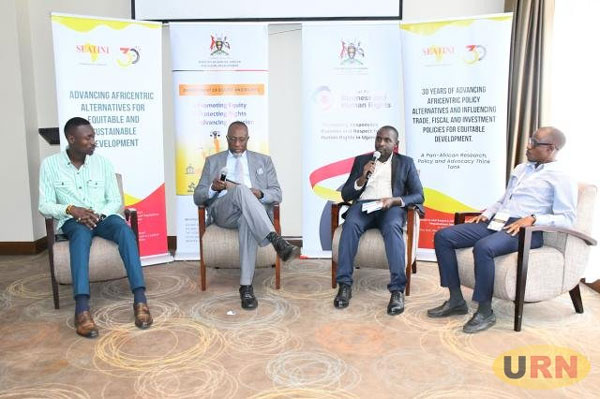
The concerns emerged following the conclusion of the 7th National Forum on Business and Human Rights in Uganda, organised by the Ministry of Gender, Labour and Social Development.
Dr Frank Mugyenyi, Global Executive Director of the Minerals Africa Development Institution, said Uganda’s mineral development strategy has prioritised revenue generation at the expense of value addition and industrial development. He noted that although gold is refined to 99 per cent purity, the country continues to export it because Uganda lacks a developed domestic gold manufacturing industry capable of producing finished products.
“Uganda, like most African countries, is still looking at maximising revenue rather than optimising value. When you are looking at maximising revenue, you are looking at milking the cow, and you don’t know whether it has salt, it has this, it has that,” Mugyenyi said.
He called for investment across the entire gold value chain, including the manufacture of finished gold products, arguing that a similar approach should be adopted for other minerals to strengthen domestic industries and retain more value within the economy.
Mugyenyi also raised concerns about the limited economic benefits accruing to communities hosting mining operations, noting that the industry has not generated sufficient employment opportunities.
He said the exemption of gold mining from royalty payments further limits the benefits available to host communities, particularly when compared with other minerals that attract a five per cent royalty payable to landowners.
However, Mugyenyi argued that community benefits should extend beyond royalty payments to include meaningful participation in the development of the mining sector.
“These are the owners of the land; these are the owners of the minerals. They are not supposed to be receiving something from royalties. They are supposed to be part of the entire development because these guys need education, food, shelter; they need a decent life,” he said.
He further questioned whether the existing legal framework adequately supports the government’s mineral value addition policy, arguing that gaps in legislation and regulation continue to constrain the sector.
“We have a good policy on the table, but do we have the law that supports that policy? Even the Minerals and Mining Act of 2023 leaves out some actors, especially in the development of the minerals, which means they have no regulations,” he said.
Mugyenyi also criticised the regulatory framework governing artisanal and small-scale miners, saying it does not adequately provide for their growth and development, leaving them vulnerable to exploitation.
He questioned the narrow definition of artisanal miners, which largely focuses on the use of rudimentary tools, arguing that the framework fails to accommodate miners who make significant discoveries despite operating with limited resources.
“You define an artisan as someone who uses rudimentary materials. What if I hit one stone while using my rudiment, like a Tanzanian guy who found a tanzanite that cost about three million US dollars?” he asked.
However, Morris Tabaaro, a Regional Inspector of Mines, defended the government’s approach, saying President Museveni’s directive on gold royalties was intended to attract investment in the refining industry.
Tabaaro said the policy had contributed to the issuance of 500 licences to investors in the mining industry and the discovery of approximately 20 minerals, benefits he argued outweighed the revenue foregone through royalties.
He also pointed to restrictions on the export of raw gold and the Bank of Uganda’s entry into gold purchases as measures aimed at strengthening the domestic gold industry.
“President Museveni banned the export of raw gold. The Bank of Uganda started buying gold this year, but until then, all gold was being bought by foreigners. So, imagine if all the gold customers said, ‘I will not buy any more gold.’ What happens?” he asked.
Tabaaro added that while Uganda’s mineral resources belong to its citizens, government policy must strike a balance between maximising national benefits and maintaining investor confidence to avoid disrupting the industry.
The experts, however, challenged the government’s position, arguing that the expansion of the refining industry has not translated into sufficient benefits for the country.
They noted that Uganda had only one gold refinery in 2017, compared with nine currently operating, while the Ministry of Energy and Mineral Development has confirmed that 11 additional refinery licences are pending approval.
They also called for the expedited establishment of a National Minerals or Mining Authority to regulate the growing number of industry players, strengthen oversight and address capital flight and revenue leakages.
Eng. Tonny Olanya, Executive Director of Lyec Bullion Consults and Afri Gold Bullion Ventures, highlighted the disparity between Uganda’s mineral wealth and the persistent poverty in mining communities, particularly in Karamoja. He cited delays in the issuance of artisanal mining licences, inadequate compensation for host communities and limited benefits from gold exports as key challenges undermining the sector.
Olanya called for a review of gold royalty and taxation arrangements, stronger government oversight of mining agreements, increased investment in artisanal miners and greater value addition to ensure that more mineral wealth is retained within Uganda. He argued that the country’s natural resources are not delivering commensurate benefits to Ugandans, with a significant share of the gains accruing to foreign investors and operators.
Olanya also urged the Bank of Uganda to purchase all gold mined in or transiting through Uganda, saying this would increase domestic retention of mineral wealth. He, however, emphasised that the central bank should be supported by a framework allowing it to trade in gold rather than merely accumulate reserves.
Meanwhile, Jackline Ensekiriyo, Technical Officer at the Uganda Extractive Industries Transparency Initiative, highlighted persistent gaps in gold production and export data.
She said artisanal and small-scale miners make a significant contribution to mineral production and employment but remain largely underrepresented in official employment statistics.
Aloysious Kittengo, Tax Policy Analyst at SEATINI, also raised concerns about gaps in tax incentives, revenue mobilisation and accountability within the extractives sector.
He questioned whether the tax exemptions and incentives granted to mining companies were delivering adequate economic and social returns, particularly in light of concerns about human rights compliance and limited access to company data by the government.