The Independent Uganda: You get the Truth we Pay the Price


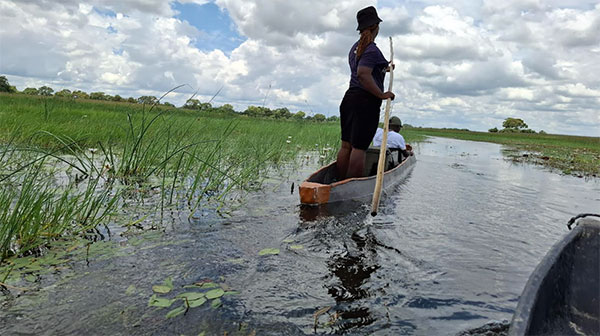
Guided by local polers, an intimate canoe safari reveals why this inland wetland sustains both wildlife and community
Boro Mokoro Station, BOTSWANA | RONALD MUSOKE | From the air, the Okavango Delta in southern Africa, appears as a blue-green mirage spilling into desert– a fan of water dissolving into sand. But at water level, seated inches above a clear channel and propelled by a single wooden pole, the Delta feels less like geography and more like breath.
That seemed the case when my party of three left the northern Botswana town of Maun before sunrise in the back of an open safari truck. We thought we were going to see a landscape. Instead, we entered a living system, one measured not in kilometres, but in silence.
For four straight days, we had been speaking the language of policy inside a hotel conference room; ecological corridors, transboundary resilience, shared governance. The workshop, convened in mid-December, last year, by the African Union Commission in collaboration with the UNDP and UNEP, sought to design a continent-wide Biodiversity for Resilience programme. We debated the architecture, financing and institutional frameworks.
Outside, the Delta was conducting its own quiet demonstration of connectivity. And when Botswana’s Environment Minister, Wynter Boipuso Mmolotsi, urged workshop participants to spare time — “even briefly” — to visit nearby attractions, we did not hesitate. From an array of tourist offerings, my two compatriots and I chose a canoe or “Mokoro” cruise on a river inside the southern reaches of the Okavango Delta.
The road to water
At 8:25 a.m. on December 19, two senior Ugandan conservation officials and I climbed into an open, army-green tourist vehicle (more truck than car) and headed toward the Mokoro Station on the southern fringes of the Delta.
The tar road soon surrendered to a muddy but motorable track. Maun town thinned into scrub. Cattle grazed lazily near the rural homesteads. The air grew warmer, edged with the faint scent of livestock and sun-warmed sandy-clay earth. The transition from town to rural Botswana felt gradual yet decisive — as though we were crossing not just geography, but tempo.
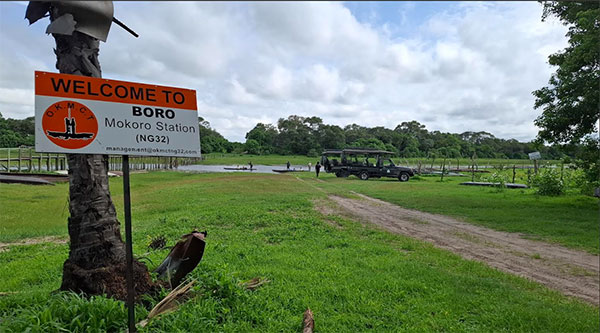
Soon, we reached the Okavango Kopano Mokoro Community Trust, where we found our polers/coxswains, Will and Obvious, waiting. Will, 34, stood with the relaxed composure of someone who has grown up on water. Obvious, a young woman with steady eyes and effortless balance, rested her pole lightly against her shoulder.
“The transport that we are going to use, we call it mokoro,” Will explained, gesturing toward the long, slender grey canoes resting at the water’s edge. “It accommodates two passengers, with the guide behind. The guide is the one who does the balance.” Traditionally carved from hollowed trunks of African ebony or sausage trees, mokoros are now largely fibreglass — lighter, durable, and kinder to forests. “Nowadays we prefer the fibre glass,” Will aaid. “It’s less weighty.”
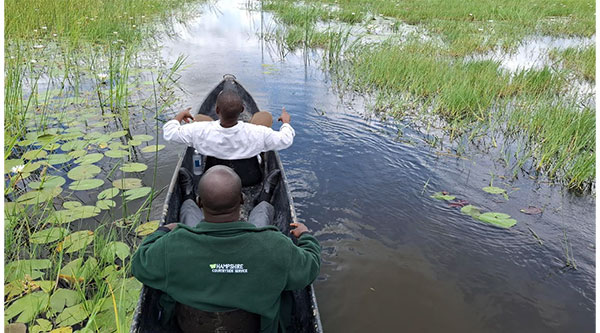
My senior colleague and I settled low into the narrow hull ready to begin the cruise while our other colleague jumped into the other canoe that would be poled by Obvious, the young woman. That boat also carried our lunch box.
“Please don’t bend your hands or your face into the water,” Will cautioned us, gently. “We have sharp grass underneath the water. It can cut your fingers.” The water beneath us was startlingly clear — about several metres deep. Dragonflies shimmered over hippo grass. The nkashi pole entered the sandy bed with a soft plunge and we we began to glide. To an unfamiliar eye, it appeared like we getting into the middle a thick carpet of waterplants and tall grass.
Entering the Delta
The Okavango Delta is one of the world’s rare inland, or endorheic, deltas — a vast wetland whose waters never reach the sea. The Okavango River travels some 1,500 kilometres from Angola before fanning into Botswana’s Kalahari sands. Its annual flood arrives during the dry winter, not the rainy season — an inversion that has shaped the biological rhythms of every species here.
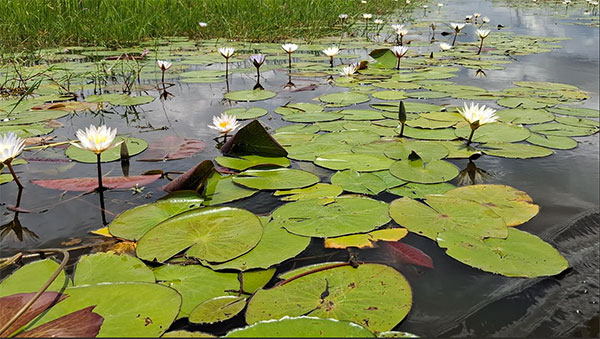
In this ecological quirk, plants flower as waters recede while fish breed with rising floods. Flooded grasslands wait for distant rains upstream. From a mokoro, these processes reveal themselves not as scientific theory, but as texture: reed beds dissolving into open channels, water lily-carpeted lagoons giving way to dry islands edged with palms. “Along the route we will encounter water birds, water plants and flowers,” Will had told us before departure. “Sometimes zebras or wildebeests. If you want pictures, we can stop.”
Crocodiles and distance
I then asked Will what every visitor perhaps asks.“Are there crocodiles? Hippos?”“Yes, of course,” Will replied evenly. “But we don’t provoke them. We give them space — at least 150 metres.”
Will said Mokoro safaris navigate narrow, shallow channels, avoiding deeper corridors where hippos congregate. Licensed polers recognise crocodile nesting zones and they avoid these spots. Safety here is not bravado; it is restraint. I then I asked about a wooden barrier that cuts across part of the channel, near the docking area. “That is a buffalo fence,” Will explained. “It separates domestic cattle from wildlife areas. Lions sometimes cross toward villages in search of livestock.” I learnt that the Delta is not sealed wilderness; it is shared terrain, carefully negotiated.
Livelihood and stewardship
Theo Mokgadi of African Excursions, the organizer of our excursion, would later in the evening sketch the Delta’s geography for me. He expalined to me how the Okavango River enters Botswana near Shakawe, forms a pen-handle shape, then fans into a network of channels and rivulets. The southern part — where we cruised along the Boro River — carries substantial water volumes. Community concessions, designated as NG areas, are managed by local trusts. Camps deep inside the Delta — Chiefs Camp, Mombo Camp — sit on islands accessible mainly by small aircraft. Their remoteness partly explains their cost. The Delta is not a uniform wetland. It is a shifting mosaic — floodplain, island, channel, grassland — constantly redrawn by water.
Lilies and light
Will has guided mokoro cruises for close to a decade while his female colleague is relatively young in the business. During the busy season — June through November — they might work twice a week. The community trust schedules each team so that income is shared.
“We are many,” Will told us. “Everybody has to share something.” The village of roughly 300 people depends on tourism, farming and cattle. Fishing is permitted seasonally, mainly for household consumption. Throughout the year, women harvest mushrooms and weaving materials from the wetlands. Botswana has placed roughly 40% of its land under protected status and strengthened community-based natural resource management laws. Here, conservation is not abstract policy; it is livelihood, negotiated daily.
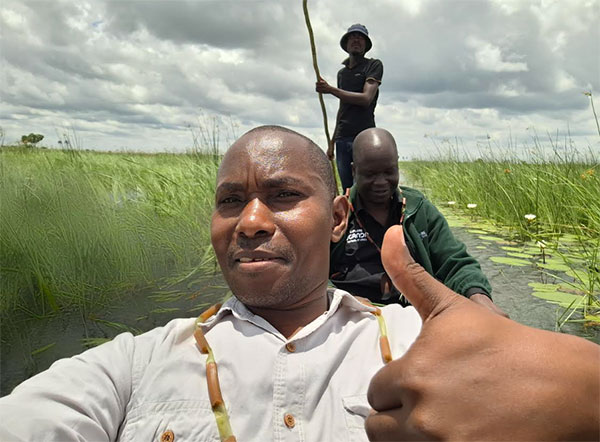
As we continued gliding effortlessly, Will kept pointing toward yellow water lily stems rising elegantly from the shallows. “Here we see both night and day water lilies,” he explained. “There are those that are active between six in the morning and six in the evening.”
In other places along the channel white lily blossoms spred across the water’s surface. An African jacana stepped across lily pads on impossibly long toes. White ibises swept overhead. Hadad ibises protested in raspy calls while Grey herons stood statuesque at the margins. Yellow-billed storks probed patiently while swallows stitched the sky in quick arcs. Dragonflies hovered electric blue against the green.
At water level, scale transforms everything. You see the sandy bottom. You hear reeds brush softly against fibreglass. You notice the physics that allows a water strider bird to skate across surface tension. Luxury here is intimacy.
Mmadikhudu Island
By late morning, almost an hour into our cruise, we reached Mmadikhudu — the Mother of Tortoise Island. We stepped ashore for a short walk and lunch on a meadow. But, first, we wanted to spot some animals on this island. But not so far fast. Midway, Will knelt beside a cluster of sage, a luxuriant shrub. “Our traditional doctors use this,” he said. “They dig the roots and boil them for stomach aches. The leaves — you boil them, let it cool, then gargle. The roots cleanse the stomach.” He smiled.
“Elephants also eat it to deal with worms.”He explained how hunters once crushed the leaves and rubbed them over their bodies to mask scent, how the plant doubles as a mosquito repellent. The Delta is not merely scenic; it is medicinal and practical.
The Zebra moment
Soon, we spotted a herd of zebras grazing within a dense shrub line. We gestured for Will to angle closer. The zebras lifted their heads in unison, ears alert. For a suspended moment, we held one another’s gaze. Then they turned and retreated — not in panic, but in measured grace — disappearing deeper into thickets. Only after they vanish did Will speak. “The zebra is Botswana’s national animal,” he said.
He then explained the stripes —the black, white, and what he called shadow stripes, subtle brown tones between them that assist with cooling under intense sun. “Black is for black people,” he added thoughtfully. “White is for white people. And the brown — the shadow stripes — they remind us that we are one.”
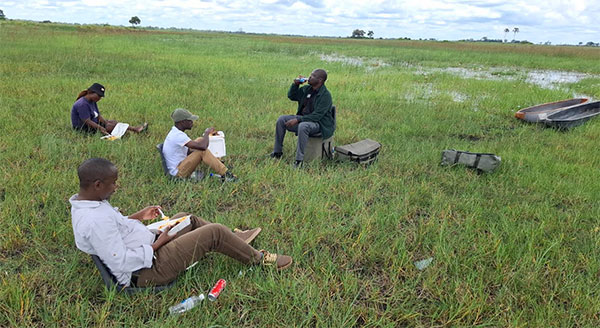
Zebras often graze alongside wildebeests and impalas. Zebras crop taller grasses; others feed on shorter shoots exposed behind them. More species feeding together means more eyes scanning for predators. “It’s a symbiotic relationship,” he said. “For safety.” We then settled down for a quick Nandos chicken and rice, washed down with cold canned coca colas.
The rhythm of return
At 12:10 p.m., we pushed off from Mmadikhudu Island, the mokoros slipping once more into channels stitched with lilies. This time, the journey back appeared quicker. We were now cruising in sync with the tide.
As we neared the Mokoro Station, my colleague reflected quietly. “It has a calming effect on the mind,” he said of the mokoro cruise. Even if he had hoped to see kudus, the famous antelopes in this part of Africa, we wasn’t disappointed. But perhaps the mokoro offers something beyond a checklist of sightings. It recalibrates expectation. It rewards patience.
Back at the docking station, we found members of the Bayei community performing a traditional hunting song once sung after successful elephant hunts. Layered voices carried memory and pride — reminders that this landscape, the Okavango Delta, is as cultural as it is ecological.
From the sky, the Okavango Delta astonishes as geography. From a mokoro, it astonishes as relationship between river and desert, community and conservation, policy and practice. And in that slender canoe, propelled by quiet expertise, the Delta does not simply reveal itself. It breathes.