The Independent Uganda: You get the Truth we Pay the Price


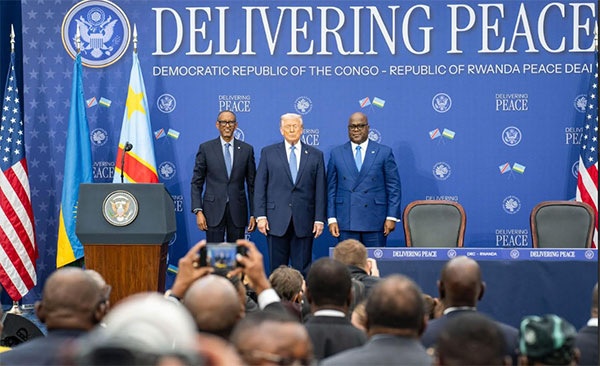
The continent navigated a tumultuous 12 months at the whim of America’s mercurial president
NEWS ANALYSIS | AGENCIES | Donald Trump declared a ‘white genocide’ in South Africa, threatened military action in Nigeria and cut off live-saving foreign aid.
The US president also reinvigorated commercial dealmaking with Africa, especially around critical minerals and energy, and launched unfinished peace-making in eastern Congo.
It’s been a roller-coaster of a year for the US-Africa relationship. Here’s a recap of some of the main developments of the past 12 months:
January
- Executive orders
Trump’s second term gets off to a dizzying pace, with the president signing a record-breaking 36 executive orders (EOs) in his first week.
These include freezing foreign aid and life-saving health programmes, suspending refugee admissions and ending President Joe Biden’s diaspora engagement, setting the tone for a more transactional Africa policy.The EOs also create the short-lived Department of Government Efficiency (DOGE) under Elon Musk, laying the groundwork for the dismantlement of the US Agency for International Development (USAID) and a restructuring of US foreign aid that continues to this day.
February
- End of USAID
Declaring USAID “beyond repair”, Musk announces that he is shutting the agency down.
The administration will end up laying off around 4,500 federal employees and cutting billions of dollars in aid, resulting in the estimated death of hundreds of thousands of people from disease and malnutrition while setting back US soft power around the world.
The hasty move also terminates USAID-led initiatives promoting US economic ties to the continent, including Prosper Africa and Power Africa.
Trump also moves to shutter the US African Development Foundation and the US Institute of Peace.
- Democratic backsliding
US support for the rule of law takes a backseat to transactional dealmaking under Attorney General Pam Bondi.
In her first week in office, the nation’s top law enforcement officer deprioritises good governance initiatives, including the Foreign Corrupt Practices Act (FCPA), the Foreign Agents Registration Act (FARA) and the Justice Department’s Foreign Influence Task Force.
- South Africa in the crosshairs
South Africa’s year of living dangerously begins with a White House executive order ‘addressing egregious actions’ by Pretoria.
Citing land seizures and other actions ‘fuelling disproportionate violence against racially disfavoured landowners’, the order freezes bilateral aid and announces plans to take in white Afrikaner refugees.
- Rwanda sanctions
The US Treasury Department sanctions Rwanda’s minister of state for regional integration, James Kabarebe, for his alleged support for the M23 rebel group in eastern Congo. Also sanctioned is M23 spokesperson Lawrence Kanyuka Kingston.
March
- Fossil fuel revival
Energy is one area where Trump gets generally good marks from African political and business leaders.
With 600 million Africans lacking access to electricity while the continent contributes least to global emissions, Washington’s all-of-the-above energy policy – outlined by US energy secretary Chris Wright at the Powering Africa Summit – generates plenty of excitement.
The US retreat on climate policies however threatens a continent that’s uniquely vulnerable to global warming.
- Defending AFRICOM
Talk of merging US Africa Command (AFRICOM) with US European Command, both based in Stuttgart, reaches fever pitch as the Trump administration examines ways to cut spending.
There is also talk of downgrading the State Department’s Bureau of African Affairs. The moves are a non-starter in Congress, which acts to protect both AFRICOM and the State Department bureau in its annual defence bill.
- Persona non grata
Secretary of State Marco Rubio expels South African Ambassador Ebrahim Rasool after the envoy accuses Trump of mobilising white supremacy around the world.
Nine months later, Pretoria still doesn’t have an ambassador in Washington.
April
- Congo minerals
Trump’s global quest for strategic minerals reaches Africa. The president taps his daughter Tiffany’s father-in-law Massad Boulos as his senior adviser for African Affairs and dispatches him on a four-nation trip to Democratic Republic of Congo (DRC), Rwanda, Kenya and Uganda in hopes of striking a security-for-minerals deal in the war-ravaged eastern Congo.
In Washington, Rubio hosts the foreign ministers of DRC and Rwanda for the signing of a Declaration of Principles for peace.
- Liberation Day tariffs
The US president triggers panic across the continent with his 2 April ‘Liberation Day’ tariff announcement.
Punishing countries for their trade surpluses with the US, Trump threatens tariffs ranging from 10% to 50% on tiny Lesotho, a key beneficiary of the African Growth and Opportunity Act (AGOA).
Faced with a crashing stock market, Trump pauses the tariffs for 90 days. Future reversals earn him the moniker TACO, short for ‘Trump Always Chickens Out’.
May
- Ramaphosa in Washington
Eager to reset relations with America and save one of South Africa’s biggest export markets, the head of Africa’s leading industrial power heads to Washington on a diplomatic mission.
South Africa’s President Cyril Ramaphosa is ambushed in the Oval Office by an ill-informed Trump who parrots Musk’s ‘white genocide’ exaggerations about the threat to white Afrikaner farmers and shows him a misleading video that contains images of body bags actually filmed in Goma, DRC.
- Deportee saga
The tiny kingdom of Eswatini becomes the first known African country to sign a ‘third-country deportation’ scheme with a Trump administration eager to dump what it calls ‘uniquely barbaric’ deportees into some of the world’s poorest countries.
Several other African countries follow suit, including Ghana, Liberia, Rwanda, South Sudan and Uganda. Deals with Equatorial Guinea and Libya are rumoured but unconfirmed.
- Commercial diplomacy
During the Africa CEO Forum in Abidjan, the State Department’s top Africa diplomat Troy Fitrell unveils a six-point plan for boosting US trade and investment on the continent.
Fitrell also announces plans for a US-Africa Leaders Summit in New York in September that does not take place.
June
- Trump travel ban 1.0
Citing the need to protect US citizens from terrorist threats and ‘hateful ideology’, the White House announces its first batch of travel bans.
The State Department stops issuing visas (with rare exemptions) to citizens of 12 countries including Chad, the Republic of the Congo, Equatorial Guinea, Eritrea, Libya, Somalia and Sudan.
Chad slaps reciprocal visa bans on US citizens. The US also partially suspends visa issuance to nationals of seven other countries, including Burundi, Sierra Leone and Togo.
- US launches Sudan ‘quad’
Deputy Secretary of State Christopher Landau gathers representatives from Egypt, Saudi Arabia and the United Arab Emirates (UAE) in Washington for the launch of a ‘Quad for Sudan’ to end the brutal conflict in Sudan.
The initiative aims to get some of the main outside actors in the civil war on the same page, but Washington’s reluctance to forcefully call out the UAE’s support for the genocidal Rapid Support Forces (RSF) hampers its effectiveness.
- National Security Council shakeup
The turmoil inside the White House continues, with Major General Jami Shawley forced to step down after less than four months as senior director for Africa on the National Security Council (NSC).
This comes as the Africa office gets subsumed into the larger Middle East and North Africa apparatus, which experts see as a ‘significant downgrading of Africa’s importance as a national security issue’.
- Angola hosts US business summit
Fitrell leads the US delegation to the US-Africa Business Summit in Luanda.
With a record turnout of 2,700 participants including 12 heads of state, the State Department announces $2.5bn in new deals and commitments between US and African partners, including millions in new investments in the Lobito Corridor connecting the copper and cobalt mines of Zambia and DRC to Angola’s Atlantic coast.
July
- Trump’s mini Africa summit
Trump hosts five leaders of smaller West African states on 9 July for a working lunch at the White House.
The visit is a diplomatic coup for the presidents of Gabon, Guinea-Bissau, Liberia, Mauritania and Senegal, all eager to avoid Trump’s tariffs.
The US makes some progress on minerals deals, but the visit is overshadowed by controversy over Washington’s unmet demands for third-party deportations and Trump’s praise of Liberia President Joseph Boakai for his command of English, the country’s official language.
- New AFRICOM chief
The US Senate confirms Air Force General Dagvin Anderson as the new head of AFRICOM, replacing Marine General Michael Langley.
No stranger to Africa, Anderson previously led Special Operations Command-Africa (SOC-Africa).
August
- Tariffs 2.0
On 1 August, Trump unveils his revised list of tariffs, set to take effect on 7 August.
Many African nations, subjected to the new minimum 10% reciprocal duties, let out a sign of relief.
Algeria, Libya and South Africa, however, suffer a 30% hit, while Tunisia gets a 25% tariff.
- US returns to the Sahel
Members of the House Armed Services Committee make their annual visit to the continent.
After previous efforts twice failed, they finally make it to Burkina Faso for talks with President Ibrahim Traoré’s government.
The visit comes as the Trump administration is also ramping up its outreach to the Sahel’s putschist regimes.
Deputy Assistant Secretary (DAS) of State for African Affairs William Stevens visits Burkina Faso and Niger in May and Mali in late July, while Rudy Atallah, NSC principal deputy director for counterterrorism, also travels to Bamako.
September
- US engages Africa at the UN
The US takes advantage of the UN General Assembly (UNGA) in New York to engage with Africa.
While Boulos holds a rare meeting with foreign affairs minister Osman Saleh Mohammed of Eritrea, Landau sits down with the sanctioned Vice President of Equatorial Guinea, Teodoro Nguema Obiang Mangue.
Landau also announces support for government-backed investments in the Morocco-occupied Western Sahara.
- ‘America First’ health partnerships
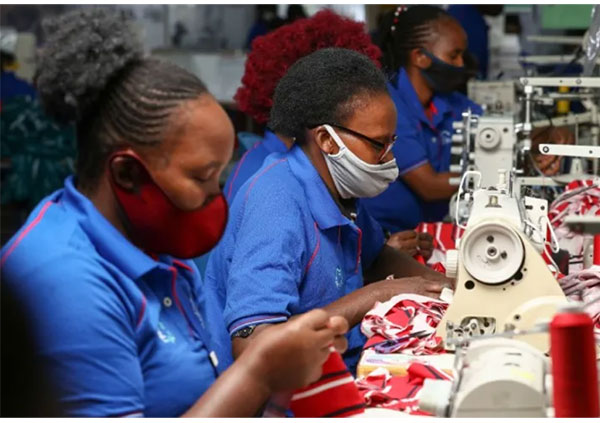
In New York, the Trump administration unveils its new ‘America First Global Health Strategy’, replacing support for non-governmental organisations (NGOs) with government-to-government contracts.
Kenya is the first to sign a pact with the State Department in early December, quickly followed by Rwanda, Lesotho, Eswatini, Uganda and Cameroon.
The deals promise millions of dollars of US assistance to beef up African health systems, but raise concerns around national sovereignty.
- AGOA expires, MCC reopens
AGOA officially expires on 30 September, bringing an unceremonious end to the cornerstone of US commercial engagement with Africa for the past 25 years.
On the flip side, the Millennium Challenge Corporation (MCC) emerges from its Musk-imposed purgatory with a $300m regional electrification grant for Côte d’Ivoire.
October
- Trump goes after Nigeria
Nigeria joins South Africa on the US blacklist when Trump espouses conservative Christian rhetoric about religious persecution in Africa’s most populous country.
On 31 October, the US president announces that he is reinstating Nigeria on the US list of ‘Countries of Particular Concern’ regarding freedom of religion.
A day later, he threatens to send the US troops “guns-a-blazing” to protect Christians.
- Indian Ocean investments
With the US eyeing greater strategic and commercial investment in the Indian Ocean, the Corporate Council on Africa (CCA) announces Mauritius as next year’s destination for the US-Africa Business Summit. It’s the first time the annual summit is held in the region.
November
- Trump and Vance shun Africa’s first G20
Vice President JD Vance cancels his trip to South Africa and Kenya after Trump refuses to send a US delegation to the first-ever G20 held on African soil.
This follows Rubio’s cancellation of an April trip to Ethiopia and Kenya, leaving the US without a high-level visit to the continent this year.
- Saudi’s MBS urges Trump to act on Sudan
Trump announces a renewed effort to pursue peace in Sudan following a request by Saudi Crown Prince Mohammed bin Salman during a visit to the White House.
A few weeks later the Treasury Department sanctions Colombian mercenaries fighting for the RSF, but not their alleged Emirati funders.
December
- Congo peace deal
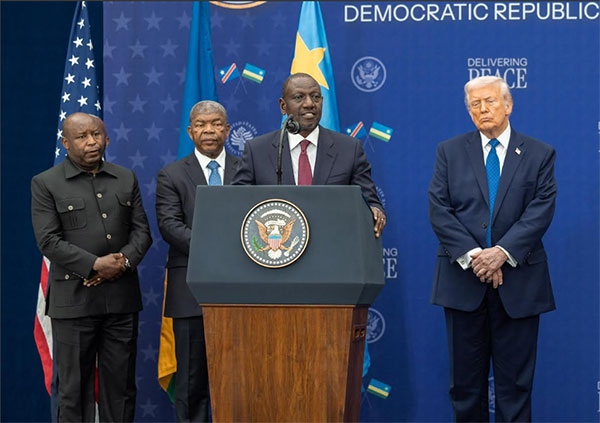
After multiple false starts, Congolese President Félix Tshisekedi and his Rwandan counterpart Paul Kagame finally meet in Washington, DC to sign the Washington Accords for peace in eastern Congo.
The presidents of Angola, Kenya, Burundi and Togo all bear witness during a ceremony at the US Institute of Peace.
The US also signs a series of bilateral and trilateral economic agreements with the two countries.
Days later, the Rwandan-backed M23 capture Uvira, dispelling any notion of imminent peace in the region.
- Congress reauthorizes DFC
The US Congress votes to renew the US International Development Finance Corporation (DFC) as part of the annual defence authorisation bill, or NDAA (National Defence Authorisation Act).
US investor Benjamin Black takes over as CEO and immediately signs a $553m loan for the refurbishment of the Lobito Corridor.
The $900bn NDAA also protects AFRICOM and the State Department’s Bureau of African Affairs.
Source: Africa Report.