The Independent Uganda: You get the Truth we Pay the Price


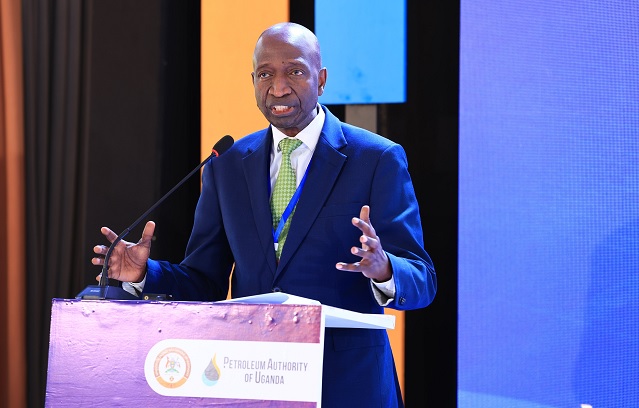
Kampala, Uganda | THE INDEPENDENT | After ten years at the helm of the Petroleum Authority of Uganda (PAU), Ernest Rubondo is stepping down, leaving behind a legacy that has significantly shaped Uganda’s oil and gas sector, even before the first barrel of oil is produced. He will officially leave office in August 2026 when his contract expires.
The Authority advertised the position in December 2025, with a deadline for applications set for January 2, 2026.
Under his leadership, PAU has grown into a prominent regulator, positioning Ugandans to benefit increasingly from the country’s oil wealth.
“When I joined PAU, the task was enormous,” Rubondo told reporters at a recent press briefing. “We had to ensure that Uganda’s oil resources are developed sustainably, that our people benefit, and that the environment is protected, all at the same time.”
When commercial oil was first confirmed in Uganda in 2006, few anticipated that local professionals and enterprises would play a central role before production began.
Rubondo’s tenure has focused heavily on changing that trajectory. Today, nearly 20,000 Ugandans are directly employed in oil and gas operations, with an additional 180,000 benefiting indirectly through related activities.
National content initiatives indicate that Ugandans now hold 64 percent of management roles, 85 percent of technical positions, and 99 percent of support roles.
Central to these efforts are digital platforms such as the National Supply Database and the National Oil and Gas Talent Register.
“We wanted transparency and accessibility,” Rubondo explained. “If a Ugandan company can deliver, it should be able to compete; this is why these platforms exist.”
The Authority has also prioritized skills development.
More than 14,000 Ugandans have been trained and certified in petroleum-related technical disciplines, including welding, scaffolding, heavy vehicle operations, and health and safety.
Universities such as Makerere, Kyambogo, and Nkumba now offer internationally recognized certifications, enabling local professionals to manage complex operations and reduce reliance on foreign specialists.
While these achievements are significant, independent experts caution that sustaining local participation as production scales up may prove challenging. Supply chain gaps, infrastructure limitations, and fluctuating global oil prices could affect the long-term competitiveness of small and medium enterprises.
Environmental stewardship has also been a defining feature of Rubondo’s tenure, particularly amid growing international scrutiny.
“Over the past five years, we faced intense pressure from anti-fossil fuel campaigners, claiming Uganda’s oil would devastate the environment,” he said.
“We welcomed scrutiny, but we also had to separate honest environmental concerns from political campaigns that were misleading the public.”
PAU has established petroleum waste management facilities, enforced rigorous environmental impact assessments, and monitored land acquisition and resettlement programs.
“All the waste generated from petroleum operations in the country is being managed at designated state-of-the-art facilities. And I want to say state-of-the-art, and I think those of you who have been to the field will agree with me,” Rubondo said.
These facilities include thermal desorption units, rare even among oil-producing countries, and have helped prevent reported incidents of waste pollution.
Nonetheless, environmental advocates argue that continuous monitoring and enforcement will be critical as production begins and operational scales increase.
On the social front, more than 475 houses were constructed for project-affected families, and nearly 20,000 households across 11 districts have benefited from livelihood restoration programs.
“These are tangible results,” Rubondo emphasized.
“We didn’t just want words on paper; we wanted communities to see real benefits and the environment to be protected.”
Under Rubondo’s leadership, PAU has maintained steady oversight as infrastructure and production wells advance. Procurement, budgeting, and cost recovery programs have been rigorously monitored, with audits overseen by the Office of the Auditor General.
According to PAU figures, Uganda’s petroleum projects can deliver a barrel at $30, even as global oil prices fluctuate between $60 and $70. Resource estimates have also been revised upward.
The country’s petroleum resources increased from 6.5 billion to 6.6 billion barrels, while recoverable resources rose from 1.4 billion to 1.65 billion barrels. Rubondo attributed this growth to improved geological understanding of the Albertine Graben.
Three major projects currently dominate the Authority’s oversight: the Kingfisher Petroleum Production Project (CNOOC), the Tilenga Petroleum Production Project (TotalEnergies), and the East African Crude Oil Pipeline (EACOP).
“Why do we say they are mega? The Kingfisher project is worth $3 billion, the Tilenga project is between $6 to $7 billion, and the EACOP is around $5 billion.”
Rubondo said, noting that the Karuma project, Uganda’s largest prior investment, was valued at $1.6 billion.
While these projects represent significant investment, analysts caution that mega-projects carry inherent risks, including cost overruns, environmental concerns, and social impacts that require sustained oversight.
Rubondo acknowledged these challenges, noting, “Some of the criticisms from international anti-fossil fuel campaigners were genuine, others were misleading. We had to stay the course, rely on rigorous environmental assessments.”
PAU’s engagement has extended beyond Uganda’s borders. Rubondo forged partnerships with regulators and institutions in Norway, Ghana, Kenya, Tanzania, and through the African Petroleum Regulators Forum. Participation in international platforms such as the International Upstream Forum in Canada helped benchmark Uganda’s regulatory framework against global standards.
“Oil and gas regulation is not something you can do in isolation,” he said. “Our collaborations ensured that Uganda could adopt proven practices tailored to our context.”
As Uganda approaches first oil, new responsibilities lie ahead: regulating production across oil fields, overseeing the East African Crude Oil Pipeline, refinery operations, and downstream regulation, while strengthening linkages between oil and other sectors, including health, transport, agriculture, tourism, and education.
Rubondo estimates that these linkages could generate up to $8 billion in GDP growth even before the first oil. “Oil is more than revenue; it’s a catalyst for development,” he said.
Reflecting on his tenure, Rubondo emphasized institution-building as his guiding principle. “Leadership is about building institutions that outlast you,” he said. “I am confident that PAU is ready for the next chapter, and I am proud to have been part of this journey—for God and my country.”
He leaves behind a strengthened regulatory framework, a skilled workforce, engaged communities, and international partnerships, a foundation intended to guide Uganda’s oil and gas sector for decades. His successor will steer the sector under PAU’s third strategic plan (2026–2030), themed “Enabling a Sustainable Petroleum Industry.”
****
URN