The Independent Uganda: You get the Truth we Pay the Price


Kampala, Uganda | URN | A new UNESCO Global Education Monitoring Report highlights chronic underfunding as one of the biggest barriers to education in Uganda.
It warns that low public spending continues to undermine learning outcomes and fuel alarmingly high dropout rates across the country.
Uganda has, over the years, emerged as one of Africa’s earliest champions of the Education for All movement. However, the promise of quality, accessible education for every child remains an ambition far from reality.
Released this week, the report paints a stern picture of a system that expanded access dramatically through the introduction of Universal Primary Education (UPE) in the late 1990s, only to see progress stagnate and, in some areas, reverse.
While enrolment surged in the early years of UPE, the quality of education has suffered as government investment failed to keep pace with growing needs.
“Arguably, one of the biggest impediments to improving education in Uganda is with respect to financing,” the UNESCO report states.
It added that low spending has led to poor infrastructure, inadequate teaching materials, and overburdened schools, all factors well-documented as driving children out of the classroom.
These concerns have sparked ongoing national debate, with calls for increased investment echoed by parents, teachers, policymakers, and development partners for years.
Ireland’s Ambassador to Uganda, Mags Gaynor, last week reiterated the urgency during the “Teachers Making a Difference” awards ceremony at State House, Entebbe. While praising outstanding educators, she joined the chorus urging greater public spending to support quality teaching and learning across the sector.
Education expert Gonzaga Kaswarra says underfunding drives many challenges in Uganda’s education system, from low teacher morale and salary gaps to shortages of instructional materials.
He warns that without a significant and sustained increase in investment, Uganda risks missing its national development goals.
“For millions of young learners, the gap between ambition and reality depends on whether government action translates long-standing calls into meaningful budget allocations,” Kaswarra added.
The government should define education as a public good to guide spending, reduce reliance on declining donor funds, and reconsider reducing or removing the sector from the private sector.
Patrick Kaboyo, a technical advisor with Education Advocacy Network, also emphasized that repeating the same approaches will not yield different results.
He noted that the issue of underfunding has been raised repeatedly and called for increased investment in education, pointing out that global trends show rising inputs.
He stressed the need to cut unnecessary costs and treat education as a long-term investment.
Available data shows that Public education expenditure as a share of total government spending rose sharply from 14 percent in 1990 to 25 percent in 1998 to support the rollout of UPE.
Yet those gains proved short-lived. Between 2011 and 2022, spending as a proportion of GDP edged up only slightly from 2.3 percent to 2.6 percent, while its share of total public expenditure fell sharply from 13.6 percent to 8.5 percent among the lowest levels in sub-Saharan Africa and globally.
The latest figures show it dipping even further to just 6.6 percent in the 2024/25 financial year, well below the international benchmarks of at least 4 percent of GDP and 15–20 percent of total public spending.
In 2023, the Cabinet approved an additional 1.48 trillion shillings for the education sector over the 2024–2028 period, with Shs309.16 billion planned for the first year.
The funding targeted key gaps in the UPE system, including the increasing capitation, recruitment of 78,888 primary teachers to achieve a 40:1 pupil-teacher ratio across 12,433 understaffed schools.
However, this remains an unfunded priority to date. Capitation grant allocations for primary schools in 2025/26 remain at only 18,000 shillings, far short of the 59,000 shillings to 63,000 shillings estimated in 2018 as necessary for delivering quality UPE in rural and urban settings.
With the government failing to fund education, many public schools continue to charge informal fees through parent-teacher associations to cover basic costs such as chalk, textbooks, and maintenance, a practice repeatedly flagged by the Auditor General, with more than half of schools still doing so. These hidden costs hit families hard.
The cost of schooling has been cited as the main reason for dropout by 60 percent of households, according to recent Uganda Bureau of Statistics data. Low government funding in the education sector is reflected in rising household spending.
Data from the National Household Survey shows that the share of education in household consumption increased from 5 percent in 2012/13 to 7.8 percent in 2016/17, and further to 8.5 percent in both 2019/20 and 2023/24.
This stands well above the global average of 2.1 percent and the low-income country average of 0.9 percent, according to UNESCO and the World Bank.
It is also noted that close to 60 percent of children who enrol in Primary One never complete Primary Seven, despite early gains in completion rates before UPE was introduced.
The UNESCO report points out that the primary completion rate had actually begun rising prior to UPE. Between 1990 and 2000, the ultimate completion rate (including late completers) grew by 1.2 percentage points per year, climbing from 39 percent to 51percent.
The report adds that progress slowed in the 2000s to 0.9 points annually, reaching 60 percent by 2010, before entering a period of stagnation and decline.
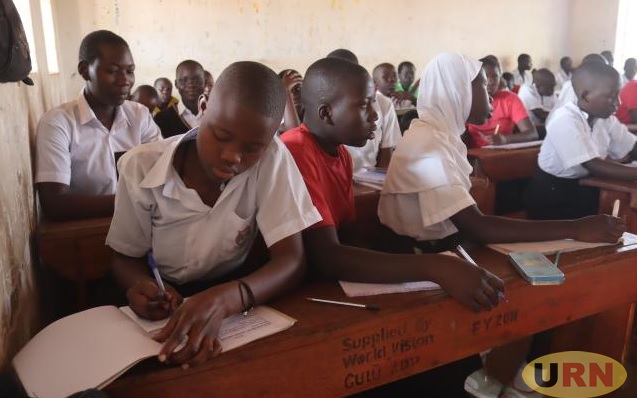
Low funding is also seen driving overcrowded classrooms, especially in regions like the North and West Nile, where pupil-to-classroom ratios exceed 100:1, and persistent infrastructure gaps continue to hinder learning.
High levels of over-age enrolment further complicate the picture, contributing to elevated repetition rates that waste scarce resources.
Although the government introduced automatic promotion to address this, the policy has been undermined by high-stakes terminal examinations such as the Primary Leaving Examination (PLE).
Both the World Bank and Uganda’s National Planning Authority have recently advised considering the scrapping or reform of the PLE to reduce pressure and repetition. The challenges extend beyond financing.
Overcrowded classrooms, especially in regions like the North and West Nile, where pupil-to-classroom ratios exceed 100:1, and persistent infrastructure gaps continue to hinder learning.
Kaboyo said much of what is raised in the report is not new, noting that similar findings have appeared in studies by organisations such as Uwezo, known for its report “Are Our Children Learning?”.
He said it is time for the government to move beyond these reports and take action. “If learners are not learning, are teachers teaching?” he asked, urging authorities to respond with concrete measures.