 The Independent Uganda: You get the Truth we Pay the Price


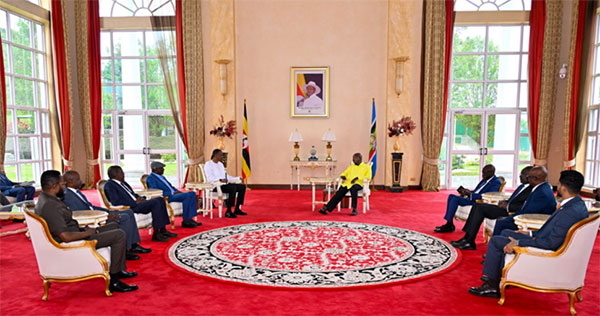
Analysts say Museveni-Dagalo meeting has created ‘political normalisation of RSF’
Kampala, Uganda | IAN KATUSIIME | Uganda’s mediation role on Sudan, which has been locked in a civil war for almost three years, has caused consternation among those watching the conflict and hoping for a peaceful resolution.
Last November, President Yoweri Museveni was appointed by the African Union to mediate the conflict between the Sudanese Armed Forces (SAF) and the Rapid Support Forces (RSF) which has claimed 24,000 lives and displaced more than 13 million people since it started in April 2023.
SAF is led by Gen. Al-Burhan, who is also head of the Sudan Transition Sovereignty Council. Burhan has not visited Uganda since fighting broke out. Mohamed Hamdan Dagalo,the Commander of the RSF, has been to Uganda a number of times.
However, when President Museveni hosted Dagalo at State House Entebbe on Feb. 20 in efforts aimed at finding peace in Sudan, there was uproar internationally.
In a strong statement, the Sudanese ministry of foreign affairs condemned the Ugandan government for hosting Dagalo. Sudan described the actions as “an unprecedented move that is an affront to humanity as a whole, before it is an affront to the Sudanese people.”
Museveni said in a statement that “dialogue and a peaceful political solution are the only sustainable paths to stability for Sudan and the region.”
On the other hand, Uganda’s Chief of Defence Forces Gen. Muhoozi Kainerugaba, launched an offensive against the RSF on Twitter, saying the Uganda Peoples Defence Forces (UPDF) could launch an attack on the RSF for killing blacks in Sudan. Muhoozi’s tweets have since sent mixed signals for those closely watching Sudan.
“We are ready to work with our South Sudanese brothers against the menace of RSF! When they captured El Fasher last year they killed our black brothers and sisters worse than you would kill a dog. They are going to pay for that one way or another!!” Muhoozi tweeted on Feb. 19 a day before Dagalo was ushered into State House Entebbe. Some observers have called Muhoozi’s posture a negotiating tactic.
President Museveni met with the High Command of the UPDF at State House on Feb. 24 to “review our security situation and the strategic priorities of our country.” The meeting was attended by Gen. Muhoozi and all the UPDF top brass. Analysts say Sudan likely featured on the agenda since the RSF boss was in town a few days ago.
Malik Agar’s visit
A week before Dagalo’s controversial visit, Museveni hosted Malik Agar, Deputy Chairman of Sudan’s Transitional Sovereignty Council where they discussed the security and political developments and the ongoing efforts to restore stability. The fledgling STC is the internationally recognised head of State of Sudan that is caught in the fighting between SAF and RSF.
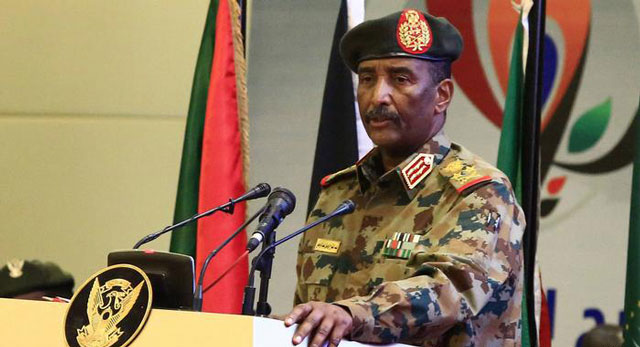
Uganda’s decision to host Dagalo sparked debate on its neutrality as a mediator. Now, Sudan no longer views Uganda as a neutral arbiter of the conflict and there is uncertainty on the direction of the mediation process and finding peace.
“Uganda is a conflicted actor, and the criticism it is getting from SAF is warranted,” says Yusuf Serunkuma, a political analyst and researcher.
“Uganda is seen as doing American-UAE bidding, and these two actors have been accused of interfering with the transition before the conflict broke out (they feared Muslim Brotherhood would win election, and thus sought a longer transition period), and have also been accused of sending weapons to the RSF,” he says.
Serunkuma says that the frequent visits of RSF leader and the fact that he normally comes ahead of the others, enables him to have advanced discussions with the Ugandan president before SAF representatives are in Kampala.
Serunkuma adds that there is the larger role of American interests in the mediation by President Museveni.
“Normally, AU appointment (what the) the big powers have endorsed. And there is only one big power with extreme interests across the world. American interests in Sudan, specifically not letting Muslim Brotherhood win any democratic elections – as happened in Egypt after the fall of Mubarak – are best protected by their Ugandan fixer and friend, Gen. Museveni, he says. “That is why Museveni works seamlessly with the UAE-American player in the conflict, Hamdan Dagalo.”
‘Normalisation of a paramilitary group’
Tsega’ab Amare, a Researcher writing in the Horn Review says Uganda’s decision to host Dagalo at State House Entebbe “represents a qualitative change in the political economy of Sudan’s conflict.”
Amare writes that although Kampala seeks to portray this engagement as part of an African Union-led mediation process, for the de facto government, headed by General Al-Burhan, this represents the “political normalization of a paramilitary group accused of grave international crimes.”
The RSF has been sanctioned by the U.S., U.K., UN, and E.U. for the atrocities committed in Sudan. The latest round of sanctions were announced on Feb. 26 by the UN Security Council on four leaders of the RSF for atrocities committed in the city of El Fasher.
The group captured El Fasher in October in what some say was the most brutal chapter of the three year conflict. A UN fact-finding mission determined the atrocities by RSF in the city pointed to a genocide.
RSF has also been accused of genocide in the western city of Darfur. Commentators say Uganda’s reception of Dagalo tantamount to backing a genocidal group. Dagalo is one of the most sanctioned individuals on the African continent.
A day before Dagalo jetted into Uganda, the US Treasury sanctioned three commanders of the RSF for their actions in El Fasher. “These individuals were involved in the RSF’s 18-month siege of and eventual capture of El-Fasher, in which the RSF perpetrated a horrific campaign of ethnic killings, torture, starvation, and sexual violence,” the US Treasury statement said.
“Since the beginning of Sudan’s civil war in April 2023, the RSF and its aligned militias have committed widespread atrocities, including war crimes, crimes against humanity, and genocide.”
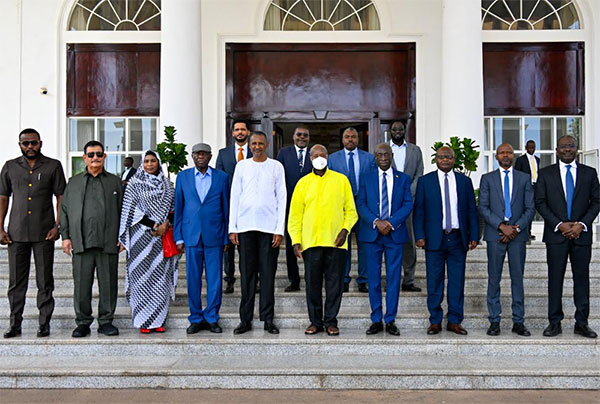
Amare said the Entebbe meeting represents an “accelerated pace towards Sudan’s transition to a state of normalized fragmentation, whereby an armed non-state actor seeks and attains not only territorial control but also diplomatic recognition”.
“This conflict represents an important case study on the weakening notion of sovereign exclusivity, mediation, and the emergence of parallel sovereignty within the Horn of Africa.”
Amare also weighed in on the Museveni-Muhoozi dynamic on the conflict. “For SAF-aligned actors, this duality is not benign pluralism but strategic ambiguity. The Museveni Track opens diplomatic space and preserves mediation credentials; the Muhoozi Track sustains leverage through coercive signaling and hedging.”
Amare opined “This good-cop/bad-cop dynamic undercuts Kampala’s credibility as a neutral broker while maximizing maneuvering room. In Sudanese eyes, Entebbe still registers as de facto recognition or facilitation tilted toward the RSF, even as Muhoozi’s bellicosity muddies the narrative and blunts unified condemnation of Kampala’s role.”
He says normalizing RSF diplomacy has far-reaching ripple effects in light of the ongoing crisis in Sudan and its implications for Nile Basin geopolitics.
“Moreover, for the Horn of African states, the precedent set by the RSF’s inclusion in a presidential reception poses a problem for regional stability. If paramilitary forces can sit in a presidential reception, then secession might just become a new route to regional influence,” he said.
Amare’s thoughts on regional stability are poignant because Kenya has granted diplomatic recognition to RSF. In February 2025, the RSF and its allied militias gathered in Nairobi and formed a parallel government.
The meeting happened just days after the African Union Peace and Security Council, convened by Heads of State and Government, condemned all forms of external interference fueling the Sudanese conflict and urged the warring parties to commit to an inclusive political dialogue to address the current crisis.
Uganda and Kenya find themselves mired in the Sudan conflict on one side. Incidentally, both countries are involved in efforts to bring peace to a country in the same region: Somalia. They have been part of the peacekeeping mission in Somalia for years now named the African Union Support and Stabilisation Mission (AUSSOM).
Uganda accused
For Uganda, its role as a mediator is now even more complicated. Uganda has been accused of funneling weapons—from the United Arab Emirates—to the RSF. Several reports have accused the UAE of sustaining RSF through its financial and logistical infrastructure. Dagalo is reported to have his business empire based in Dubai.
On the other hand, Uganda enjoys close ties with the UAE. In January 2025, President Museveni spent four days on a working visit to the UAE where the two countries signed a host of bilateral agreements. Two months later, Uganda contracted a UAE-based investment firm, Alpha MBM Investments LLC, to build a crude oil refinery in Hoima, western Uganda. Alpha MBM will have a 60% stake in the 60,000 barrels per day refinery.
The countries have also just signed a visa waiver agreement where Ugandan holders of diplomatic and service passports do not need to apply for a visa to visit the UAE.
Meanwhile, the UAE is a key ally of the US and most recently Israel which have made it a formidable actor in Gulf and Middle East politics. Some analysts cite this as the reason the war in Sudan has dragged on. This leaves Uganda in the middle of a geopolitical web of actors involved in the Sudan conflict. According to analysts, the US-Israel-UAE axis has made the fighting in Sudan a much more complex puzzle.
However, Museveni had been engaged in mediating the Sudan conflict even before the African Union formally entrusted him with the role. In January 2024, he hosted heads of state from the Horn of Africa, Nile Valley and the Great Lakes region to discuss the civil war in Sudan.
The meeting in Entebbe was under the auspices of the Intergovernmental Authority on Development (IGAD) and was attended by the leaders of Kenya, Djibouti, South Sudan and Somalia.
The summit was also attended by delegations from Saudi Arabia, UAE, Egypt, EU, UN, and the US. IGAD extended an invitation to Dagalo and snubbed Burhan showing the history of partiality between regional leaders and Burhan.
Uganda and Sudan have a history of recriminations and counter accusations of backing armed groups to destabilize the other. When Omar El Bashir was president of Sudan, it was routine to see from diplomats of either country exchanging terse statements.
Sudan accused Uganda of backing the Sudan People’s Liberation Army (SPLA) headed by the late John Garang before it led a secession from Sudan to form South Sudan in 2011. Uganda was key in the secession and has also been intimately involved in the peace and security of the world’s youngest nation.
Uganda on the other hand accused Sudan of sponsoring the Lords Resistance Army (LRA) of Joseph Kony which was behind a 20-year insurgency in northern Uganda that claimed thousands of lives.

Was the Kampala meeting in the open? Then, what’s the problem there? There are always wicked eyes trying to destroy peace efforts with cheap allegations to malign major players. Who doesn’t know that Pres. M7 is principally for dialogue and freely associate with all parties? I wish he would achieve effective firepower and apply the “peace through strength” doctrine of Trump. Many people take “peace through dialogue” as a slow option to play about with as poor populations take the brunt of mayhem. If that Sudan fighting won’t end tomorrow, Trump should come in and bomb sense into the empty heads.