The Independent Uganda: You get the Truth we Pay the Price



New census monograph highlights regional disparities, school access gaps, and rising risks prompting calls for targeted policy action
Kampala, Uganda | PATRICIA AKANKWATSA | Fresh data from the Uganda Bureau of Statistics (UBOS) is sharpening the country’s understanding of child vulnerability, revealing both the scale of orphanhood and the systemic risks facing millions of children.
At a dissemination event held on March 19, UBOS released the Orphans and Other Vulnerable Children (OVC) Monograph, derived from the 2024 National Population and Housing Census.
The report provides one of the most detailed statistical snapshots yet of Uganda’s vulnerable child population, offering policymakers a clearer basis for targeting interventions.
At the centre of the findings is a stark figure: 2.9 million Ugandan children about 13% of the child population are orphans, having lost one or both parents.
With Uganda’s total population standing at 45.9 million as of May 2024, children under 18 account for 22.7 million nearly half the population. Officials say this demographic reality makes child-focused policy not just a social imperative, but a central economic concern tied to the country’s long-term development trajectory.
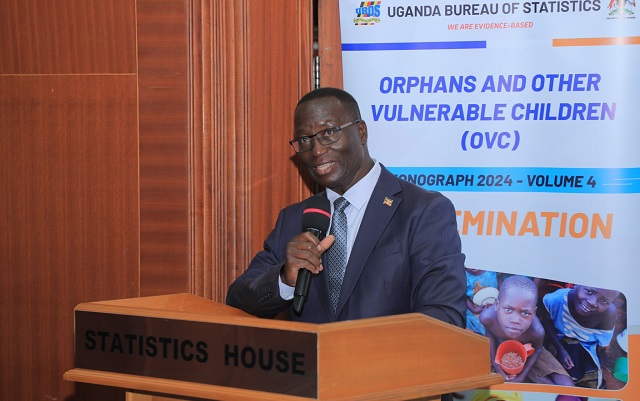
Speaking at the release, Chris N. Mukiza, Executive Director and Chief Statistician at UBOS, framed the monograph as a response to growing demand for more granular, sector-specific data to guide interventions.
“The generation of these monographs is demand-driven and avails sector-specific indicators to close gaps and respond to emerging challenges,” he said.
Mukiza pointed to a range of vulnerabilities captured in the report, including school dropout, early pregnancy, and the persistence of child-headed households, warning that without targeted responses, these risks could deepen.
“The indicators we are disseminating today will equip policymakers and other players, including civil society, with evidence for planning and decision-making,” he added.
The OVC monograph is part of a broader series of census-derived outputs, following earlier releases on sub-regional profiles and disability, with additional reports expected in the coming weeks. Together, they signal a shift toward more data-driven governance.
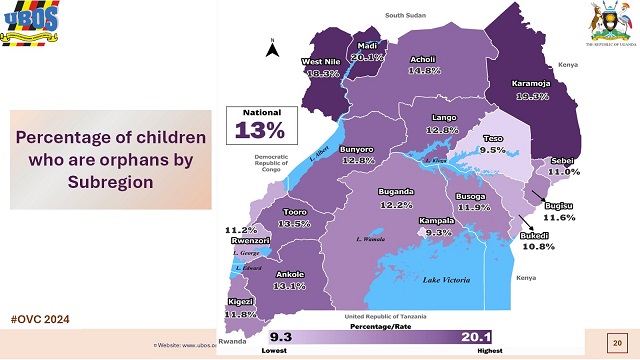
Beyond national averages, the data reveals stark regional inequalities in orphanhood levels. The highest prevalence is recorded in the Madi sub-region at 20.1%, followed by Karamoja at 19.3% and West Nile at 18.3% areas already grappling with poverty and limited access to services. At the other end of the spectrum, Kampala records the lowest orphanhood rate at 9.3%, highlighting the persistent urban–rural divide.
District-level patterns reinforce this uneven burden. Yumbe District stands out with the highest orphanhood rate at 27.3%, while Bududa District, Ntoroko District, and Lwengo District also record elevated levels. Rural areas overall show higher orphanhood rates than urban centres, reinforcing concerns about unequal access to health, education, and social protection services.
The report also highlights a notable demographic pattern: children who have lost only their fathers outnumber those who have lost only their mothers, pointing to gendered differences in mortality and family structure that carry implications for household stability and child welfare.
Education outcomes remain a major concern. The monograph shows that a significant proportion of orphaned children aged three to five have never attended school, with boys slightly more affected than girls. However, the data also reveals that school exclusion extends beyond orphans, indicating broader structural barriers in early childhood education related to access, affordability, and awareness.
Delivering a message on behalf of the UBOS Board, Allen Kabagenyi described the data as a “strategic national asset” essential for aligning Uganda’s development agenda with global commitments.
“Reliable data is not only a technical requirement for policymakers but also a strategic asset that enables informed decisions,” he said, noting that the findings could inform progress on global development priorities, including poverty reduction, education access, and inequality.
For the Ministry of Gender, Labour and Social Development, the monograph arrives at a critical policy moment. Aggrey Kibenge, the ministry’s Permanent Secretary, said Uganda has shifted toward a broader understanding of child vulnerability under the National Child Policy 2020, recognising that all children face some level of risk, even as targeted interventions remain necessary for those most exposed.
“These include street-connected children, orphans, children living with HIV, those in institutional care, refugees, children with disabilities, and child-headed households,” Kibenge said, linking these vulnerabilities to wider socio-economic pressures such as poverty and weak child protection systems.
He added that the government is working to integrate findings from the monograph into a national social registry to improve targeting of services, alongside efforts to strengthen interoperability between data systems, including national identification and parish-level platforms.
The ministry is also exploring a child disability grant to support families raising children with disabilities, an area identified as particularly underserved.
Despite the availability of more detailed data, challenges remain. The issue of street-connected children continues to persist, with many traced back to the Karamoja sub-region, driven by economic hardship and trafficking networks. Rehabilitation and reintegration efforts have had limited long-term success, with many children returning to urban centres.
“We need a more comprehensive strategy that addresses both the push and pull factors,” Kibenge said.
UBOS officials acknowledged the role of partners such as UNICEF in supporting data generation and analysis, and called for continued collaboration to expand statistical systems and improve the quality of indicators.
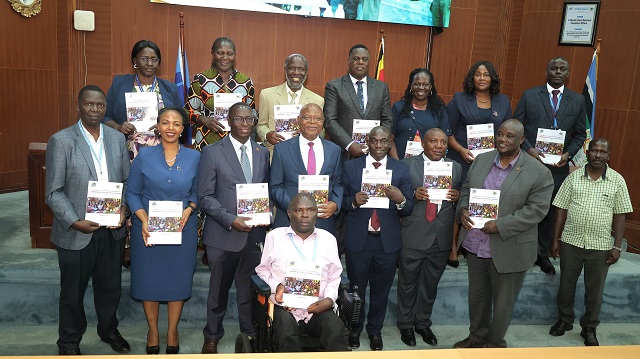
Dr. Moses Sichei, Chief of Social Policy representing UNICEF Uganda, commended UBOS on this milestone, noting that the OVC Monograph provides critical data on who vulnerable children are, how many they are, and where they are located. He emphasized that such data is essential for monitoring commitments under frameworks like the United Nations Convention on the Rights of the Child and for informing effective policy and programming. He reaffirmed UNICEF’s commitment to supporting UBOS in strengthening data production, underscoring that without data, evidence-based policy and interventions for children cannot be achieved.
Mukiza urged stakeholders, including the media, to ensure wider dissemination and application of the findings.
“We remain committed to producing high-quality statistics that support evidence-based planning and decision-making,” he said.