 The Independent Uganda: You get the Truth we Pay the Price


How Museveni’s rallies now reflect a curated campaign era — and what the opposition reveals
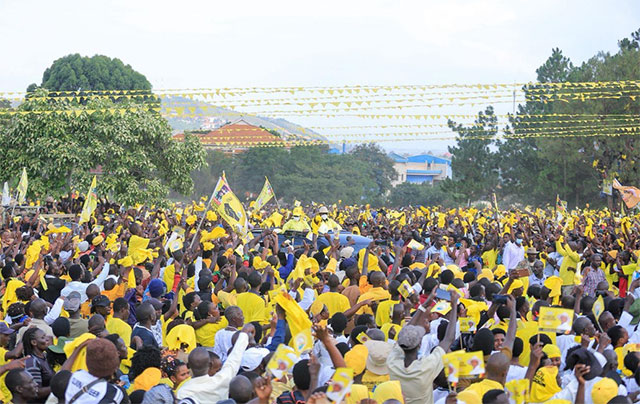
COVER STORY | JULIUS BUSINGE | On the morning of December 1, 2025, a convoy of police trucks wound through the streets of Mbarara, ferrying what appeared to be a sea of supporters toward La Rooftop Lounge. From there, they were set to march to Boma Grounds, the venue for the presidential campaign rally of Uganda’s incumbent, Yoweri Kaguta Museveni, as he canvasses votes ahead of the 2026 general election.
The spectacle was carefully choreographed, a blend of pomp, power, and performance that has increasingly defined the National Resistance Movement’s (NRM) approach to public rallies.
For decades, President Museveni has maintained a grip on Uganda’s political apparatus, but over the past 10 years the ruling party has struggled to sustain the visible enthusiasm of earlier campaigns.
Declining attendance at rallies, particularly in urban centres, has prompted a shift in tactics. What was once spontaneous political fervour is now being supplemented and in many instances, replaced by orchestrated displays of support.
The police truck in Mbarara was emblematic of this evolving strategy, an overt manifestation of state machinery employed not merely for security but for political mobilisation.
State machinery as a political tool
Leaked documents from three district local governments, Adjumani, Kamuli, and Kabale, reveal a systematic effort to marshal civil servants, teachers, and schoolchildren into the service of political theatre.
The letters, framed as “invitations” or directives to “show love,” carry the unmistakable weight of command. They instruct recipients to attend presidential rallies, transforming public servants and pupils alike into a captive audience.
In Adjumani, Chief Administrative Officer Ocean James Andrew authorised all headteachers to mobilise students for a presidential rally at Paridi Stadium on October 20, 2025. The letter, dated October 17, explicitly requested participation in the event to support the president.
Similarly, Kamuli District’s Chief Administrative Officer Muktibi Naissei instructed principals to release both staff and students for a rally at Bupadhengo Primary School on November 20, framing the visit as an opportunity “to show love to our President.”
Kabale District’s mobilisation extended beyond schools; Chief Administrative Officer Murtageki Ronald directed all civil servants to attend a rally at Kigezi Lower Primary School on November 25, stressing attendance “without fail” to hear the president’s message on wealth creation.
Observers note that such state-directed mobilisation blurs the line between governance and partisanship, raising questions about the politicisation of Uganda’s civil service and education system. By deploying public resources, including personnel and institutional infrastructure, the NRM appears to be converting administrative machinery into an instrument of political performance.
Parliamentary uproar
The phenomenon is not new. As early as June 2024, the practice of mobilising schoolchildren and civil servants became a flashpoint in Parliament. The incident in Bukedea District, where hundreds of pupils clad in NRM regalia performed at a rally, drew sharp criticism. John Bosco Ikojo, the MP for Bukedea County, described the deployment of minors as “unacceptable,” highlighting the disruption of education and the inherent safety risks.
Joel Ssenyonyi, the Leader of the Opposition in Parliament, escalated the critique, terming the practice a “systematic and state-sponsored abduction of children’s futures and the hijacking of the impartial civil service.” In his view, the orchestrated rallies constituted more than mere political theatre. They were symptomatic of a deeper corrosion of democratic norms. He was speaking during a parliamentary plenary session on Oct.20.
Justice and Constitutional Affairs Minister Norbert Mao downplayed the issue, framing it as a partisan dispute rather than a genuine ethical breach. Ssenyonyi’s evidence-based challenge was dismissed by Mao as “early campaigning,” a rhetorical manoeuvre that shifted scrutiny from the accused to the accuser.
Deputy Speaker Thomas Tayebwa concluded the discussion by rejecting Mao’s assertion that Ssenyonyi’s concerns were politically motivated. He emphasized the need for immediate action and accountability among civil servants.
“Some of these acts are unnecessary and undermine trust in public institutions…the head of public service must urgently caution civil servants and ensure such conduct does not recur,” Tayebwa said.
Crowd engineering and media choreography
The orchestration extends beyond human mobilisation. Photographic and video coverage of rallies is often tightly controlled, with media personnel instructed to focus exclusively on densely packed sections of supporters. Passersby, including pedestrians and motorists near rally venues, are reportedly held in temporary confinement to maintain an appearance of mass support, only being allowed to proceed once the event concludes.
Meanwhile, opposition supporters, particularly those aligned with Robert Kyagulanyi, widely known as Bobi Wine, are frequently obstructed from attending rallies in numbers sufficient to challenge the state’s narrative.
Kyagulanyi’s campaigns have repeatedly faced state-sponsored blockades in locations such as Arua, Kawempe, Kayunga, Iganga, where one person reportedly died after being hit by a stray bullet, as well as Mbarara, Sheema, Masaka, and other areas.

Despite these obstacles, Kyagulanyi has continued to push into areas he did not reach during the 2021 campaign. For instance, he held events at Kakumiro Town Council, a political stronghold associated with Prime Minister Robinah Nabbanja, and at Bujuni Primary School in Karuguuza Town Council in Kibaale district, linked to Finance Minister Matia Kasaija. At Kakumiro, a police helicopter had been stationed in the middle of the grounds, yet Kyagulanyi pushed through with his supporters, addressed the crowd for some time, and departed.
On many occasions, he has urged followers to proceed to intended venues without fear, telling police and other security personnel not to interfere because, as he puts it, “we have committed no crime.”
However, he is frequently diverted onto remote, dusty routes before reaching his destination or turned back entirely. These challenges underscore the contrasting realities of Uganda’s political theatre. While NRM rallies benefit from orchestrated logistics, opposition figures navigate a landscape fraught with obstacles that limit public visibility and participation.
The Buganda Kingdom Prime Minister Charles Peter Mayiga has since condemned the continued police brutality on supporters of opposition candidate supporters in the ongoing election campaigns.
Premier Mayiga, in a post on his X account urged the security agencies to be nonpartisan as they carry out their work and called for a review of the police ban on processions during the campaigns.
“Once again, I urge police/security agencies to keep law and order in a non-violent and non-partisan manner during this campaign period” he said.
He added, “” It’s unrealistic to ban processions of supporters. Political rallies are not prayer meetings to which worshippers go calmly. Political rallies are about excitement. And with Uganda’s public transport (boda boda) it’s unrealistic to expect supporters to move to campaign venues quietly. Ensure supporters don’t harm others, but let them be”.
Mayiga further urged the security personnel to think about the country’s image as they unleash terror on opposition supporters.
“Bullets; tear gas; dogs…these make the Pearl of Africa bleed,” he said.
Premier Mayiga’s warning comes on a growing condemnation of the police’s actions by a large section of the public, including human rights activists and the Uganda Law Society (ULS).
The ULS Vice President, Anthony Asiimwe, condemned the unleashing of dogs, use of tear gas, violent dispersals and forceful arrests of civilians supporting the National Unity Platform supporters in Kawempe Division in Kampala as a crowd control measure by security forces.
Asiimwe noted that the deployment of police dogs in political rallies today reflects continuity with colonial and apartheid-era practices in which animals are weaponised to instill fear and enforce authoritarian control.
“ULS therefore calls for an immediate and unconditional halt to the use of police dogs in any political rally or campaign. The immediate release of all innocent civilians arrested arbitrarily in Kawempe during the campaign events. Compliance with constitutional policing standards that respect human dignity and uphold the rights of all Ugandans regardless of their political affiliation,” he said.
The opposition’s organic momentum
Interestingly, opposition rallies, those organised by Kyagulanyi’s NUP, Mugisha Muntu’s Alliance for National Transformation, and Nandala Mafabi’s Forum for Democratic Change, are largely characterised by self-mobilisation. Participants attend voluntarily, driven by political conviction rather than directive or coercion.
“I love Bobi,” one supporter chanted during Kyagulanyi’s rally in Kawempe, “He is my President.”
Analysts argue that the genuine enthusiasm observed at opposition events may offer a more accurate barometer of electoral sentiment than the carefully managed displays of support orchestrated by the NRM.
Crowd size, while significant, is not artificially inflated. The energy is grassroots rather than state-fabricated. This distinction is crucial in understanding Uganda’s political dynamics. Whereas NRM rallies reflect institutional might and administrative compliance, opposition gatherings reveal the organic resonance of their political messages, whether advocating for governance reforms, anti-corruption measures, or socio-economic equity.


Historical context of NRM’s incumbency
President Museveni’s tenure, now approaching four decades, has been marked by a blend of popular support, strategic patronage, and, according to critics, state-facilitated electoral manipulation.
Senior NRM officials continue to maintain that their candidate enjoys widespread support and is well-positioned for victory. The party emphasizes that President Yoweri Museveni remains popular among voters nationwide, highlighting the submission of over 2.2 million endorsement signatures to the Electoral Commission ahead of the 2026 elections.
NRM Secretary General Richard Todwong said in September this year, “We are submitting more than two million signatures to the National Electoral Commission to meet the requirements for our chairman and flag bearer’s nomination. These signatures represent confirmed support for the NRM party.” He added that the overwhelming backing underscores public confidence in the party’s track record and future prospects.
One of Museveni’s supporters, Margaret Nakazige, 72, from Kagadi District, told The Independent: “Leave Mzee to rule. He has brought us from far. People used to line up to buy salt, but now it is everywhere.”
But opposition figures have consistently challenged the integrity of electoral processes. In 2021, Museveni officially secured 58.64% of the vote against Kyagulanyi’s 34.83%, prompting allegations of “industrial-scale vote rigging” from the National Unity Platform. Previous contests featuring Dr. Kizza Besigye, including four consecutive presidential elections from 2001 through 2016, also provoked claims of systemic electoral malpractice.
European Union and other international election observers have repeatedly highlighted administrative and logistical deficiencies, noting that the political environment has often been “intimidating for opposition voters.” Within this context, state-backed mobilisation of civil servants and schoolchildren is perceived as part of a continuum of strategies that extend beyond campaign rallies into the mechanics of electoral competition.
The deployment of minors and public servants raises profound ethical questions. Education experts argue that diverting students from classrooms undermines their right to uninterrupted learning, while labour economists point to the diversion of civil servants from official duties as a misappropriation of public resources. Furthermore, legal scholars contend that the use of state machinery for partisan purposes contravenes the principle of a neutral civil service, a cornerstone of democratic governance.
“This is not merely a procedural misstep,” says Dr Angela Kitanwe, a political analyst based in Kampala. “It is a structural distortion of democratic norms, where the lines between state, party, and personal ambition are deliberately blurred.”
Crowd perception versus reality
A striking feature of these state-led mobilisations is the contrast between perception and reality. Streets may appear packed on broadcast footage, yet the voluntary enthusiasm of the general population often remains unmeasured. Political scientists emphasise that artificially inflated displays of support can backfire, creating a disconnect between public perception and on-the-ground sentiment.
Dr. Emmanuel Muwanga, an election observer and researcher at the Centre for Policy Analysis, notes, “When support is manufactured, it risks delegitimising the political process. Citizens can see through orchestrated spectacles, and international observers increasingly recognise these patterns. Perception management is not a substitute for genuine consent.”
As the 2026 general election approaches, Uganda faces a complex interplay of coercion, performance, and political theatre. The letters from Kamuli, Adjumani, and Kabale are emblematic of a wider strategy in which state resources are leveraged to construct a narrative of enduring popularity. Meanwhile, opposition parties continue to cultivate organic support, navigating a political environment that many consider highly skewed.
The unfolding campaign season underscores a fundamental tension in Ugandan democracy: the coexistence of entrenched incumbency with emerging, grassroots opposition energy. In this context, the visual spectacle of state-backed rallies may project power, but it cannot fully account for the political undercurrents coursing through towns, villages, and city streets across the nation.
Uganda’s political theatre is increasingly defined by the intersection of state power and partisan ambition. From police trucks ferrying attendees in Mbarara to official letters mobilising children and civil servants, the NRM’s approach to rally organisation exemplifies a sophisticated, if controversial, blend of coercion and spectacle. At the same time, opposition rallies offer a glimpse of genuine political energy, suggesting that while the machinery of the state may dominate the stage, the pulse of the electorate may yet tell a different story.
The 2026 elections, therefore, promise to be a revealing contest, not merely of policies or personalities, but of how power is displayed, perceived, and ultimately legitimised. For analysts and citizens alike, the theatre of the campaign is as consequential as the ballot, offering insights into both the endurance of incumbency and the resilience of opposition in Uganda’s complex democratic landscape.

Do civil servants vote? They do, although some may not fulfill that civic mandate. Do school children vote? Yes! If they are 18 and above. Should they attend rallies? Why not? It’s an opportunity for learning. How will civil servants determine whom to vote if they don’t attend rallies- or implement programs as per their terms-of-service -without following the politics of the country? What happened in Adjumani, Kabale and Kamuli after the President’s rallies? Was anyone penalised for not attending? Out of 146 districts and cities in the country, how widespread is that “pressure” on those categories of Ugandans when only 3 places are “sampled”?
I started attending rallies when i was 14 even though, obviously, i wasn’t a voter yet and i have always had the tendency to attend rallies even of those that i wouldn’t eventually vote ( I know this is a standard of play that few can muster). I vote will full awareness of my reasons-not pomp or pressure. Nobody will convince me that attending a presidential rally harms anyone’s conscience whether student or civil servant or journalist or cleric or security personnel or cultural leader. I would be willing to attend a presidential rally even if i had to pay for it. Would those children rather be mobilised to go for musical or leisure shows? Priorities!!