 The Independent Uganda: You get the Truth we Pay the Price



With a new dashboard, the Bank of Uganda is finally mapping the billions of dollars sent home by its diaspora
Kampala, Uganda | RONALD MUSOKE | In the early morning hours at Entebbe International Airport, the departure hall often fills with a quiet, nervous energy. Small groups of young Ugandan women and men, some barely out of school, others in their early twenties, wait to board flights bound for cities they have only seen in photos: Amman, Doha, Dubai, Manama, Muscat, Riyadh.
For many, it is their first time on a plane, their first time leaving home, and their first encounter with cultures vastly different from their own. Clutching the sky-blue Ugandan passports and neatly arranged documents, they make final phone calls to parents and siblings, exchanging reassurances and promises to stay in touch.
They are part of a growing wave of Ugandan labour migration to the Middle East, where thousands, many of them women, take up domestic and service jobs in search of better pay. The work can be demanding and the transition difficult, but the intention is clear: to earn and send money home.
Those transfers, sent in small but steady amounts, have become a financial lifeline for families across Uganda. The remittance goes into payment of school fees, covering hospital bills, and sustaining households in both rural and urban communities. For years, however, much of this flow has remained only partially visible, tracked through estimates rather than precise data. That is beginning to change.
Remittances dashboard
On April 1, the Bank of Uganda, in collaboration with the UN’s International Fund for Agricultural Development (IFAD), launched a new interactive remittance dashboard that offers the most detailed picture yet of how money moves between Ugandans abroad and their families at home. By capturing transaction-level data across financial institutions, the platform marks a shift from approximation to precision in understanding one of the country’s most important economic flows.
The numbers emerging from this new system are striking. Uganda received an estimated US$2.5 billion (Approx. Shs 9.3 trillion) in remittances in 2025, equivalent to about 3.8% of the country’s Gross Domestic Product (GDP). This figure is significantly higher than previous estimates, which had placed annual inflows closer to US$1.5 billion.
For Augustus Nuwagaba, the deputy governor of the central bank, the revised figure reflects not a sudden surge in remittances but a clearer understanding of what has long existed. “This tool has already helped us capture an additional US$1 billion in remittances,” he said at the launch in Kampala.
“It is not simply a larger number; it is more accurate because it includes information on where the remittances come from, how they are sent, and what they are used for. That distinction matters enormously for policymaking.”
Remittances central to Uganda’s economic stability
The implication is profound. Remittances are no longer a peripheral financial flow; they are central to Uganda’s economic stability.
Prof. Nuwagaba described them as a “lifeline”, noting that they represent the sacrifices of Ugandans working abroad and have proved to be a reliable source of foreign exchange, competing with traditional earners such as coffee and tourism.
The new dashboard offers a level of detail that has rarely been publicly available. It tracks not just the total volume of remittances, but also the number of transactions, their average size, the countries they originate from, and the channels through which they are sent and received. It even maps how these flows are distributed across Uganda’s districts and provides insights into the profiles of senders and recipients.
In 2025 alone, more than 16 million remittance transactions were recorded, with an average value of US$152. The overwhelming majority of these transfers were relatively small, with over 93% falling below US$499. This pattern underscores the everyday nature of remittances. They are not large, infrequent investments but regular contributions that sustain daily life.
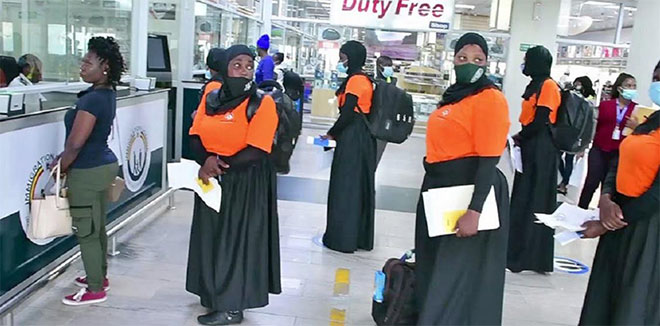
The data also reflects the changing geography of migration. The United States remains the largest source of remittances to Uganda, accounting for US$702 million, or 28% of total inflows. It is followed by Saudi Arabia, the United Kingdom, the United Arab Emirates, and Canada. The prominence of Middle Eastern countries highlights the growing importance of labour migration to the Gulf, where many Ugandans, including the young women departing from Entebbe, are seeking opportunities.
Uganda, however, is not only a recipient of remittances. In 2025, the country recorded outflows totalling US$402 million, with funds sent primarily to India, Kenya, the United States, the United Kingdom, and Canada. This reflects Uganda’s position as both a source and destination of migration, hosting foreign workers and refugees who also send money abroad.
Digital financial channels
One of the most significant shifts captured by the dashboard is the rise of digital channels. Nearly three-quarters of remittances are now received digitally, with mobile money accounting for the largest share. This trend builds on Uganda’s rapid expansion of mobile financial services, which has helped raise financial inclusion levels to among the highest in the region.
Yet the transition to digital systems is far from complete. A significant portion of remittances is still received in cash, and barriers such as limited financial literacy, lack of trust in digital platforms, and uneven access to infrastructure continue to slow adoption, particularly in rural areas.
This rural-urban divide remains a defining feature of Uganda’s remittance landscape. Although the majority of the population lives in rural areas, most remittance transactions are completed in urban centres, where financial service providers are concentrated. As a result, many rural households still depend on intermediaries or must travel long distances to access funds.
The persistence of informal channels adds another layer of complexity. Despite the growth of formal financial services, a portion of remittances continues to flow through unofficial means, including transfers via friends, traders, and unlicensed operators. These channels often emerge as a response to high costs and limited access, even though they lack transparency and security.
Indeed, the cost of sending remittances to Uganda remains among the highest globally. On average, transferring US$200 can cost around 11% of the transaction value, well above the global average. For many migrants sending small amounts, these fees represent a significant burden and can influence how money is sent.
More than a dashboard
By making detailed data publicly available, the new dashboard is expected to support efforts to address these challenges. It provides regulators, policymakers, and private sector actors with the information needed to better understand market dynamics, identify inefficiencies, and design financial products that respond to the needs of migrants and their families.
For Mohamed El-Ghazaly, IFAD’s Country Director in Uganda, the initiative is about more than data. “By transforming high-quality remittance data into actionable insights, this initiative strengthens the foundation for inclusive, evidence-based policymaking while catalyzing private sector innovation,” he said.
The dashboard is part of a broader push to strengthen Uganda’s remittance ecosystem under IFAD’s Platform for Remittances, Investments and Migrants’ Entrepreneurship in Africa (PRIME) programme, which is implemented in partnership with financial institutions such as Stanbic Bank Uganda.
One such initiative involves the use of digital wallets designed to simplify access for unbanked and underbanked populations. By lowering entry barriers and integrating cross-border transfers into mobile platforms, these solutions aim to reduce costs and bring more users into the formal financial system. These efforts aim to reduce transaction costs, expand digital access, and improve financial literacy, particularly in rural areas.
At the policy level, the initiative also builds on the work of the National Remittance Stakeholder Network, which brings together regulators, financial institutions, and development partners to coordinate reforms. By aligning data, policy, and innovation, stakeholders hope to unlock the full development potential of remittances.
The platform itself was developed in response to gaps identified through this collaborative process, particularly the need for more reliable and comprehensive data. The introduction of transaction-level reporting marks a significant evolution in how remittances are measured in Uganda. By complementing traditional survey methods with administrative data collected directly from service providers, the new system captures flows that were previously overlooked. This not only improves accuracy but also provides a more nuanced understanding of remittance behaviour.
Yet while the dashboard offers a clearer picture, it also highlights the complexity of the challenges ahead. Expanding digital adoption will require continued investment in infrastructure, education, and trust-building. Reducing transaction costs will depend on fostering competition and improving the efficiency of payment systems. Bridging the rural-urban divide will require targeted efforts to extend financial services to underserved areas.
Back at Entebbe, as flights depart into the early morning sky, the journeys of those young women continue to shape this story in ways that statistics alone cannot capture. Each transfer they send is a thread in a vast, complex network of financial support that stretches across borders and generations. For Uganda, the challenge now is to ensure that this flow of money, hard-earned and faithfully sent, moves through systems that are efficient, affordable, and inclusive. With better data finally in hand, the country is closer to understanding not just how much is being sent but what it truly means.


