The Independent Uganda: You get the Truth we Pay the Price


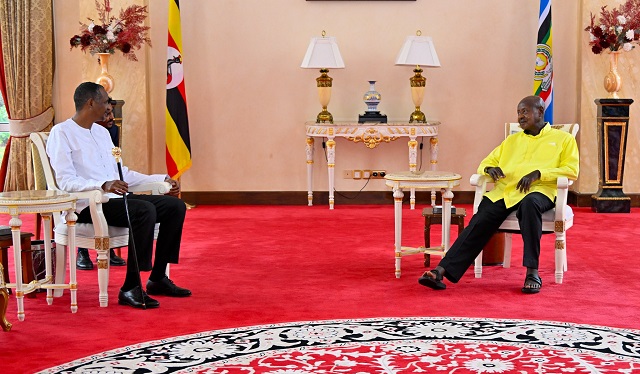
Kampala, Uganda | THE INDEPENDENT | President Yoweri Kaguta Museveni on Friday hosted Sudan’s Rapid Support Forces (RSF) commander, Gen. Mohamed Hamdan Dagalo, at State House Entebbe, in a high-stakes diplomatic engagement aimed at exploring pathways to end Sudan’s devastating civil war.
The meeting comes nearly three years after conflict erupted in April 2023 between Sudan’s national army, the Sudan Armed Forces (SAF) led by Gen. Abdel Fattah al-Burhan, and the RSF, commanded by Dagalo, widely known as Hemedti. What began as a power struggle in Khartoum has spiraled into one of the world’s worst humanitarian crises.
According to United Nations estimates, more than 8 million people have been displaced internally and across borders since the fighting began, with neighbouring countries including Chad, South Sudan, Egypt and Ethiopia absorbing large refugee flows. Health facilities have collapsed in several regions, food insecurity has deepened, and large parts of Khartoum and Darfur have been devastated by urban warfare.
The conflict has also disrupted Red Sea trade routes and heightened instability in the Horn of Africa, a region already grappling with insurgencies, fragile political transitions and economic shocks.
Against this backdrop, Museveni used the Entebbe meeting to reiterate his long-standing view that sustainable peace in Sudan can only be achieved through inclusive dialogue rather than military victory.
“When I last came to Sudan, I met President Bashir and advised against the politics of identity instead of the politics of interest,” Museveni said, referring to former Sudanese leader Omar al-Bashir, who was ousted in 2019 after three decades in power.
“Identity politics is poisonous. It does not yield good results. What is important are shared interests that unite people,” Museveni added, urging Sudan’s rival factions to embrace negotiations.
Uganda has consistently positioned itself as a proponent of “African solutions to African problems,” advocating mediation through continental and regional mechanisms such as the African Union and the Intergovernmental Authority on Development (IGAD).
While Kampala has not formally announced a mediation initiative, diplomatic analysts say hosting Gen. Dagalo signals Uganda’s intention to remain actively engaged in shaping outcomes in Sudan.
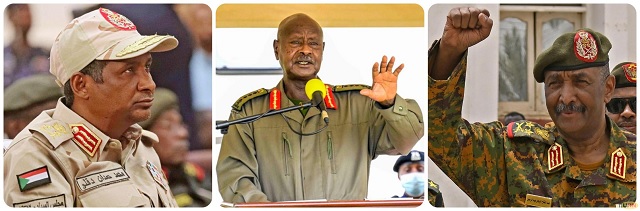
Sudan is a key geopolitical player in East and Central Africa. Prolonged instability risks spillover effects, including arms proliferation and cross-border insecurity, concerns that directly affect Uganda’s strategic interests.
“Sudan’s stability is important for the entire region,” Henery Okello Oryem , State Minister for Foreign Affairs said. “What happens in Khartoum does not stay in Khartoum.”
For Dagalo, the Entebbe visit forms part of a broader diplomatic outreach as both warring factions seek international recognition and leverage.
The RSF leader thanked Museveni for his hospitality and described him as “a wise man of Africa,” adding: “Your victory is not only a gain for Ugandans but for the whole continent. We truly believe in your principles and your commitment to peace.”
Gen. Dagalo acknowledged Sudan’s deepening humanitarian and institutional crises, stressing the need for a peaceful resolution. He also expressed interest in strengthening bilateral cooperation with Uganda, particularly in trade, education and regional integration.
Analysts note that Sudan historically served as an important trade corridor linking East Africa to North Africa and the Middle East. Prolonged war has severely disrupted these economic linkages.
Museveni’s engagement with the RSF leader may draw scrutiny from some quarters, given allegations of human rights abuses against various actors in the Sudan conflict. However, Ugandan officials frame the meeting as part of broader efforts to encourage dialogue among all parties.
Observers argue that durable peace in Sudan will likely require negotiations that include both the SAF and RSF leadership, alongside civilian actors who were sidelined when fighting erupted.
“The solution will not come from the battlefield alone,” Museveni said, underscoring the need to “prioritize peace over military confrontation.”
Despite multiple ceasefire attempts brokered by regional and international actors, fighting has continued intermittently, with neither side securing decisive control. The risk of Sudan fragmenting further along ethnic and regional lines remains high.
As war fatigue deepens and humanitarian costs mount, diplomatic engagement by regional leaders such as Museveni could play a role in reviving stalled peace efforts, though analysts caution that entrenched mistrust between Sudan’s rival generals remains a formidable obstacle.
****
URN