The Independent Uganda: You get the Truth we Pay the Price


COMMENT | NNANDA KIZITO SSERUWAGI | If you want to understand the quality of life lived by the people of any country, the measure, or most widely used standard, is the Human Development Index (HDI). It is published annually by the United Nations Development Program (UNDP), ranking nearly all countries. This makes it the go-to tool if one intends to discuss development issues.
The HDI tool was developed in 1990 by a Pakistani economist, Mahbub ul Haq, then serving as the UNDP Administrator, William Draper’s Special Adviser. Haq was highly critical of the GDP/GNP per capita metrics, which dominated the development thinking of the 1980s. His key contribution was in leading the argument against the narrow focus that such metrics had, yet they informed World Bank reports and influenced global policies on development. According to Haq, focusing on national income growth while ignoring how people’s conditions in terms of health, education, and standard of living were impacted was too narrow. There was need to de-center national income from development economics discourse, and bring people to the fore. In fact, UNDP’s HDI 1990 report opened with the line: “People are the wealth of nations.”
Whereas alternative development measures have emerged since 1990, these have largely been developed to complement rather than substitute for the HDI standard. Therefore, I am not blind to the significance of such indicators of human wellness as the World Happiness Report, the Numbeo Quality of Life Index, the OECD Better Life Index, the Inequality-adjusted HDI, and the Social Progress Index.
That said, my focus for this opinion piece is to assess the performance of President Museveni’s government on the improvement of the quality of life for Ugandans. To make a fairer assessment, I think we should compare Museveni’s performance against his sub-Saharan African peers in multiple categories that account for similar contexts. Sub-Saharan African countries make for a good comparison group because they share similarities with Uganda in factors that need to be controlled for a fair assessment, including initial conditions or circumstances that existed at the start of our development process, geography, history and structural challenges.
The HDI measures three key dimensions of human wellness. Firstly, health: the life expectancy at birth of the population of a country. Secondly, education: the mean years of schooling and expected years of schooling. Lastly, standard of living: the Gross National Income (GNI) as adjusted for purchasing power parity (PPP).
The earliest consistent data available on Uganda’s own historical progress in human development dates back to 1980. Benchmarking with this data would help us isolate the key contributions or failures of Museveni in health, education or income. Based on the most recent data of 2023, Uganda’s HDI increased by an average annual growth of 1.62% from 0.342 in 1990 to 0.582 in 2023. This has seen the country rise from the low to the medium human development category.
Haq designed the measurement of HDI using a simple score (from 0 to 1), showing how countries perform in providing a good life for their citizens. Each of the three scores we highlighted above, i.e., health, education and standard of living, are given a mini-score between 0 and 1. Then the three mini-scores are multiplied and averaged technically to get a final HDI number between 0 and 1. A country can be designated higher or lower in human development based on how high it scores between 0 and 1. In this categorisation, very high human development is ranked at 0.800 and above; high development is between 0.700 – 0.799, Medium is 0.550-0.699, and low is below 0.550. Uganda’s 2023 HDI score of 0.582 means that our country is in the medium human development range, or that an ordinary Ugandan generally lives a fairly good overall quality of life.
If we compare Uganda with the regional average in sub-Saharan Africa, where we share regional traits with multiple countries in terms of factors like tropical diseases, infrastructure gaps, governance challenges, colonial legacies, economic dependencies, etc., we find that Uganda outperforms most countries. The rate of HDI growth in Uganda is higher than the sub-Saharan Africa average, which 1.03%, whereas Uganda’s is 1.62%. When we come even closer home to East Africa, Uganda still performs better than most of her peers, only beaten by Kenya, whose score is 0.628.
To get more specific with categories of human development, let’s start with education. Access to education was broadened when the government introduced universal primary education in 1997. Whereas this initiative was not unique to Uganda, Museveni championed it radically. As such, even when adjusted to the rate of population growth, Uganda still performs better as one of the countries with the highest primary school enrolments in the region. The number of children enrolled in primary schools grew from 2.5 million in 1997 to 9.52 million today. The number of teachers recruited has also increased from 84,825 in 1997 to 147,176 in 2025.
According to the World Bank and UNESCO Institute for Statistics, the average adult literacy rate in sub-Saharan Africa is 68-69%. Uganda still performs above this average, with our national literacy rate standing at 74%. This increase grew from as low as 43% in 1986. Access to higher education has also increased, with student enrolment growing from 4000 in 1986 to 220,800 in 2025. The number of universities has also increased from just Makerere University in 1986 to 78 universities today. Whereas this may seem to be a big number, note that countries like Japan have over 800 universities, which is a big number even when adjusted to its population. Therefore, we should not limit the expansion of knowledge production by unreasonably inhibiting the number of higher institutions of learning.
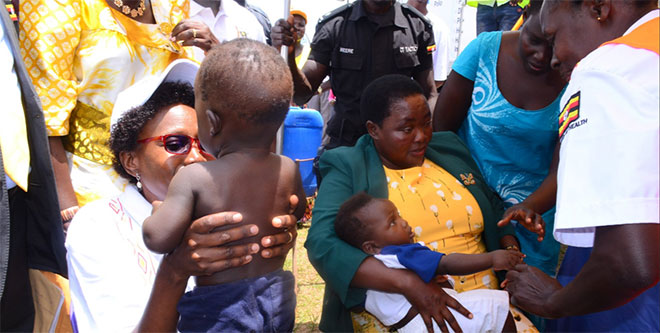
On health, Uganda’s life expectancy at birth has risen from 44 years in 1986 to 68 years today. This is much higher than the average life expectancy at birth in Sub-Saharan Africa, which stands at approximately 62.6 years. We are also closing in on the global average of 73 years. Immunisation coverage has increased from 30% in 1986 to 95% today, and the remaining 5% is on account of the parents who, for some reason, refuse to take their children for immunisation. Additionally, the number of mothers delivering at health facilities has increased to over 80% from 37% in 2001. The overall maternal mortality ratio has reduced to 189 per 100,000 live births from 336 per 100,000 live births in 2015; the infant mortality rate has reduced to 28 per 1,000 live births in 2024, from 122 per 1,000 live births in 1986. Malaria incidence has also reduced to 230 per 1,000 people from 302 per 1,000 people over the past five years.
Uganda has also exhibited strong performance in the standard of living as compared to its regional peers. The standard of living is measured based on a country’s GNP per capita. Uganda’s GNP has increased by about 158% since 1990, making the country rank above the sub-Saharan average. Indeed, it is this income growth that has helped in pulling our overall HDI upward, often outperforming gains in health or education in relative terms.
An overall assessment of Uganda’s human development record under President Museveni would show significant improvements since he took power. According to Worldometer, the HDI has almost doubled since 1980, increasing from 0.293 in 1980 to 0.582 in 2023. Our country has also recently moved from the “low human development” to the “medium human development” category. Life expectancy, mean years of schooling, and expected years of schooling have also significantly increased. In terms of economic growth, our GDP grew at an average rate of 7.1% annually from 1992 to 2011, well above the Sub-Saharan average (between 3.5-5%). That notwithstanding, there is still road to travel to achieve or even surpass the global average HDI scores.
****
 The writer is a Ugandan thinking about Uganda.