The Independent Uganda: You get the Truth we Pay the Price


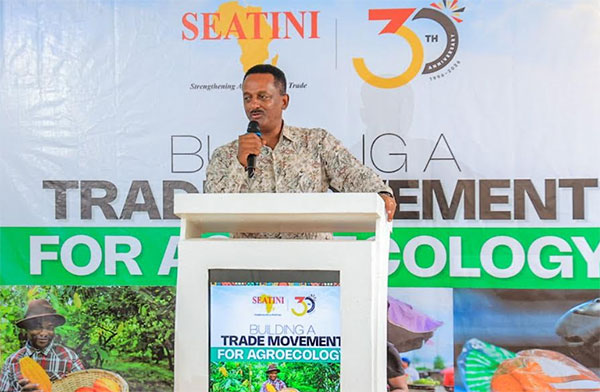
presents his paper on cross-border trade in agroecological products in the East African
Community during the workshop in Kampala on March 19. COURTESY PHOTO/SEATINI.
Smallholders are already saving soils, biodiversity, and communities; they just need the market to notice
Kampala, Uganda | RONALD MUSOKE | In global markets, value often depends on visibility. Coffee is graded; organic produce is certified and fair trade comes with a label. Yet agroecological products; grown with care for ecosystems, biodiversity, and human health often leave the farm as unrecognized commodities, invisible to the markets they deserve to thrive in.
At a recent consultative workshop convened in Kampala by the Southern and Eastern Africa Trade and Information Negotiations Institute (SEATINI), a Kampala-based trade policy thinktank; farmers, policy makers, trade officials, and advocates from the East African Community discussed over two days, how to identify, certify, verify, and trade agroecological products in the regional bloc. The goal was not abstract—it was about putting value back into the hands of those who cultivate the region’s soils sustainably, while creating mechanisms to access national, regional, and global markets.
From farm to market: The missing link
Jane Nalunga, SEATINI’s Executive Director, framed the discussion with honesty. “If we are to make agroecology sustainable, the farmer has to be able to make a profit,” she said. “If we don’t put money in the pockets of the farmers, we are exploiting them.” Her words resonated throughout the Esella Country Hotel conference hall, emphasizing that the ecological practices of farmers; from soil restoration to biodiversity preservation, cannot be separated from economic realities.
Nalunga explained that while East African farmers are already producing agroecological products, the challenge lies in making them tradable. The East African Community, the tripartite EAC-COMESA-SADC arrangement, the African Continental Free Trade Area (AfCFTA), and even markets like the European Union and China represent enormous opportunities, but only if products can be formally identified and certified, she said. “Whenever you say this is an agroecological product, somebody will ask: have you verified it? How do I trace it? Am I sure?” she asked, stressing the need for a regional mechanism of recognition and traceability.
Richard Okot Okello, the Assistant Commissioner of External Trade at Uganda’s Ministry of Trade, Industry and Cooperatives, reinforced the economic urgency. With Uganda’s Vision 2040 aiming to grow the economy from US$50 billion to US$500 billion within 15 years, diversification of agricultural exports is vital. Agroecological products, he argued, present a unique niche. Yet, entering emerging markets like Malaysia, Pakistan, Indonesia, and the Middle East requires standards that go beyond conventional expectations—standards that may even incorporate Halal certification, accreditation which proves that products have been passed to be compliant with Islamic dietary laws. “We need drastic, radical changes,” he said. “It’s about incorporating the agricultural agroecological practices into what we are doing now and ensuring our products are unique in branding and packaging.”
Herbert Kafeero, the Deputy Executive Director of SEATINI, added a social and ecological lens to the discussion. “Agroecology speaks to a people-centred, nature-based approach that works with ecological processes rather than controlling them,” he said. Kafeero highlighted that while East Africa’s smallholder farmers are already practicing agroecology, their efforts rarely translate into market value. “The production is expanding, but the growth is not reflected in the markets,” he explained. “Policy must translate diversity into market-recognized value.”
The barriers, he argued, are systemic and often include; fragmented production, inconsistent certification, weak integration into formal markets, and a lack of harmonized standards across countries. Without a framework for identification, recognition, and verification, agroecological products risk remaining invisible, their social and environmental contributions uncompensated.
Building trust and standards: Learning from organic movements
Trust, as several experts pointed out, is the currency of agroecological markets. Chariton Namuwoza, the CEO of the National Organic Movement of Uganda (NOGAMU) and President of the African Organic Network, explained that simply declaring a product “agroecological” is insufficient. Consumers demand proof. “It starts in the market. They are demanding safe, healthy, nutritious, environmentally friendly products. But how do they trust that what you’re talking about is truly organic or agroecological?”
For over two decades, Namuwoza has worked to link African farmers to global organic markets. He highlighted that the East African Organic Product Standard, established in 2007, and its Kilimohai Mark have already provided mechanisms for certifying organic products in the region. The next evolution, he said, is the Blue Kilimohai Mark, piloted in Murang’a County, Kenya, which aims to extend certification to agroecological practices specifically.
“The Blue Mark is meant to facilitate a process of peer reviewing, checking that this farmer has complied with the principles of agroecology,” he explained. The system is designed not only to instill consumer trust but also to reward farmers for positive environmental impact and social responsibility.
Edward Mukiibi, the Team Leader at Slow Food Uganda, reminded participants that markets are more than economic spaces; they are expressions of social and environmental priorities. Agroecology, he said, is a tool for building local economies and hyper-local markets. “The organic movement is not only about markets, but social reconstruction, focusing on biodiversity,” he emphasized. He encouraged participants to see agroecology as a mechanism to address non-economic concerns, including nutrition, health, and social cohesion.
Mukiibi also stressed the importance of harmonizing regional standards before aiming for global certification. “A safe product in Uganda is not necessarily considered safe in South Sudan. We must first harmonize the standards we already have before attempting a common regional standard,” he said. This harmonization, he argued, is critical for scaling agroecological products from informal local markets to structured national, regional, and continental trade systems.
Policy, law, and the regional architecture
Legislation and policy frameworks emerged as central themes during the workshop. Gideon Gatpan, the Chairperson of the Agriculture, Tourism and Natural Resources Committee in the East African Legislative Assembly (EALA), emphasized the importance of political consensus and alignment among stakeholders. “Policy makers are driven by the demand of the public. A public that does not understand its own needs cannot properly influence policy,” he said.
Gatpan described a blended approach: grassroots awareness, top-level policy design, and a regional legislative umbrella to synchronize efforts across member states. Harmonizing national legislation is essential, he argued, to eliminate unnecessary barriers and ensure that agroecological products can move seamlessly within the EAC bloc. “We need something that binds us together, something that governs our actions as a region,” he said.
Francine Rutazana, the Chairperson of the Communication, Trade, and Investment Committee in EALA, reinforced the legislative perspective. She emphasized that the Assembly is prepared to support both policy and oversight functions to enable agroecological trade. With resolutions already endorsed and tabled by the Council of Ministers, Rutazana said, the path toward integration and enforcement is open. “We are here to continue seeing where gaps exist and what should be the role of legislation so we can fill them,” she said, highlighting the collaborative role of legislative bodies in supporting on-the-ground practices.
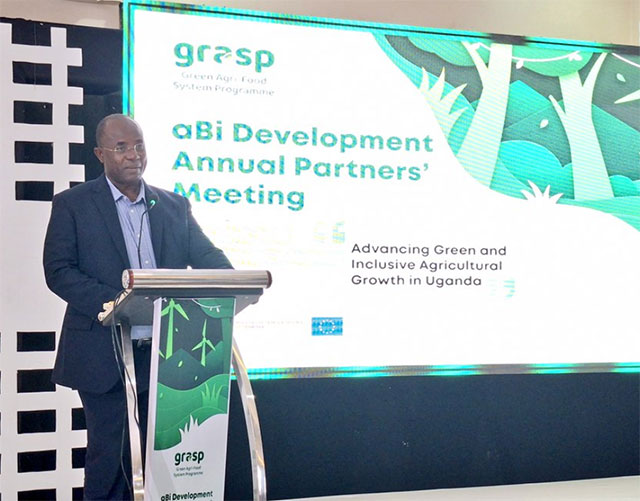
Uganda’s Minister of State for Agriculture, Fred Bwino Kyakulaga, provided the executive view. He argued that a harmonized regional mechanism must focus on five pillars: visibility, recognition, certification, verification, and trade facilitation. “It’s about health, environment, dignity, sustainability, and long life,” he said, summarizing the broader social and ecological rationale behind the initiative. He emphasized that agroecology is not merely a production system; it is a holistic approach that integrates ecological, social, and economic dimensions.
“Agriculture remains the backbone of our economies across the East African region, whereby millions of households depend on farming not only for food security but also for income and livelihoods,” he noted in a speech read for him by Sande Bob George, the Focal Person for organic agriculture and agroecology in Uganda’s Ministry of Agriculture, Animal Industry and Fisheries.
Minister Kyakulaga added: “As we face the growing challenge of climate change, soil degradation, biodiversity loss and food system vulnerabilities, it is clear that we need to transition towards a more sustainable and resilient agricultural food system by embracing more environmentally friendly farming systems so as we are able to meet the food, feed and fibre needs of the current generation and future generation.”
“Agroecology provides that pathway. It is not merely a farming system but a holistic approach that integrates ecological principles into agricultural production while respecting social, cultural and economic dimensions.”
Markets, visibility, and the path forward
The workshop repeatedly returned to one core point: the market rewards visibility. Agroecological practices may be widespread, but without identification, certification, and traceability, their value is lost. Jane Nalunga highlighted that a product properly identified and verified as agroecological can command a premium price. “They (small holder farmers) put in a lot to protect our soils, to protect the environment. That should come out in the price they are getting,” she said.
Edward Mukiibi of Slow Food extended the argument to social markets, noting that agroecology is not just about food. “There are agroecology markets beyond food and feed: knowledge sharing, farm visits, inputs, services, technology, research, and development,” he said. For example, agritourism—where visitors pay to observe sustainable farming in action—provides an additional revenue stream that benefits farmers and builds public awareness.
Herbert Kafeero of SEATINI added that agroecology addresses both local and global vulnerabilities. “Communities are at the brink of the climate crisis, yet agroecology is a response. It also builds resilience against global shocks like the Russia-Ukraine war,” he said. Reducing dependence on external inputs like fertilizers is not just environmentally sensible; it is economically strategic.
Chariton Namuwoza of NOGAMU tied trust to trade readiness. “It is not enough to tell people my product is agroecological. It must speak to their needs. And there must be a way to prove it.” By leveraging existing structures like the East African Organic Product Standard and piloting initiatives like the Blue Kilimohai Mark, the region has an opportunity to move from fragmented, informal trade to structured, recognized markets.
Across all voices, a common theme emerged: for agroecology to thrive, collaboration is essential. In Uganda, the ministries of agriculture, trade, and Uganda National Bureau of Standards (UNBS); customs, farmer organizations; civil society groups; and regional legislative bodies must converge to create a harmonized framework that bridges the gap from practice to market.
SEATINI’s Jane Nalunga concluded with both urgency and optimism: “Putting a mechanism in place is a journey, not a walkover. But if we are consistent, we can work it out. There are so many opportunities, not just regionally but globally. Agroecology is already happening—our farmers are doing it. Now it’s time for recognition, certification, and trade.”
As the two-day workshop drew to a close, it was clear that agroecological products in East Africa occupy a unique position; they are at the intersection of environmental stewardship, social responsibility, and economic opportunity. The challenge lies not in production but in visibility, standardization, trust, and market integration. For a product to command value, it must first be seen.
In an era of climate uncertainty, escalating food insecurity, and global market shifts, East Africa has a chance to set a precedent. By formalizing recognition, certification, and trade mechanisms for agroecological products, the region can reward its farmers, protect its ecosystems, and create resilient food systems that are both local and globally competitive. The path ahead requires patience, political will, and collaboration across multiple layers of society. But for the farmers tending the soils, nurturing biodiversity, and feeding communities, recognition is not merely a policy goal—it is the currency they deserve, finally reflecting the value they already create.