The Independent Uganda: You get the Truth we Pay the Price


Good news for Ugandan lobbyists who fear loss of EU market
COVER STORY | RONALD MUSOKE | On Sept. 23, the European Commission quietly sent a letter that set off ripples across global trade, agriculture, and environmental advocacy circles. In it, Environment Commissioner, Jessika Roswall, admitted that a proposed law banning imports of agricultural products from deforested land and their derivatives planned for December 2025 has to be postponed, again.
Affected products include commodities like coffee, cocoa, palm oil, beef, soy, rubber, and timber along with their derivative including; leather, chocolate, and other products. These are mainly tropical commodities linked to forest destruction from the Amazon in South America to the Congo Basin in Africa. Smallholder farmers and export traders in countries like Uganda are expected to comply.
The proposed postponement of roll-out of the EU’s flagship Deforestation Regulation (EUDR) is the second. On October 2, 2024, the Commission adopted a proposal for a delay of one‑year which moved the implementation and enforcement date December 30, 2025.
The admission of likely second postponement of roll-out of the EUDR is what many in Brussels had long suspected but few wanted to say out loud: the reason, this time, might not be politics or diplomacy, but something as mundane yet as serious as IT challenges.
According to Roswall, the Commission’s digital platform, designed to process the due diligence statements for every bag of coffee, slab of beef, or shipment of timber destined for the European supermarket shelves and warehouses, was buckling under the sheer weight of what it was meant to handle.
“The implementation of the EUDR requires the availability of an information system (henceforth “the IT system”), to be developed, managed and maintained by the Commission,” Roswall’s letter addressed to Antonio Decaro, the Chair of the European Parliament’s environment committee reads in part. “This IT system must be able to handle all the transactions for products covered by the EUDR and initiated by economic operators in the scope of the EUDR, both upstream and downstream, inside and outside the EU.”
She noted that over the last year, the Commission has been deploying the IT system in close contact with stakeholders. “In this context, new projections on the number of expected operations and interactions between economic operators and the IT system has led to a substantial upward reassessment of the projected load on the IT system,” she said.
Besides projections of the number of transactions increasing “substantially,” small consignments, customs cross-checks, and downstream operator obligations have also threatened to slow the system to a crawl.
Another postponement?
Companies might not even be able to register as operators or file their legally required statements, a glitch that could paralyze trade and undermine the very law designed to clean it up. Her proposed fix? Another postponement of 12 months. “If we go live as planned,” Roswall warned, “we risk repeated and long-lasting disruptions.”
“The Commission is considering a postponement of the entry into application of the EUDR, currently foreseen for 30 December 2025, for one year, in order to avoid uncertainty for authorities and operational difficulties for stakeholders in the EU and third countries, and to allow time to remedy the identified risks,” she noted.

For Brussels, this was a technocratic announcement about servers, capacity, and digital bottlenecks. But outside Europe, the implications reverberated much further. In Africa, where farmers, traders, and civil society groups have spent months warning that the EUDR could become a barrier rather than a bridge, the delay was confirmation of something deeper: if the EU itself is struggling with the law’s complexity, how can it expect smallholder farmers in Uganda, Malawi or Ghana to comply without massive support?
What the EUDR is all about
The law itself is ambitious. Passed in June 2023 after years of debate, the European Union Deforestation Regulation (EUDR) bans imports of commodities like palm oil, beef, soy, cocoa, coffee, rubber, and timber along with their derivative including; leather, chocolate, and other products, if they were produced on deforested land or in violation of local laws after 2020.
The aim is simple: stop Europe’s consumption from driving deforestation abroad. The EU is the world’s second-largest consumer market, and its appetite for tropical commodities has long been linked to forest destruction from the Amazon in South America to the Congo Basin. The regulation is meant to put the bloc at the forefront of “deforestation-free” trade, a bold plank of its wider “Green Deal.” But, it now appears, ambition is one thing and implementation is another.
‘Every delay costs forests’
For conservation groups, the delay is a disaster. “Yet again, the Commission is sacrificing the world’s forests to appease industry laggards,” said Sam Lawson, the Director of the UK-based watchdog Earthsight.
Businesses, Lawson argues, have had years to prepare. “Some multinationals have already promised to purge deforestation from their supply chains. Pushing the deadline back not only rewards those dragging their feet but risks watering down the law entirely.”
“The European People’s Party has already said it will use this opportunity to weaken the law,” Lawson warned. “Every second of delay means more forest lost to satisfy European consumption.” Earthsight even put numbers to it: a one-year delay, they estimate, could lead to carbon emissions equivalent to 18 million cars.
For activists like Lawson, this is a question of urgency and political will. Forests around the world are disappearing; the climate clock is ticking and IT glitches are not an excuse. But in African capitals and farming villages, the picture looks different.
Uganda at the front line
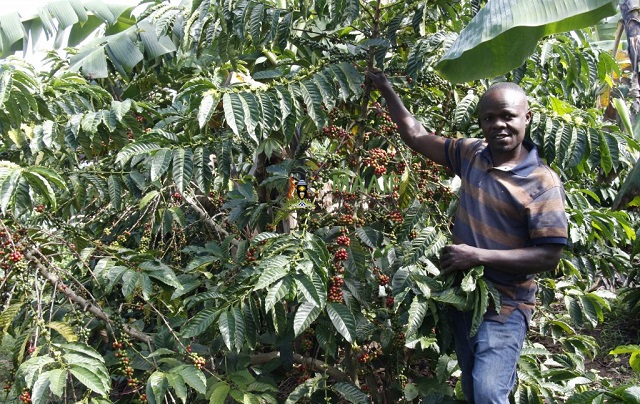
Few countries illustrate the stakes better than Uganda. Coffee is the country’s leading agricultural export, bringing in more than US$2 billion in a period spanning one year (May 2024-June 2025), according to records from the Ministry of Agriculture, Animal Industry and Fisheries. Most of the sold 7.43 million bags weighing 60kg each ended up in Europe signifying the importance of the European market to the average Ugandan coffee farmer.
Over 12 million Ugandans depend directly or indirectly on coffee farming. When the EUDR says that every shipment of coffee beans must be traceable to plots not linked to deforestation after 2020, it’s not just a Brussels regulation — it’s a matter of livelihoods.
That was the backdrop for a major conference at Speke Resort Munyonyo, Kampala, in May 2025. Organised under the Team Europe Initiative on Deforestation-Free Value Chains, and backed by the German Development Cooperation Agency (GIZ)-implemented Sustainable Agriculture for Forest Ecosystems (SAFE) project, the four-day gathering brought together 10 African coffee-producing countries and European buyers. The conference theme was blunt: “EUDR readiness in the African coffee sector: where are we and what is left to do?”

Uganda’s government came armed with numbers. A “National Compliance Action Plan” had been launched. A farmer registration system, supported by aBi Development and private sector partners, had geo-mapped more than 900,000 Ugandan coffee farmers. Awareness campaigns were rolling out. But the gaps were glaring. Only 30% of farmers had submitted data. The fragmented value chain made traceability a nightmare. And while Shs 35.6 billion was needed to get the country EUDR-compliant, only Shs 13.9 billion had been secured.
“The transition period must be used to avoid exclusion from the EU market,” an EU official warned delegates. The message was clear: without urgent progress, Uganda’s coffee exports could face barriers come December 2025.
Dr. Gerald Kyalo (PhD), the Commissioner for Coffee Development, representing the agriculture minister, stressed the stakes. The two popular coffee varieties, Arabica and Robusta, he noted, could contribute significantly to Uganda’s climate targets — reducing carbon emissions by 12% and 9% respectively. But that contribution would only count if exports continued to flow.
Trust, time, and incentives
But the Munyonyo conference also highlighted what’s often missing from Brussels debates: the lived reality of smallholder farmers. According to a conference report seen by The Independent, many Ugandan coffee farmers are wary of outsiders arriving with GPS devices to map their plots. “Farmers respond better when local individuals do the mapping instead of foreign people,” one participant noted. Trust is not a technicality; it is the hinge on which compliance depends.

Others stressed the need for gradual rollout. “Slow and progressive implementation of EUDR should be done to allow all producers to come on board with time,” a farmer representative urged. The value chain is highly fragmented, with cooperatives, middlemen, and exporters all playing roles. For smallholders, the leap to full digital traceability is huge.
Incentives matter too. As one delegate put it: “At the moment, there are no incentives provided for registered farmers. If EUDR is to succeed, farmers need to see clear benefits — otherwise motivation will remain low.”
The Munyonyo meeting also flagged the importance of handling geodata sensitively. Farmers want assurance that data stays in trusted hands, ideally at cooperative or national level, not floating in European databases. And finally, participants called for cross-country learning. Ghana and Côte d’Ivoire, with their cocoa traceability systems, have lessons Uganda could adapt and, no single country should face the EUDR learning curve alone.
‘Yes, to forests, but not at our expense’
These Ugandan realities echo across the continent. Reacting to Commissioner Roswall’s Sept.23 letter, Herbert Kafeero of the Uganda chapter of the Southern and Eastern Africa Trade Information and Negotiations Institute (SEATINI-Uganda), a non-profit that works to promote pro-development trade, fiscal and investment-related policies and process in Africa, told The Independent that the think-tank does not dispute the urgency of tackling deforestation but the EUDR is a misplaced “non-tariff barrier.”
“We welcome and support global efforts to address deforestation,” he told The Independent. “But the EUDR, as currently structured, places disproportionate burdens on countries with the least historical responsibility for deforestation and climate change.”
Rangarirai Machemedze of SEATINI-Southern Africa had weeks earlier offered even a sharper rebuke: “This becomes a non-tariff barrier. It risks undermining Africa’s export-led growth, especially in agriculture and forestry.”
In August, this year, a coalition of African civil society organisations convened by SEATINI issued a joint statement where they praised Europe’s climate leadership but also criticised its “unilateral” approach. The fear, they said, was a “two-speed transition”: large corporations with the capital to comply would adapt, while smallholder farmers would be excluded. Their call was blunt: Africa seeks partnership, not paternalism. They urged the EU to co-finance traceability systems, adopt flexible timelines, and share the costs of compliance.
A colonial hangover?
For some African voices, the issue is not just technical, it’s historical. “The legal systems we inherited were designed for extraction, not development,” argued Machemedze. “Now we are asked to comply with complex sustainability directives without the institutional foundations to do so. This risks institutionalising a new form of neo-colonialism.”
Veteran Swiss trade negotiations expert, Christian Häberli, who featured on the panel of the civil society virtual meeting held on Aug.13 noted the double standards. He said European SMEs enjoy exemptions under the EUDR, but African SMEs — with far fewer resources — are expected to absorb the costs. Agriculture, for example, is excluded from Europe’s own Carbon Border Adjustment Mechanism to shield EU farmers, yet African producers face full exposure to new compliance rules.
Häberli suggested that Africa could leverage existing trade agreements, from the World Trade Organisation (WTO) rules to the EU’s Economic Partnership Agreements. Trusted trader schemes, “green lanes” at customs, and differentiated responsibilities could ease the burden — but only if African negotiators assert themselves, he said.
Where do we go from here?
Back in Brussels, the European Commission insists its delay is purely technical. But to many, it feels political. Each postponement strengthens the hand of European lobbyists and heightens suspicion in Africa that sustainability is being used as a smokescreen for protectionism.
Still, the delay may also be an opportunity. For Uganda, it buys time to close funding gaps, complete farmer registration, and build trust with cooperatives. For Africa, more broadly, it is a chance to demand financial and technical support, not as charity, but as climate justice considering the fact that, without genuine partnership, the EUDR could deepen inequalities instead of bridging them.
The stakes
The debate over the EUDR is not just about servers or deadlines. It is about what kind of climate transition the world will have; one led by wealthy economies imposing their rules, or one shaped through genuine partnership.
Forests are indeed vanishing, and time is short. But as Kenyan scholar-activist Ruth Nyambura put it during the Aug.13 virtual briefing: “The application of sustainability rules should not be punitive. Adequate resources must be provided. Otherwise, we are just reproducing the inequalities of the past under a green label.”
Uganda’s coffee farmers know this better than anyone. For them, the EUDR is not an abstract Brussels directive. It is the difference between exclusion and inclusion, between survival and collapse. And that is why the world is watching not just what Europe decides, but how Africa responds.
“If current timelines remain unchanged, the EUDR could become a non-tariff barrier for African agricultural products. This would undermine livelihoods, fracture value chains, and run counter to the EU’s stated commitment to partnerships with the Global South.” Kafeero told The Independent that this could damage trust in EU-Africa trade cooperation at a time when greater alignment is needed to address shared climate and development challenges.