The Independent Uganda: You get the Truth we Pay the Price



From Karugyembe to Kampala, the new technology is on the horizon, but most users still connect via 4G
NEWS ANALYSIS | IAN KATUSIIME | A few kilometres outside Mbarara City, in the tranquil village of Karugyembe, an American Tower Corporation (ATC) mast stands tall among the banana groves, its steel framework glinting under the midday sun.
Erected to bolster Airtel’s network, the tower is part of a broader push to ready Uganda for 5G connectivity. On paper, it represents a leap forward: higher speeds, more reliable coverage, and a digital infrastructure poised for the next generation of technology.
But on the ground, the reality feels different. Villagers still grapple with weak signals, inconsistent data speeds, and calls that fade out without warning. Despite Airtel’s early rollout of 5G in select urban pockets, infrastructure gaps, fiber constraints, and the high cost of nationwide upgrades mean rural communities like Karugyembe remain stuck in a connectivity limbo.
This solitary Airtel-linked mast—standing tall yet surrounded by buffering screens and dropped calls—captures the dilemma of Uganda’s 5G ambitions: the infrastructure is rising, but the quality of experience isn’t keeping pace.
As Uganda accelerates toward the ultra-fast future, the question is whether the ground beneath its digital vision is strong enough to hold the weight. Telecommunications companies at the forefront of the 5G promise have a tall order.
David Birungi, the Public Relations Lead at Airtel Uganda told The Independent that the company recently added 50 new 5G sites in October alone, bringing the total number of active 5G sites to 250 across the country. “The pilot phase initially focused on the Central Business District (CBD), but all new deployments are now focused on expanding coverage beyond Kampala to other top cities,” he said in an email.
“Over the next 6 to 12 months, we plan to scale up, ensuring broader accessibility and reliability across Uganda,” he added.
The promise of 5G is about ultra-fast speeds and low latency (minimal delay in a computer network or system) which heavily depends on robust infrastructure. This requires companies like Airtel to make substantial investments in fiber, spectrum, and tower partnerships like the one with ATC to optimize 5G network performance.
“To deliver on the full potential of 5G, Airtel has made significant investments in its network backbone and infrastructure. We now operate the widest fiber network in Uganda, spanning over 10,000 kilometers, which provides the critical backhaul needed to support high-capacity 5G traffic.”
Birungi said that the telecom has upgraded its core network to be fully 5G-ready end-to-end. “Both the core (90% completion) and site sides of our network have been enhanced to handle 5G speeds and capacity.”
The masts and network infrastructure are part of Uganda’s efforts to scale its Digital Public Infrastructure (DPI): foundational digital systems that form the backbone of modern societies to enhance communication, payment systems, data exchange frameworks. DPI is essential for delivery of social services, support innovation, improve governance and foster economic growth.
The reality is that many Ugandans still rely on 3G or 4G devices. Telcos like Airtel face the challenge of making 5G accessible and affordable, both in terms of data pricing and handset availability.
4G reality
“We came ahead of the market and introduced the affordable Airtel 5G router that has transformed the way Ugandans connect to opportunities and do business. We will continue to shop around the world for world-class customer premise equipment (CPEs), supporting behavioral change as we roll out technology,” says Birungi.
He said Airtel has also partnered with handset resellers such as Transsion and device financers to ensure that customers can acquire 5G handsets affordably with an option to pay for them in installments. “Every new 5G handset on the Airtel Network acquired through our handset partners gets a free data bundle pack of 15GB to experience the 5G speed for the first time.”
The company says it remains open to partnerships that can seize commercial solutions for manufacturing, healthcare, mining and the delivery of commercial deployment of 5G.
Beyond connectivity, companies like Airtel have to support local innovation through startups, fintech, health tech, or education platforms for 5G to become reality.
Birungi says that Airtel is investing in a reliable 5G network first in the Central Business District in Kampala and then areas outside of CBD to give a seamless network experience from any local innovation hubs across the country. “We have set up a 5G experiential center at Airtel Ntinda shop and the plan is to create more experiential centers at select shops starting with the CBD and then across the country.”
Airtel Uganda’s rival, MTN Uganda, which is also the largest company in the country, was the first to announce 5G trials. It has 5G sites numbering 660 with deployments focused within dense urban areas including a 67% deployment in Kampala according to Rhona Arinaitwe, the Corporate Communications Manager at MTN Uganda.

She says all major towns in Uganda have 5G sites deployed in densely populated areas but added that a host of technical factors is why the new technology needs time.
“Uptake of 5G initially is still slow largely due to few devices available for enhanced mobile broadband, however the uptake on Fixed Wireless Access has grown significantly with 5G supporting small businesses and home connectivity. 5G is quite handy now especially in areas without fiber that require fiber-like speeds,” she said.
Arinaitwe said that 5G as an advanced technology has high power requirements, heavier Tower costs and a mature transport network which require more investment than 4G and makes maintenance of a 5G site quite high.
MTN Uganda has to overcome these infrastructure bottlenecks to ensure consistent high-speed connectivity which is the true promise of 5G.
“The current available 5G spectrum is in the high bands (2.3Ghz – 3.5Ghz) These high bands are more susceptible to losses due to building clutter which impacts coverage. With most 5G users being indoor, this leads to installing a lot more 5G sites than the average 2G/3G network to guarantee user experience; this situation would have been different if there was spectrum available in the low bands for 5G.”
She stresses that since Uganda is landlocked, it feeds into the high rental costs of fiber uplinks in neighbouring countries and increases the overall cost of maintaining a 5G site. Then there are other complications.
“Vandalism of transmission and power equipment used on sites is a big issue that affects user experience of 5G users,” she said.
Like Airtel, MTN is engaged in a host of partnerships to make 5G available for the vast majority of Ugandans. “At MTN, we believe that everybody deserves the benefits of a modern connected life. Through our strategic partnerships with industry players such as MKOPA and TakeNow, we have availed our customers of the opportunity to own a smartphone through installment plans for as little as 1,000/= per day,” Arinaitwe says.
She says MTN has a program that enables the customer to own a smartphone with 4G capability by simply paying an initial deposit of Shs 45000 and paying the rest through daily or weekly installments for the next 8 months.
MTN Uganda is also working with leading industry players to develop 5G use cases. In 2023, the telecom partnered with Hima Cement to provide remote monitoring, real time sensor data analysis and remote control of equipment.
“MTN Uganda has also partnered with the Fort Portal town leadership to develop use cases that turn the city into a “Smart City” which will not only improve the well being of the city dwellers but also increase government revenues,” Arinaitwe said.
5G connectivity could vastly improve an ecosystem of services in a city like Kampala experiencing rapid growth and urbanisation.
For ride-hailing platforms like SafeBoda and Faras, 5G promises to be a game-changer. Real-time GPS tracking and instant communication between riders, drivers, and dispatchers become faster and more reliable, potentially reducing wait times, improving route accuracy, and minimizing errors.
The ultra-low latency of 5G also enables advanced features like dynamic traffic prediction and smarter routing, which could boost efficiency and safety. But the impact won’t stop at mobility: sectors such as healthcare could leverage 5G to support telemedicine, real-time remote diagnostics, and IoT-enabled medical devices, while fintechs like mobile money companies pesapal could use it to build low-latency payment systems, real-time fraud detection, and rich mobile financial services.
In essence, 5G could transform Uganda’s digital economy: powering ride-hailing, strengthening healthcare, and fueling a new wave of financial innovation.
This would require strong policy direction from the regulator, Uganda Communications Commission (UCC). Executive Director Nyombi Thembo responding to a question on how the body is fast-tracking 5G deployment said the Commission has implemented a licensing framework that is neutral towards technology.
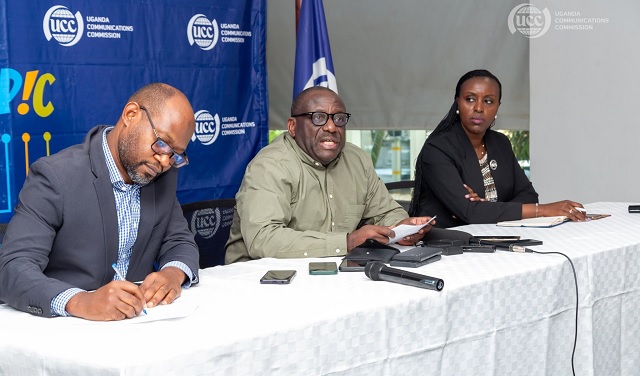
Technology neutral licensing
“This means we do not specify which technologies operators must adopt; instead, we establish performance benchmarks and allow innovation to guide the market. This strategy provides operators with the flexibility to invest wisely, while guaranteeing consumers a uniform, high-quality experience across 2G, 3G, 4G, and eventually, 5G networks,” Nyombi told The Independent.
Thembo said when allocating radio spectrum, UCC does not designate it solely for “5G” but rather prioritises user experience and socio-economic benefits.
“Rather than simply saying “deploy 5G here,” we set minimum quality standards, such as guaranteeing speeds of at least 25 Mbps in specific coverage zones,” he said. “This approach promotes efficient spectrum use and keeps consumers, rather than just the technology, at the heart of our considerations.”
He added that UCC’s policy focuses on building preparedness rather than hastening deployment. “While 5G demands extensive infrastructure and significant investment, we are aligning it with Uganda’s Vision 2040, which aims to make the country a modern, knowledge-driven economy. Our goal is to ensure deployment is sustainable, inclusive, and impactful, rather than merely appearing impressive.”
On the matter of spectrum allocation, UCC has stated that Uganda’s licensing system is technology-neutral.
“Spectrum isn’t designated as “for 5G only,” but rather allocated in a manner that lets each operator select the most suitable technology for their customers, be it 4G, 5G, or upcoming generations,” he said. According to UCC, this strategy ensures that operators invest based on market development rather than regulatory mandates.
Regarding affordability, Nyombi says UCC has developed a spectrum pricing model that is fair and transparent, ensuring fees represent the actual market value while promoting investment. “Our goal is to prevent any operator from being priced out and to ensure all players, regardless of size, have an equal opportunity to expand coverage and enhance services.”
In a country where a large population still lacks access to reliable 4G, regulators face the hurdle of balancing the push for 5G with the need for affordable and universal broadband connectivity. Nyombi says the focus is to first ensure dependable 3G and 4G coverage arguing that is where most users are located.
He states that through the Uganda Communications Universal Service and Access Fund (UCUSAF), there are investments aimed at expanding broadband infrastructure to rural and underserved regions.
“This effort ensures connectivity for schools, health centres, and communities that currently rely on outdated networks. By doing so, we are not only preparing for the rollout of 5G but also bridging the digital divide that remains in some parts of Uganda,” he said.
UCC, Nyombi said, has also adopted a cautious approach. “Many users operate 5G-enabled phones unknowingly, mainly for simple tasks like TikTok or WhatsApp, which could run on 3G or 4G. Therefore, the Commission aims to promote adoption cautiously, ensuring market readiness before expanding heavily into 5G.”
A report released in October 2025 by GSMA on driving digital transformation in Uganda’s economy states that the adoption of 5G is expected to benefit most sectors of the African economy.
“Low-band 5G could contribute nearly USD 3 billion in sub-Saharan Africa, whilst the mid-band 5G could deliver USD13 billion, adding almost 0.4% to GDP in 2030,” the report notes.
GSMA is a global organisation unifying the mobile ecosystem to develop innovation and foster economic growth.
The report states that the wide area coverage enabled by low band 5G will be essential in driving the digital transformation of the agricultural and manufacturing sectors, enabling Internet of Things (IoT) applications such as smart farming solutions, smart factories, smart cities and smart grids. But for the above gains to be realised, GSMA advises that an enabling policy and regulatory environment is critical.
****
This story was done with support from Collaboration on International ICT Policy for East and Southern Africa (CIPESA)