 The Independent Uganda: You get the Truth we Pay the Price


THE LAST WORD | ANDREW M. MWENDA | At the beginning of January, I drove from Kabale to Rukungiri, Bushenyi, Kaseese, Fort Portal, Kyenjojo, Mubende, Mityana and Kampala. Then in the last week of the election, I was joined by Prof. Melina Platas of New York University and Prof. Jude Kagoro of Bremen University. We drove through Kayunga to Jinja, Iganga, Busia, Tororo, Mbale, Soroti, Lira, Gulu, Pakwach, Masindi, Hoima, Kagadi, and back to Fort Portal. We talked to ordinary citizens, campaign agents, security officials, religious leaders – people from all walks of life – to get a feel of what was happening.
This is a two-part series of my reflections from this experience. The issues that I raise in this article – how Museveni organizes and manages elections and how the opposition responds – tend to raise high emotional and political passions. Some readers will be curious to know where I stand on these issues and which of the two main candidates I favor. So what political and emotional baggage am I carrying? The answer is simple: when it comes to emotional baggage, my preference is to travel light. My strategy while gathering information and shaping my views for/in this article has been to suspend my judgement in order to gain understanding. I seek to first understand and then analyze, rather than to advocate or condemn. Yet I cannot deny that I am free from bias and/or prejudice.
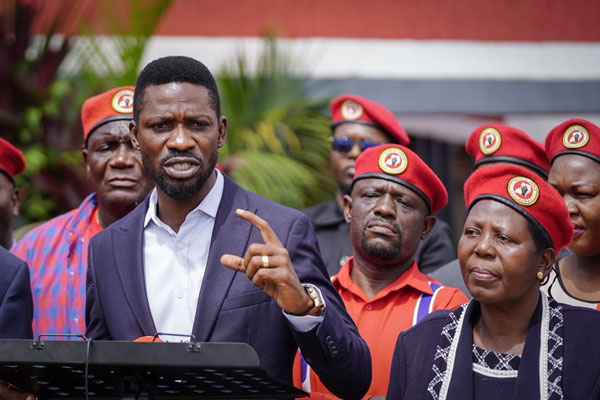
Two men faced off in Uganda’s political ring over the last five years: Robert Kyagulanyi (hereinafter referred to by his stage name, Bobi Wine) and President Yoweri Museveni. One had run elections six times; the other only once. Yet there was little or no change in the way the incumbent organized the election and how his main challenger responded.
Since he came to power, Museveni has presented his opponents with a dilemma. Long before polling begins, he uses the might of the state – its financial resources, propaganda institutions and security forces – to create a field where his opponents have little or even no chance of success. The opposition are blocked, obstructed, frustrated, impeded, etc., from building party structures, accessing radio stations upcountry, raising money, registering members, opening branches, etc. While his opponents are wont to claim that he steals their votes on polling day, these obstacles give the president a crushing advantage long before polling day. Therefore, to complain that he steals their votes on polling day sounds as if the rest of the campaign process was free and fair.
Thus, for the opposition, the dilemma is big: should they participate in an unfree and unfair electoral process in which they are certain to lose and thereby legitimize a sham election but have a chance to traverse the country and present their grievances and ideas on the national political agenda within the limits imposed upon them? Or should they boycott the entire process to deny it legitimacy but thereby lose an opportunity to make themselves heard by the people and therefore sink into political oblivion? The opposition has always made a strategic choice which I agree with, i.e., chosen to participate. However, after legitimizing the process, they fail to make the next step: to concede defeat under its rules and find a way to work with the then “elected” government as a loyal opposition.
Thus, my assertion of Museveni’s victory is within this context: of how the entire electoral process is organized over the years, not on the basis of the campaign period. Yet I feel that even within the limits imposed on them, Bobi Wine and his NUP had a chance to perform better, to increase their share of the vote compared to 2021. The point I am making is that Museveni’s obstructions should not blind us to the gross incompetence and many false assumptions that shape NUP’s approach to politics.
It was clear from the beginning that Bobi Wine and his NUP had little or no chance. But this has little to do with what Museveni did. It had a lot to do with what NUP did or did not do. Why? Museveni’s methods in every election are known and predictable. For instance, Museveni always puts many roadblocks in the way of his main challenger, which I have already enumerated above. These obstacles make it very difficult for his opponents to organize and/or mobilize supporters. Then he uses the resources of the state conveniently deployed near election time to win over voters. Everyone knows this is Museveni’s tool kit. Everyone expects it.
Surprisingly, the opposition’s reaction to Museveni’s election methods has also remained the same and predictable. They try to get onto radio stations and are stopped. They plan rallies that are violently broken up. Then cry foul at these unfair tactics and make moral appeals to the press, the people and the international community, seeking and getting sympathy. True, these cries attract public attention and sympathy, but nothing more. After 30 years of these same cries, one would expect opposition politicians to find new and novel ways to beat the system or work with it.
No one changes their winning strategy unless and until it ceases to help them win. It follows that Museveni has no reason to change his strategy. It is the opposition that always loses. It follows, therefore, that it is they that need to change their strategy and tactics. They haven’t. The challenge facing the opposition, and Bobi Wine therefore, was how to respond to the specific way Museveni conducts his election campaign. It is not profitable to use the same strategies and tactics that have failed to deliver constantly improving performance year after year. What is amazing is that Bobi Wine did not change his ways. Like Kizza Besigye before him, and in fact much worse than Besigye, he repeated the same old used and failed strategy of making moral appeals to the country and the outside world that Museveni should behave better, level the playing field, and give him a fair chance.
Museveni’s strategy in every election is based on his relative position. He and his party have control of the state. So he relies on state resources – financial, logistical and military. This is understandable and expected because he has effective personal control over these core elements of the state. He is therefore Goliath. Bobi Wine, on the other hand, has limited resources. It is thus incumbent upon him to design a strategy that matches his ends (wrestling power from Museveni) with the very limited means at his disposal. To do this is in the realm of strategy, something Bobi Wine doesn’t understand. In such a struggle, the underdog has to use asymmetric methods.
*****

amwenda@ugindependent.co.ug



There is this huge assumption that Ugandans hate, and therefore, can’t vote M7 because he has stayed long in power. If wanters could see past this and look at themselves in the mirror, tactics would change. Now imagine after 40 years the incumbent’s percentage win rising while the new ones see a downturn. Whoever becomes the next kingpin must think and think again before jumping into the queue first and thinking strategy later. One trick involves the incumbent but this I won’t divulge here due to its certainty.
It is clear M7 does not want Bobi around at transition time. He views his presence as problematic. Who ever missed Bobi in Arua and got Kawuma instead must have been fired because that poor performance led to this ongoing dilemma with Bobi. He is making the regime appear barbaric.
The whole argument centers on a simple, reassuring idea for the current government: Museveni wins due to the opposition’s incompetence, not because the system is set up to defeat them. All other factors like state capture, pre-election hindrances, financial control, and security threats are just seen as expected background noise that a smart underdog should have been able to navigate around.
Initially, Mwenda places nearly all the agency and responsibility on the weaker side. Museveni’s tactics are labeled as “known and predictable,” suggesting that predictability somehow diminishes their impact. On the other hand, the opposition is criticized for not coming up with some vague “asymmetric” strategy that would somehow counteract state power. Mwenda never specifies what that strategy should entail. He merely claims that such a strategy must exist because, according to him, repeating moral arguments and complaining is proof of “gross incompetence.” This is a classic case of victim-blaming disguised as strategic analysis.
Secondly, Mwenda subtly downplays the extent of repression. He refers to roadblocks, prohibited rallies, and limited radio access, but only as normal challenges that any serious politician should expect and deal with. The arrests, beatings, kidnappings, and murders that have occurred alongside Bobi Wine’s campaigns since 2017 are completely overlooked. Additionally, the fact that numerous NUP supporters and organizers were killed in 2020–2021 is not acknowledged. When one side can imprison or eliminate the other’s activists without facing consequences, criticizing the survivors for their lack of strategic creativity is not objective analysis; it is heartless.
Thirdly, Mwenda’s evidence is mostly based on personal stories. He and two academic friends traveled across the country, speaking with “regular citizens, campaign workers, security personnel, religious figures, and individuals from various backgrounds.” There are no statistics provided, no sample size mentioned, and no clue about how representative these discussions were. We are just expected to believe his subjective sense of the national sentiment. This does not qualify as thorough political analysis; it resembles a travel narrative pretending to be deep understanding.
Fourth, there’s a clear circular logic at play. Museveni has no reason to alter his approach since it’s effective. As a result, the opposition needs to adapt theirs. However, the opposition’s strategies are limited by Museveni’s tactics. They cannot freely build structures, gather funds, or organize big rallies because the government stops them from doing so. Mwenda views this limitation as a permanent part of the situation that smart politicians should maneuver around, instead of seeing it as the main factor that ensures the result.
Fifth, Mwenda brushes aside the question of legitimacy with a quick maneuver. He argues that the opposition gives legitimacy to the process by taking part, but he doesn’t follow through by acknowledging defeat and becoming a ‘loyal opposition.’ However, if it’s clear from the start that the process isn’t free or fair, then participating doesn’t mean agreeing to the rules; it’s often the only way left to connect with voters in a controlled environment. Expecting a graceful concession afterward is just asking the losing side to accept their own marginalization.
This article isn’t the unbiased analysis it pretends to be. Instead, it’s a well-crafted attempt to shift blame downwards, letting those in power off the hook, and framing structural domination as just a strategic challenge that the oppressed have foolishly failed to navigate. That’s not real insight. It’s just apologetics disguised as realism.
Rotten AI generated comment. Please desist this artificial pollution of debate.
WHEN WE RENT-OUT OUR FREEDOMS TO UNWORTHY LEADERS.
Barbie Kyagulanyi is the wife to Uganda’s leading opposition figure Robert Kyagulanyi. For eight straight days now since the elections, their home is under siege by a jamboree of camouflaged security forces armed to the teeth with anti-aircraft ground missiles, handguns and shortguns, assault rifles, combat knives and visible containers of explosives…it is as if Lord Joseph Kony and his L.R.A dissidents are finally cornered….in this one location. (I have a personal health concern though, ….if these soldiers are given daily meals…. how and from where do they ease themselves?)…
So, yesternight they broke into Kyagulanyi’s house (apparently, this ex-drug addict lives in a swanky house…. there’s some bit of alchemy in Bobi Wine’s existence. )
According to Barbie, these hoodlums forced themselves inside the house (Kyagulanyi reinforces this claim by saying that they “broke” doors that were not even “locked!!!”…. clearly, there was premeditated menacing intent!!!)
They pursued Barbie who had taken umbrage to her bedroom….they dragged her back to the livingroom. They demanded for her phone, they begged for her password…. when she hesitated, she was manhandled… uplifting her by the pyjama shirt and in the process losing all the buttons…. this act, exposed her breasts but it never fazed the filthy onlooking goons… that in fact, it excited most of them ….to the extent of exuding intestinal pleasure!!! Barbie testifies, that all this while, there was someone happily recording the swinging of her titties!!!
And it is from this that I draw my discussion.
When we were young, we exhibited nascent behaviour… and as adolescents we were affected emotionally and cognitively. In trying to satisfy our curiosities, we sometimes went overboard and invaded the private spaces of our female friends. In instances of naughtiness, we would arm ourselves with mirror glasses and “upskirt” (kulingiza) our sisters…..it was an innocent act of curiosity.
It seems and psychological studies indicate that some of us fail to “outgrow” the vice. That this curiosity resurfaces during adulthood in the form of “voyeurism.” And some strict jurisdictions have devised reprehensible measures to curb the vice. Voyeurism laws criminalize the non-consensual, secret observation, recording, or photographing of a person in a private act or state (e.g., nudity, sexual activity, or in undergarments) for the purpose of sexual gratification. There’s another legal term to it….”Scofflaw” which identifies a person who flouts the law, especially by failing to comply with a law that is difficult to enforce effectively.
The people who attacked Bobi Wine’s wife had prior intelligence that she was defenceless (since her husband was in hiding)…. and it was well within their sight…. that naturally, she was a weaker sex….why did they use brute force to manhandle her?… And to compound her humiliation… they filmed her ordeal!!!…. These are military men….On whose sick, shameless and barefaced orders were they operating? (your guess is as good as mine.)
The longevity of the aberrant “movement system” has over the years permeated our society to acculturation levels….. that the abhorrent ways of the dominating few have overshadowed and in some instances subverted our thinking into believing that what they say or do is “right” and we’re “wrong.” Muhoozi Keinerugaba has been on a rampage objectifying women….at one time he tweeted that “Bazungu” women were obsessed with him….at another, he tweeted that Kenyan woman were “dreaming” about him…he has severally tweeted about his lustfulness with Beyonce….. around the time they invaded Kyagulanyi’s home…he tweeted how “nyashless” women give birth to idiots…. He seems to be carrying an unmatched fetish about women…. Could he be behind the sadistic-beastial display of inhumaneness….
There’s a sociological dictum that states…a society gets the leaders it deserves…. Much as we are being violated by our leaders on a daily basis….we seem to always find “excuses/reasons/covers” as to why they violated and humiliated us…we always try to find new levels of contentment…. and we normalise the violation through couselling from people in high-up places….it could be the clergy, the cultural leaders…or a family elder…. Through our paternalistic layers of leadership, we are cooed over into accepting the prevailing status quo.
In reality, we only exist but far from living. In essence, we have been politically hypnotized and we settle for everything and anything fronted before us.
Rajab Kakyama
” ….On whose sick, shameless and barefaced orders were they operating? (your guess is as good as mine.)”
For purposes of emphasis and remembrance, those who raided Kyagulanyi’s home were operating on the orders of Mwenda’s powerful sadistic above-the-law friend, who is none other than Gen. Muhoozi Kainerugaba, whom I consider to be 10 times worse than his own father – Y. K. T. Museveni. For Muhoozi Kainerugaba, winning the election by 71% is not enough !
What M7 is doing, abusing his political opponent’s wives in their bedrooms, makes a mockery of what Kiwanda, Seninde, Namayanja, Kiryowa and Kasolo etc. have been selling. If this is what M7 for Buganda means, we want no part of it. What is happening is beyond barbaric.
Mwenda people fear to say anything bad about government especially to strangers ! You don’t seem to live in this country ! So your travel through Uganda and interviewing people is fallowed because you are a known PLU member, did you expect them to tell you their true feelings ?
In the eyes of many Andrew will never regain his independence until he addresses hus friend’s tweets head on..Andrew, why are you silent about those tweets? After all, I heard you are recommending him for PM.
Some adult needs to advise Andrew’s friend. The world is a dangerous place. Unforgiving. It flips on a dime. The idea of absolute power is an illusion. It does not exist. Remember the Nuremberg trials? Please. please. Is there an adult in the room? Please, please. save the young man from himself.
My fellow Ugandans, let’s talk. There’s a certain flavour of article that comes out these days. You’ve seen it. It drives upcountry, talks to boda boda men and market vendors, and comes back with big, heavy English telling us why the opposition failed. It’s clever writing. But if you peel back the layers, you find something troubling. It’s not just analysing a politician. It’s actually writing a death certificate for something much bigger: the very idea of a fair fight in our politics. And the worst part? It gives a blank cheque to any government, today or tomorrow, to keep the system broken.
Part 1: The Realistic Bait
These articles always start strong. They state the obvious we all live with. That the playing field is not level. Each and everybody has been knowing that it’s a steep hill. The one with the instruments of state… the money, the police, the administrators, the radios….starts at the top. They control the timetable, the rules, the referees. This isn’t speculation… it’s the daily reality of our political season. The article names it well. It calls it a “dilemma” for the challenger… to join a race you know is fixed, or to stay at home and be forgotten. So far, so true. It’s describing the system, the process.
Part 2: Blame Shifting
After describing this crooked system in detail, the writer performs the magic. He says, “But the real problem is not this system. The real problem is that the fellow running uphill is not a good climber.” How is this not journalistic witchcraft?
The focus shifts from those who have been owning the hill and those who designed the slope. Instead, the spotlight shines bright on the one trying to climb it. He is called predictable. He is accused of “crying” too much instead of innovating. He is told he needs “asymmetric tactics.” The language changes from analysing power to judging performance. The undeniable unfair advantage becomes like the weather… it’s just there, to be endured as per normal. The climber’s every stumble is analysed as a personal failure. The hill itself is forgotten.
Part 3: Normalization – The Gift that Keeps Giving
This is not just unfair analysis. This is planting a poisoned seed in our national discourse. Why? Because this story does three ugly things:
1. It Makes the Abnormal Normal. By talking about the incumbent’s methods as “predictable,” it makes them sound like sunrise and sunset. It removes the outrage, the accountability. It says, “This is just Uganda’s way.” It makes dysfunction the permanent background of our politics.
2. It Makes a System Problem a Person Problem. It tells us democracy is failing because the opposition leaders are not smart enough, not clever enough… that they are lacking enough tricks. Not because the system itself is engineered to fail. It’s like blaming a fisherman with a torn net for not catching fish… kumbe, the one who cut the net is ignored.
3. It Writes a Script for Every Future Ruler. This is the most egregious part. This style of thinking creates a manual that any future government can use. The script is ready: “Yes, times are hard. It’s not easy. The system is tough. But look at our weak opponents! Their failure is their own. Don’t look at the system; look at their poor tactics.” Once we accept this logic today, we give permission for it to be used forever. The next group that takes power will simply point to these clever articles and say, “Have you seen? Even your top analysts said the problem is the opposition, not the rules.” It immortalises the crooked game.
Part 4: What Are We Really Burying?
So, when you read such a polished “obituary” for a political challenger, first look again. You are not reading about one man’s career. You are reading the obituary for fair political competition itself. It is a funeral service for the idea that the rules should be just. The article, in its polished, reasonable tone, is quietly lowering the coffin of democratic possibility into the ground.
We Are Not Mere Spectator Ions!
Our job is to see this journalistic witchcraft for what it is and call it out. Not to defend any politician, or side with any politician… but to defend the truth.
We must refuse to let the conversation be shifted from the process to the person.
We must keep asking the hard, uncomfortable questions about the kind of democracy we want our children to inherit.
If we, the people who are meant to think deeply, accept a story that blames the climber for the steep hill, then we have signed the death certificate with our own pens.
Regardless of who your candidate may be, or even in which direction your political leaning points… this kind of obituary is an obituary we should all refuse to honour or even validate… it must be roundly rejected for the sake of the kind of democracy that we, as Ugandans, want our children and grandchildren to inherit.
Kale fine… as respected veteran journalist (let’s first ignore the journalistic witchcraft for now and we forgive each other… for now) who has for many years been analysing the imbalances of the system and the weaknesses of opposition… when you say this:
“…design a strategy that matches his ends (wrestling power from Museveni) with the very limited means…”
Allow me to edit the above slightly, just to bring out my point and my question more clearly:
“…design a strategy that matches his ends (following all the rules, regulations, laws, constitution etc …to participate freely in fair, normal, transparent democratic processes) with the very limited means…”
Since you have been analysing these things for a very long time, and since you are having a lot of magezi… what exactly are you proposing the opposition should do, without breaking any laws, when you say it’s “…incumbent upon them to design a strategy…”
Please share some examples, at least one… since you seem to suggest that the problem is that opposition is lacking ideas and strategies… you can also be be part of the solution rather than being part of the problem (using VAR to judge and belittle the opposition’s best efforts to participate freely in democratic processes while acting within the laws of Uganda… and normalizing the unfair referees and probably unconstitutional imbalances of the system they are up against)…
Please share some tips and tricks… even at least one hint.
We can even vote for you, if you can at least demonstrate to us that you are having that magezi which you say the opposition lacks.
In my opinion, the oresident should stop pretending that we are having elections. Ban them outright, abolish the useless parliament, then utilise the billions used to run stage-managed elections to improve service delivery. Let him minimise corruption emanating right from people associated with him, state house and office of the president and deploy the resulting savings on improving infrastructure, agriculture et al.