The Independent Uganda: You get the Truth we Pay the Price


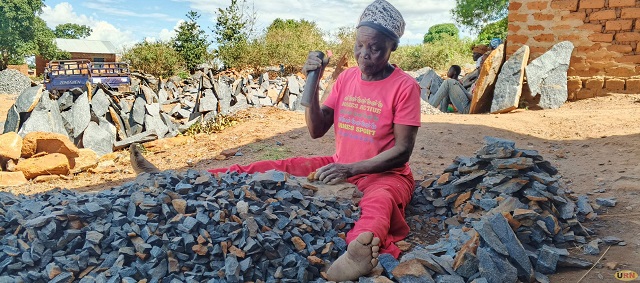
Arua, Uganda | URN | At 18 years of age, Janet Eyotaru, now 62, joined male artisan miners at the Ayelembe stone quarry site after getting married in the same area at the age of 16. After giving birth to her first child, Eyotaru was forced to join a group of men who extracted stones from underground and crushed the boulders into smaller pieces for concrete work.
Seated on the ground, surrounded by piles of crushed stones and with visibly scarred hands, Eyotaru holds an iron bar and continuously strikes hard-core stones, which break and scatter around her as she keeps collecting them. Eyotaru, a widow with six children—three of whom have since passed on, leaving behind several orphans—says she has been crushing stones from Monday to Saturday for the last forty years.
Speaking in the Lugbara dialect, Eyotaru narrates: “I’m the first woman to join stone quarrying here, and I’m now the oldest still doing this work for my survival and that of the orphans my three sons have left. At least ten other women who joined this work have since retired and passed on.”
There are over 40 women currently working at the Ayelembe stone quarry site, and this number rises to over 100 during school holidays, as students and pupils join their parents to crush stones to raise school fees and meet other needs. The stone boulders are extracted by men from the pits and sold to the women, who then crush them into smaller pieces and sell them to customers.
However, the artisan miners work with bare hands, without face masks or gumboots, and under the open sun—conditions that expose them to various health risks, including accidents. “My body aches all over with a burning sensation after every day’s work. My chest also pains. I have to take painkillers every day, and some are forced to drink local waragi to relieve the pain arising from this work. I will die here doing this work because I have no other option for survival,” Eyotaru further narrates.
At the quarry site, a heap of crushed stones is sold at between UGX 15,000 and 18,000, while a truckload of crushed concrete stones goes for between UGX 250,000 and 270,000, depending on negotiation. “I’m able to pay school fees for my grandchildren, cover medical bills, support community events, and also buy food from the stones I crush here,” Eyotaru adds.
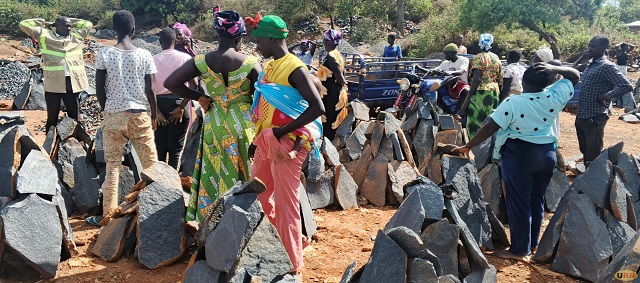
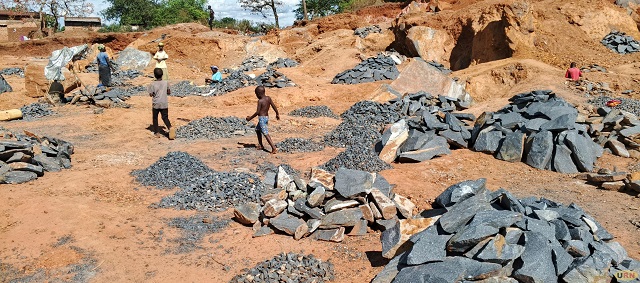
But Evelyn Andy, 25, from Ayelembe Village in Eruba Parish, Vurra Sub-county, is a secondary school dropout due to pregnancy. She has since replaced her mother at the quarry site. Evelyn reveals that after her mother could no longer manage the quarry work, she had to take over, allowing her mother to return home, where she is now confined. Evelyn, a mother of one who now looks after her elderly mother, explains that many of them face challenges ranging from physical injuries to harsh weather conditions, and they appeal to the government for support.
Meanwhile, Alfred Amandu, the Principal Health Officer in charge of Environmental Health in Arua City, explains that the local stone quarrying activities have far-reaching health effects on miners, which continue to take a toll on women quietly. He advises that there is a need to ensure that personal protective equipment (PPE) is provided for all people involved in quarry work.
Due to the increasing demand for concrete construction materials in urban and trading centres, many people have resorted to extracting stones using handmade tools, often ignoring the far-reaching health implications. Some of the stone quarry sites dominated by women include Oluko, Muni, Awindiri, and Adumi in Arua City, as well as Ayelembe, Kuluva, and Ezuku in Vurra Sub-county, Arua District.
In most stone quarry sites across West Nile, women have taken over the business of crushing and selling stones, as the traditional responsibility of feeding and supporting families has largely shifted onto them.
***
URN