The Independent Uganda: You get the Truth we Pay the Price


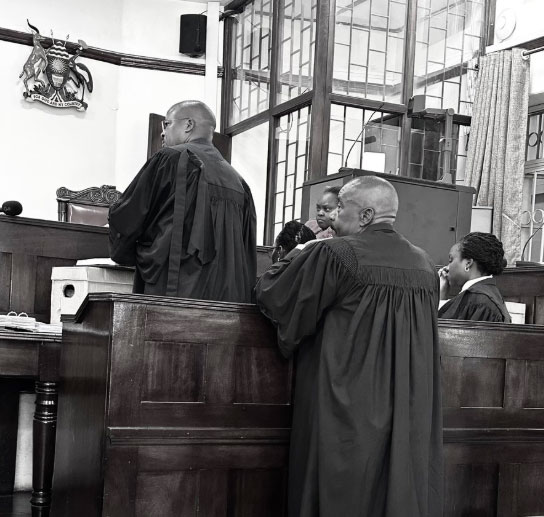
SPECIAL REPORT | ANTHONY NATIF | As recorded in the case Uganda Vs Molly Katanga and adapted from @TonyNatif on X. This is the 2nd of several series on the case ahead of February 19th, when Justice Kania is expected to rule on whether the prosecution has established a prima facie case.
****
The Prosecution’s Case Against Mrs Katanga
On 2nd December 2025, with their 25th witness, the prosecution closed its case against Mrs Molly Katanga and her 4 co-accused.
The presiding judge, Rosette Comfort Kania, directed the defense to file written submissions on “no case to answer” within 20 days (Dec/22) and then the prosecution reply by 28/Jan/2026 and a rejoinder, if any by 5th Feb 2026.
In their submissions in response, the prosecution, quoting Lord Parker in Wilbiro v. Republic (1960) EA. 184 said that “a prima facie case does not mean a case proved beyond reasonable doubt”, with the court at this time not being “required to decide whether the evidence, if believed, is sufficient to prove the case conclusively”.
They laid down the four ingredients to prove the case of murder as follows:
1. The death of a human being occurred
2- The death was caused by an unlawful act
3. The death was caused with malice aforethought
4. The accused person participated.
On 1, they relied on the evidence and postmortem report of PW7, Dr Richard Ambayo, a pathologist who testified that Mr Henry Katanga had died of a single gunshot wound to the head.
It might be worth remembering that under cross-examination by defense lawyer Elison Karuhanga, the pathologist said he couldn’t rule out the possibility of suicide.
Anyway, on the fact of death, the prosecution further relied on eyewitness accounts from PW2, 3, 4, 20, 23, and 24.
The fact that Mr Henry Katanga died hasn’t been contested by either side, with the only point of contention being proof as to whether the gunshot was due to homicide or suicide.
It is to this point that the prosecution turns:
2-Whether the death was caused by an unlawful act
The state starts by reminding Justice Kania that “it is law that any homicide is presumed to have been caused unlawfully unless it was accidental or authorized by law.”
For this, they relied on a 1948 decision: Republic v. Gusambizi s/o Wesonga (1948) 15 EACA 65. They then say that “in the present case, there’s nothing to point to the present homicide as being accidental or authorized by law.”
This is where it gets a bit murky.
The defense insists that the prosecution can’t call what happened on the morning of 2/Nov/2023 “a homicide”, as they led no such evidence and their own forensic pathologist, PW7, said he couldn’t rule out suicide.
The defense, in their submissions argued that “the prosecution bears the burden to exclusively prove, to the exclusion of all other reasonable possibilities that this was an unlawful homicide.”
The prosecution called this “misconceived”, insisting that “the position of the law is that ALL homicides are presumed unlawful unless accidental or authorized by law”.
They don’t say how they determined it was a homicide and not a suicide except to say that testimony from police officers PW2, PW23 and PW24 proves that it was a homicide. These officers said they “looked at the entry and exit wounds on the deceased and ruled out suicide.” ”.
The prosecution didn’t say why the pathologist, on looking at the same wounds, didn’t rule out suicide.
The prosecution further said that “the suicide narrative was the desired narrative of the accused persons”, but it wasn’t borne out by evidence.
They conclude this point by submitting that “the death of Henry Katanga was unlawful, as there’s no evidence whatsoever that has been advanced to show that the same was accidental or authorized by law.”
Ingredient 3: whether the death was caused with malice aforethought.
Quoting section 174 of the Penal Code Act, Cap. 128, the prosecution defines malice aforethought as: “an intention to cause death of a person or knowledge that the act causing death will probably cause the death of some person”
They say that malice aforethought, being a mental element, is difficult to prove by direct evidence, but instead they’d rely on circumstantial evidence.
Relying on a 1978 decision in Uganda v. Turomwe, they invited the court to consider…
– the type of weapon used; in this case, a gun
– nature of injuries inflicted (gunshot wounds)
– part of the body affected, whether vulnerable or not (the head)
-conduct of the accused before, during and after the attack.
I’ll not belabour the points, as these have been repeatedly made, but just to highlight the issue of the use of a gun to shoot oneself in the head and how that can imply malice aforethought, the prosecution relied on a decision in Uganda vs Kalangwa Bosco, HCCS No. 4, 2013, where the court held that “the head is a vulnerable part of the body, which, if targeted by an accused, imputes malicious intent on his or her part.”
With this, the state submits that “a gunshot to the head, which is a vulnerable part of a human being, imputes malicious intent to cause the death of a person.”
Ingredient 4: that the accused person participated in the commission of the crime
This is where things get really dicey.
The prosecution opens by reminding Lady Justice Kania that for this ingredient to stand, “there should be credible direct or circumstantial evidence placing the accused at the scene of the crime as an active participant in the commission of the offense”.
Then this: “My Lord, the circumstances of this case are unique and peculiar in the sense that the crime was committed behind closed doors, in a bedroom occupied only by the deceased and the accused person (A1). Since one of the occupants is dead, we can only rely on circumstantial evidence to prove the case against A1”.
Relying on Baitwabusa Francis v Uganda (2017) UGSC 26, the state says that “this ingredient on the participation of the accused person amounts to placing the accused person at the scene of the crime.”
Some of these circumstantial pieces of evidence were the following:
i) A1 was the person last seen with her late husband.
For this, the state relies on the “doctrine of last seen”.
Citing Jagenda John v. Uganda (CA No.1 of 2011), they say that “the last seen doctrine which enjoys global application creates a rebuttable presumption to the effect that a person last seen with the deceased person bears full responsibility for his or her death”.
ii) DNA evidence.
In seeking to answer the question of who caused the death of Mr Katanga, the state says that this “can only be answered by evidence showing the person who operated or used the fatal weapon, the gun to shoot the deceased”.
The state led evidence proving that the gun in question belonged to Mr Katanga.
On who actually shot, they are asking the Judge to rely on a DNA analysis report and testimony of the Director of Forensics in Uganda Police, Mr Andrew Kizimula Mubiru, PW8.
He testified that he took swabs from the pistol magazine, trigger and trigger house as well as the pistol barrel.
Some of these swabs were never brought to court. NO duplicates exist, so the tests can’t be replicated. In modern parlance, it seems like a “trust me bro” thing.
On the magazine, PW8 said he found a mixed DNA profile; A1 being the major contributor with Late Henry Katanga and their daughter (also charged) A2 being minor contributors. Ditto trigger & trigger house.
On the pistol barrel, a mixed DNA profile was found, but here, A1 was a minor contributor.
They argue that this DNA evidence connects Mrs Katanga with the activity of not just loading the gun (DNA on magazine), cocking the gun (DNA on the barrel), shooting the gun (DNA on the trigger and trigger house)
The prosecution then addressed issues pertaining to their witness’s character. Court of appeal in the Kato Kajubi case found that he tested a non-existent sample.
Also, system logs show he didn’t conduct these experiments.
It bears remembering that when directly asked by the defense as to the source-level inference from his findings and whether his report proves as to who shot the gun, the forensic expert said NO.