The Independent Uganda: You get the Truth we Pay the Price


The US$15,000 visa bond places travellers under sharper scrutiny as Washington tightens enforcement
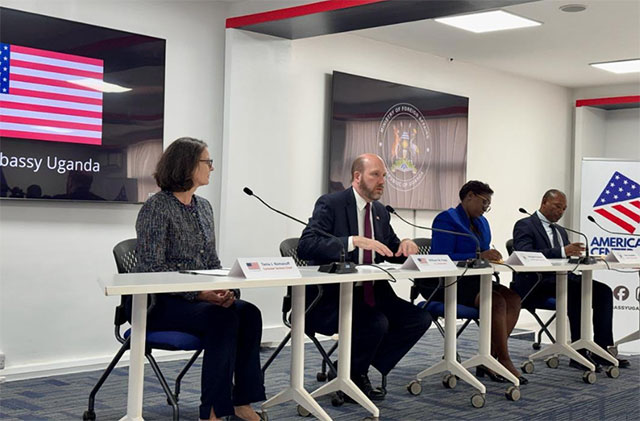
COVER STORY | RONALD MUSOKE | When U.S. Ambassador William W. Popp stepped-up to address the press at the American Centre in Kampala on Feb. 5, he was carrying a message that blended diplomacy with warning.
The United States, he said, values its strong partnership with Uganda, rooted in people-to-people ties that see thousands of Ugandans travel to America each year for tourism, business, study and family visits. But that openness now comes with tougher expectations, he said.
“The Trump Administration continues to put America and its interests first by fully enforcing U.S immigration laws and ensuring lawful travel through our visa process,” he said. A non-immigrant visa, he stressed, is a privilege granted for a specific purpose, not a right. It allows a visitor to stay only for an authorised period and only to carry out the activity stated in the application.
Behind the diplomatic language lies a significant policy shift that directly affects Ugandans hoping to travel to the United States. Since July 2025, business and tourist visas issued to Ugandan citizens have been limited to a single entry and are now valid for just three months. Then, on Jan.21, 2026, Uganda was added to an expanded Visa Bond pilot programme. Under this measure, Ugandans who qualify for B-1 or B-2 visas for business or tourism must now post a refundable bond of up to US$15,000 (Approx. Shs 54 million) before their visa is issued.
The bond is returned once the traveller enters the United States, complies with the terms of the visa, and departs on time. But it may be forfeited if the visitor overstays, breaks U.S. laws, or attempts to change status. At the same time, the U.S. Department of State temporarily paused the issuance of immigrant visas for nationals of 75 countries, including Uganda, also effective Jan. 21.
While applications and interviews continue, new immigrant visas are not being issued during this review period. Previously issued immigrant visas remain valid, and the pause does not affect non-immigrant categories such as students, tourists, business travellers or skilled workers. U.S. officials insist the measures are not punitive, nor discriminatory. Instead, they say, they are driven by data and national security concerns.
“The two issues, they’re integrated,” Ambassador Popp explained. Border protection and immigration compliance, he said, are inseparable from national security. “Every sovereign nation wants to know who is visiting, how long they are staying, what they are doing, and when they are leaving. Gaps in that system, especially when people enter for one purpose and stay for another, or fail to depart at all, are treated as security risks.”
A bond designed to enforce compliance
Consular Section Chief, Tania Romanoff, laid out the mechanics of the new bond requirement in blunt terms. Applicants must not pay any bond before their visa interview, she warned, citing fears of scams. Only after a consular officer determines that an applicant qualifies for a B-1/B-2 visa will the bond amount be communicated. Travellers then have up to 30 days to pay, or may delay payment closer to their travel date if their trip is scheduled later.
Once a visitor departs the United States, whether returning to Uganda or travelling elsewhere, the bond is refunded within 30 days. But there are clear red lines. The bond is not returned if the traveller overstays beyond their authorised period, violates U.S. laws, or seeks to change status, even on their first visit.
Romanoff also underscored that entry into the United States does not guarantee a fixed length of stay. That decision is made by a U.S. Customs and Border Protection officer at the port of entry, who informs the traveller how long they are authorised to remain. Visitors can verify this information online through the I-94 system.
Misusing a visa carries severe consequences while providing false information during an application or interview can result in permanent ineligibility to travel to the United States and possible criminal prosecution in Uganda or the U.S. Those who overstay risk deportation and long-term bans on future travel.
As Secretary of State Marco Rubio has warned, violators of U.S. law, including international students, may face visa denial or revocation and removal from the country. While the bond can reach US$15,000, U.S. officials acknowledged that many Ugandans may not have such sums readily available. Romanoff noted that the sponsors of Ugandan travellers including; family members, churches, or business partners in the United States may pay the bond on the travellers’ behalf.

Students, however, are treated differently. They are admitted for the duration of their studies, provided they maintain their status and obey U.S. laws. When they travel home and seek re-entry, they must apply for new visas, but the embassy has introduced priority appointments to help students return to their programmes quickly.
Why Uganda made the list
U.S. officials were candid about why Uganda was included in the visa bond programme. Romanoff pointed to publicly available annual data showing how many Ugandans overstay tourism and student visas. Compliance, she said, is the key benchmark. Washington continuously monitors these figures and evaluates whether travellers are respecting visa conditions.
“We need to see that number go down,” she said. She also revealed another factor drawing scrutiny: the number of Ugandans who enter the United States legitimately and later attempt to change their status.
“In most cases,” Romanoff explained, “applicants arrive intending to do exactly what their visa allows.” But once in the U.S., some change their minds — often influenced by family or community networks that suggest altering one’s immigration status is easy. The volume of Ugandans filing for status changes is “quite high,” she said, and forms part of the data being assessed. This is why U.S. authorities are also urging Ugandan communities in America not to encourage visitors to abandon the terms of their visas, she said.
Ambassador Popp stressed that the policy is about one thing: compliance. If someone applies honestly for tourism or business travel, completes that purpose, and returns within the authorised timeframe, the bond is refunded and legitimate travel continues. Visitors are simply expected to follow the laws of the countries they enter, just as Americans are expected to do when they travel abroad.
Despite the tougher requirements, U.S embassy officials in Kampala say they have not seen a decline in visa applications since the policy changes. Ugandans continue to apply, and some have already participated in the bond programme. Visa bonds, Popp noted, have existed in U.S. immigration law for years and were implemented in several countries before Uganda joined the list.
Uganda steps in to reinforce the message
Sitting alongside U.S. officials at the press conference were senior representatives from Uganda’s Ministry of Foreign Affairs, a signal that Kampala is backing Washington’s call for compliance.
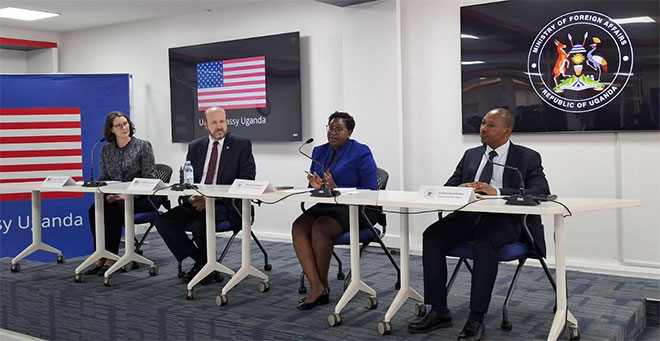
Margaret Kafeero, the Head of Public Diplomacy, said the ministry often receives appeals from Ugandans whose visa applications have been denied or cancelled. The Uganda government, she said, cannot intervene in individual cases. That is why Uganda is urging its citizens to carefully read U.S embassy guidelines, complete applications themselves, and avoid relying on third parties to interpret requirements.
“It only takes a few to ruin it for everybody else,” Kafeero said. Those few, she added, are not strangers; they are relatives, parents, and children. Their actions make it harder for other Ugandans to secure visas.
She said there’s need to be honest in applications and warned that misrepresentation carries consequences. Uganda’s ambassador in Washington D.C., she said, is delivering the same message to Ugandans living and working in the United States.
On the question of the principle reciprocity, Kafeero rejected the idea of automatic retaliation. Reciprocity, she explained, depends on context. Uganda has accepted the information provided by the U.S. in good faith and opted for dialogue rather than knee-jerk responses. If Americans were routinely entering Uganda, overstaying and changing their status, she said, Kampala would have grounds to act. But that is not currently the case.
Evans Aryabaha, the head of Consular Services at Uganda’s Ministry of Foreign Affairs, echoed that position. Uganda, like any sovereign state, enforces its own immigration laws. Those who violate them can be arrested, detained and deported.
“The question we are discussing today is because we have many violators from a number of countries, including Uganda,” he said plainly. Aryabaha said the Ugandan government fully endorses the U.S. message: legitimate travel is acceptable and achievable, but only when applicants provide accurate information and respect visa conditions.
The Independent understands Uganda’s embassy in Washington has intensified outreach since mid-2025, holding targeted programmes with students and quarterly meetings with diaspora communities. The focus is education, especially for students who complete their studies and then decide to stay illegally. The core message is simple: remain legal, and respect the hospitality of host nations.
Inside America’s overstay tracking system
The policy changes affecting Ugandans are underpinned by a sophisticated data apparatus detailed in the U.S. Department of Homeland Security’s Entry/Exit Overstay Report 2024. An overstay is defined as a non-immigrant who was lawfully admitted to the United States but remained beyond their authorised period, whether that period is fixed or tied to an activity such as study or training.
Customs and Border Protection (CBP) tracks two categories; suspected in-country overstays, where no departure is recorded, and out-of-country overstays, where travellers depart only after their authorised stay expires.
Determining lawful status requires more than simply matching entry and exit records. A visitor may receive an extension, change status, or adjust their immigration category. The DHS systems must account for all of these variables. To do this, the CBP consolidates arrival data, departure manifests, biometric information, and immigration benefit records to build a complete travel history for each visitor.
Air and sea carriers provide advance passenger manifests for all arrivals and departures. At ports of entry, CBP officers inspect travellers, conduct interviews, collect biographic data, and, for most non-immigrants, capture fingerprints and digital photographs. Carriers face fines for missing or inaccurate information.
Departure data is later matched against arrival records, while a separate DHS system integrates information on extensions, student status, and other immigration benefits. Throughout fiscal year 2024, CBP analysts reviewed out-of-country overstay leads daily. Confirmed overstayers may lose visa privileges and face three- to ten-year bars on future admission.
The scale of this operation is vast. Between Oct.1, 2023 and Sept. 30, 2024, the United States recorded 46,657,108 expected departures, nearly 20 percent more than the previous fiscal year. As of Oct. 1, 2024, more than 402,000 individuals had been flagged by DHS vetting systems. Nearly 1.5 million email notifications had been sent to Visa Waiver Programme travellers warning them in advance of the end of their authorised stay, part of a broader effort to improve compliance through awareness.
CBP notes in its report that identifying overstays is central to national security, public safety, immigration enforcement, and the integrity of the immigration benefits system. The visa bond programme now adds a financial layer to this data-driven enforcement strategy.
How Uganda compares regionally
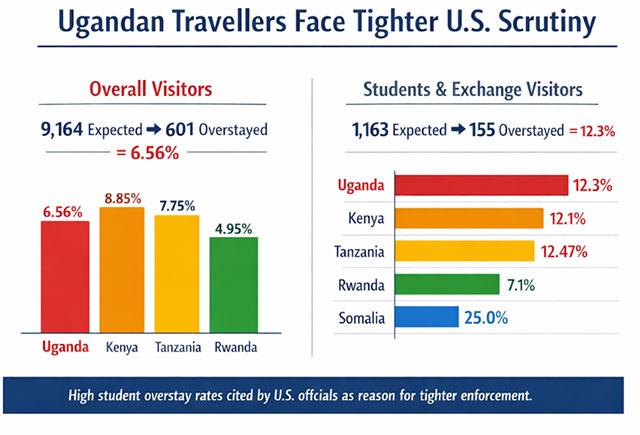
Against this backdrop, DHS data shows how Uganda fits into the broader Eastern African picture. During fiscal year 2024, 9,164 Ugandans were expected to depart the United States, but 601 remained behind, producing an overstay rate of 6.56%.
Tanzania recorded 481 suspected overstays from 6,208 expected departures, an overstay rate of 7.75%. Kenya saw 2,348 people fail to leave on time out of 26,537 expected departures, pushing its rate to 8.85%. Rwanda registered 216 overstays among 4,360 expected departures, or 4.95%.
Countries with smaller traveller volumes sometimes posted sharper percentages. Somalia recorded 43 suspected overstays from just 202 expected departures, an in-country overstay rate of 21.29%. South Sudan counted 11 overstays out of 186 expected departures, or 5.9%, while Burundi reported 42 suspected overstays from 800 expected departures, giving a rate of 5.25%.
Student and exchange visitors present a similar pattern. Out of 1,163 Ugandan students expected to leave the United States, 155 stayed on, an overstay rate of 12.30%. Kenya recorded 437 overstays among 3,612 expected student departures, or 12.1%. Rwanda saw 100 students remain out of 1,404, posting 7.12%.
Somalia’s student figures were particularly stark, with 10 of 40 expected departures turning into overstays, a rate of 25%. South Sudan recorded 24 overstays out of 92 expected student departures, while Tanzania had 131 students remain from 938 expected departures, equivalent to 12.47%. These numbers, U.S. officials say, help explain why Uganda and several of its regional neighbours have been placed under tighter scrutiny.
A shared responsibility
For both Washington and Kampala, the message emerging from the Feb.5 press briefing was one of shared responsibility. The United States is tightening its visa regime, pairing sophisticated tracking systems with refundable bonds designed to deter overstays. Uganda, for its part, is urging its citizens to travel legitimately, tell the truth on applications, and respect the laws of host countries.
Ambassador Popp framed compliance not just as a legal obligation, but as a way to preserve the broader relationship between the two nations. By following visa terms, he said, Ugandan travellers help keep legitimate travel open and strengthen enduring ties. Ugandan officials echoed that appeal, warning that a small number of violators can affect opportunities for everyone else.
At stake is more than access to U.S. visas. It is the credibility of Ugandan travellers abroad, the ease of people-to-people exchange, and the future shape of a partnership now being reconfigured by data, deterrence, and a renewed emphasis on compliance. For Ugandans planning to visit the United States in the near future, the path remains open, but it is narrower, more closely watched, and increasingly unforgiving of those who fail to follow the rules.