The Independent Uganda: You get the Truth we Pay the Price


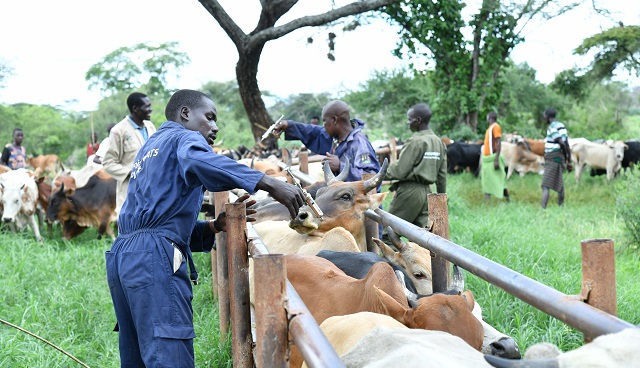
Moroto, Uganda | PATRICIA AKANKWATSA | In Karamoja, livestock is not just an asset class; it is the operating system of the local economy. Cattle and goats function simultaneously as savings, insurance, food supply, and social capital. It is within this context that vaccines often treated as a narrow veterinary intervention are assuming outsized significance as instruments of economic stabilisation and market access.
A joint monitoring mission by the Food and Agriculture Organization (FAO) and Uganda’s Ministry of Agriculture, Animal Industry and Fisheries (MAAIF) has just concluded field visits across Moroto and Amudat, assessing the implementation of an EU-funded, risk-based livestock vaccination campaign targeting transboundary animal diseases (TADs). The exercise is part of the Regional Programme in Livestock and Pastoralism for Climate Change Adaptation in the Eastern/Horn of Africa (PLACE), a multi-country initiative spanning Uganda, Kenya, South Sudan and Ethiopia.
The programme targets a cluster of high-impact diseases; Contagious Bovine Pleuropneumonia (CBPP), Contagious Caprine Pleuropneumonia (CCPP), Peste des Petits Ruminants (PPR), and Foot and Mouth Disease (FMD) that not only decimate herds but also lock Uganda out of lucrative regional and international livestock markets.
“Vaccination at this scale is very delicate,” FAO Uganda’s head of animal health, Dr Bessong Willington Ojong, told officials during the field assessment.
His remarks highlight a central theme emerging from the mission: success hinges less on policy intent than on execution discipline. The delegation interrogated what are often overlooked variables cold-chain integrity from district depots to mobile teams, the quality and durability of syringes and coolers, real-time data capture systems, and the capacity of frontline animal health workers.
Why this operational detail matters is both clinical and commercial.
Dr. Willington Bessong Ojong, Head of Animal Health at FAO Uganda, explained the purpose of their visit as he surveyed the vaccination efforts in Moroto.
“We decided to carry out a monitoring visit where FAO supports the government of Uganda. We are accompanying the chief veterinary officer, who oversees animal health in the country, to assess the vaccination process. Vaccinating an entire region is a highly delicate operation missing even small steps can compromise the success of the campaign.”
“These diseases threaten farmers’ livestock assets and limit the value they can get from their animals, while also affecting trade, since exporting products requires meeting strict regulatory standards. Uganda faces many transboundary animal diseases, and the PLACE project spans four countries Ethiopia, South Sudan, Kenya, and Uganda coordinating vaccination across borders. Every step in this process is critical; missing even small details in a region-wide campaign can compromise the outcome.”
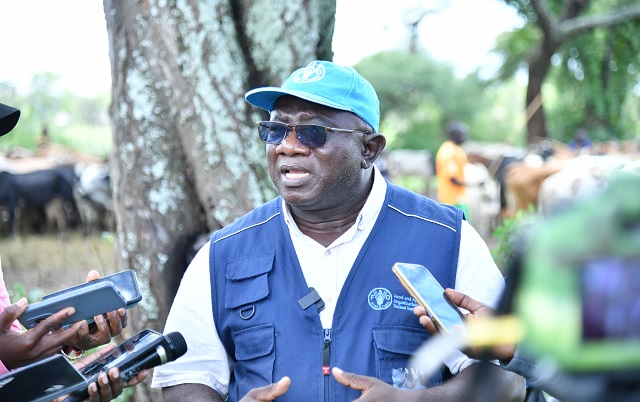
The delegation closely examined the vaccination campaign’s infrastructure, workforce, and data systems.
“We are looking at the cold chain whether there are any issues between the district facility and the field, ensuring vaccines reach the animals safely,” said Dr. Bessong added.
“The government has invested seriously in the district cold chain, but gaps can occur during distribution, so we’re checking coolers, systems, and syringes.”
They also assessed electronic tools and workforce deployment.
“Everything was designed on paper, but now that the campaign is in the field, we are evaluating how to improve future exercises. We are already preparing for another round in November,” he explained.
He highlighted the scientific approach behind the campaign.
“Before vaccination, we conducted sero-monitoring to assess herd immunity against the targeted diseases. Vaccines are now being administered, and later we will carry out post-vaccination monitoring to measure sero-conversion and ensure animals develop lasting immunity for a year or more.”
Dr. Bessong also praised the dedication of field staff. “We are impressed with the work on the ground. The technicians are extremely committed, and the administration is giving them full support. It’s a very encouraging effort.”
Dr. Anna Rose Ademun Okurut, Commissioner for Animal Health at the Ministry of Agriculture, Animal Industry and Fisheries (MAAIF), explained the campaign’s success is defined by one metric: epidemiological coverage.
“These communities are interconnected, so diseases move along with people and animals. By working together, we aim to achieve herd immunity vaccinating at least 80% of animals so even if a few are infected, the disease cannot spread widely. That’s the target of the vaccination, and it’s what protects the rest of the herd.”
“The numbers we use come from Uganda Bureau of Statistics, and vaccines are procured based on actual animal populations. For example, for contagious bovine pleuropneumonia, we purchased around 500,000 doses. The program is carefully designed, and each step is meant to ensure that animals develop immunity and that the region as a whole is protected.”
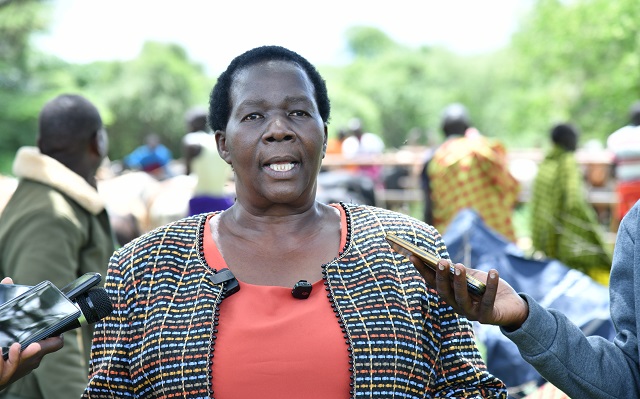
On the ground, implementation challenges are as much social as they are logistical. In Amudat, veterinary officer Dr Daniel Esoku described a system stretched by mobility.
“We have to literally move from here to those districts to look for the cows,” he said, referring to seasonal migration patterns that push herds into neighbouring districts such as Nakapiripirit and Nabilatuk during dry periods.
Cross-border dynamics further complicate delivery. In shared grazing zones between Karamojong and Pokot communities, mistrust can limit access to herds. Farmers may reject vaccinators from neighbouring areas, fearing contamination or deliberate harm, forcing authorities to deploy locally acceptable teams an approach that raises operational costs and slows coverage.
Vaccine hesitancy, though not dominant, remains a friction point. Perceived adverse effects particularly reproductive issues such as abortion are often attributed to vaccines, even where causality is unclear.
“We vaccinate only healthy animals,” Dr Esoku said, emphasising adherence to protocol. However, he acknowledged that perception can outweigh science in shaping uptake, requiring sustained community engagement.
The monitoring mission identified several areas of progress. These include the use of pre- vaccination serological surveys to target high-risk zones, the rollout of digital surveillance tools for community animal health workers, and investments in cold-chain infrastructure—including solar-powered storage systems in off-grid districts.
Local political leadership has broadly endorsed the programme.
“The more we vaccinate, the more farmers value their livestock as economic assets rather than prestige stock,” said Joseph Nangole Lobot, the Amudat district LC V chairperson, suggesting that rising demand for vaccines reflects a deeper shift toward commercialisation within pastoral systems.
“Our main request is to support these families. We are at a long, porous border with many transhumance routes, so animals constantly move in and out, including to Kenya. Vaccines are meant to prevent disease, not cure it, and with continued support, we can better protect our herds.,” he added.
However, the findings also point to systemic gaps that risk undermining these gains. The last mile of vaccine delivery remains particularly vulnerable. While district-level storage has improved, maintaining temperature control during transport to remote grazing areas remains inconsistent, with gaps in equipment, fuel, and maintenance.
Human resource constraints are equally acute. Vaccination teams largely composed of community animal health workers report insufficient staffing, limited field time, and equipment failures such as syringe leakages.
This transition from subsistence and status-driven herd accumulation to market-oriented livestock production could fundamentally reshape Karamoja’s economy. But it also raises the bar for public investment in animal health systems.