The Independent Uganda: You get the Truth we Pay the Price


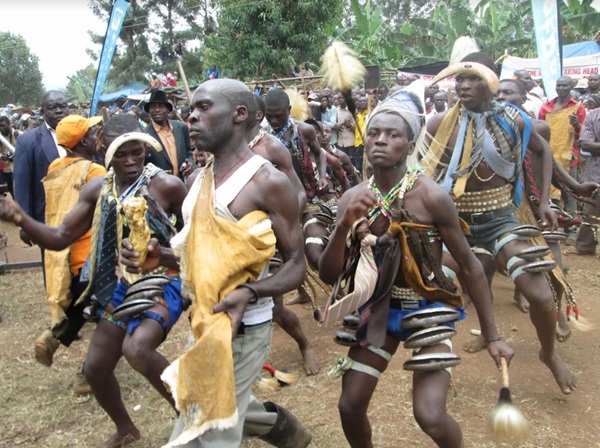
COMMENT | ALFRED GERESOM MUSAMALI | I have seen an alarmist letter (attached) allegedly written by one Joram Khamboson Mayatsa, who calls himself Umukuuka IV uwa Inzu ya Masaaba (IYM), mobilising all Bamasaaba of Uganda, Kenya and the Diaspora to participate in and support the upcoming “Circumcision Day” for Bamasaaba “defaulters”. Mayatsa specified that the New Year Imbalu (circumcision) event scheduled for this Thursday, 1st January, 2026 from 6am to 6pm is “…a vital cultural practice aimed at facilitating the transition of boys into adulthood within our community”.
The Bamasaaba are a Bantu-speaking ethnic community whose ancestral lands lie on the south-western and south-eastern slopes of Mt Elgon. The 4,321 metres above sea level mountain towers astride the Uganda-Kenya border in the East African Community (EAC). Those on the Ugandan side are also called Bagisu by virtue of their lands mainly falling into the former Bugisu district, one of the seventeen distinct administrative areas that formed Uganda at Independence in 1962. Bugisu has since been curved into six districts (Bududa, Bulambuli, Manafwa, Mbale, Namisindwa and Sironko) as well as one city (Mbale). In Kenya, however, the Bamasaaba are mainly referred to as Babukusu and are also a sub-group of the Luhya. The Baukusu are mainly in Bungoma and Kitale counties.
Calling for forced Imbalu could as well inadvertently call for FMG
On both sides of the frontier, among the immediate neighbours of the Bamasaaba are the Kalengin (such as the Kupsabiny, Pokot, Kipsigis, Keiyo, Marakwet, Tugen, Sabaot, Terik and Ogiek) who are in certain areas still being supported with great difficulty to abandon Female Genital Mutilation (FMG). So, this Mayatsa call could inadvertently incite some drunken chaps from our increasingly mixed-ethnicity, trans-boundary and cosmopolitan community into pursuing other different gender perceived “defaulters”, especially of FMG.
Besides, Uganda is currently in the middle of political election campaigns in which there have reportedly been widespread and worrying cases of violence. Media reports, for instance, indicate that on Christmas Day, supporters of the incumbent Bungokho North (Mbale district) MP John Faith Magolo and those of Shafiga Wanyenya, the ruling National Resistance Movement (NRM) flagbearer in the forthcoming elections, clashed, leaving village council chairperson Moses Nabende dead. Nabende, was also a village campaign manager for Magolo who lost the NRM party flag to Wanyenya before opting to go independent. At least 10 other persons, mostly from Nabende’s family but split between the rival factions, are still treating machete-inflicted wounds sustained in the chaos. Nabende was serving clients in his bar when the chaos broke out, thus affecting his business. Census 2024 results show that Bungokho North is predominantly a Moslem area.
I am, therefore, equally afraid that once lawlessness breaks out on the instigation of a leader with some semblance of cultural following such as Mayatsa claims to be, those cultural differences would fuse into political or economic violence. If that happens, we would find ourselves going wild by, for instance, even pursuing and mutilating the Karamojong, Iteso, Japadhola and other ethnically different or politically dissenting peoples. Our reasoning would probably be that since those persons happen to have integrated among the Bamasaaba and Kalengin and have learnt a few expressions of our languages to enable them successfully sell us ajon/malwa (millet beer) they have to do everything as we do.
Circumcision is no longer the only way of nurturing endurance
In the Pre-Independence and immediate Post-Independence days, before the prevalence of modern surgical procedures, Bagisu and Babukusu (although, confusingly, not all other Luhya!) treated public, unanesthetized adolescent male circumcision as compulsory. The ritual, undertaken as a rite of passage into manhood, usually took place during even (boys’) years only (the next one of which being 2026). Any youth who did not submit to Imbalu during or soon after adolescence (referred to in singular as “Umukoonela” and in plural as “Bakoonela”, translated as defaulter/defaulters) were humiliatingly chased, captured and forcefully cut. That is what Mayatsa is advocating almost a century later.
But, to begin with, in those days, circumcision and FMG were partially undertaken to prepare youths for challenging responsibilities in the community, including in marriage. In fact, the rituals were a form of military training where endurance exercises were undertaken, climaxing into the surgical operation that the youth had to either unflinchingly withstand or lose their moral authority for ever. Today, however, we have an education system that equally tests the endurance of our youths, though only by academic rather than sexual manhood or womanhood. We also have aspects of life such as entrepreneurship and innovation that take our youths through extremes of risk where they sometimes reap little if any. And we even have formal military training for those who wish to go a step further in, ironically, taking certain civil responsibility – all ensuring that only the most case-hardened survive to, with their heads held high, tell their stories in a variety of styles.
Yet, as a circumcised Mugisu, I know that Imbalu still has an important role to play in our community by carrying cultural symbolism and health prevention measures in the advent of the HIV/AIDS. Some people will, of course, argue that if a male is sure that he and his single, faithful sexual partner can keep the highest level of personal hygiene and that they can make love gently, without bruising each other (especially the foreskin), then male circumcision is unnecessary.
I also know that keeping male hygiene is a great challenge to the uncircumcised and that remaining gentle in moments of sexual extasy is equally difficult. I, therefore, personally recommend male circumcision. The process should be voluntary, though, with those not yet convinced being given more information, preferably privately, and much, much more time, even if that means their spilling the surgery into odd (girls’) years, rather than their being forcefully, hurriedly and publicly subjected to the ritual. As for FMG of any sort, plenty of research has shown that rather than give the woman any dignity or safety, it is culturally repugnant, physically dangerous to both the women and their partners and spiritually unhelpful. Why would anybody wish to, however inadvertently, call for that at all?

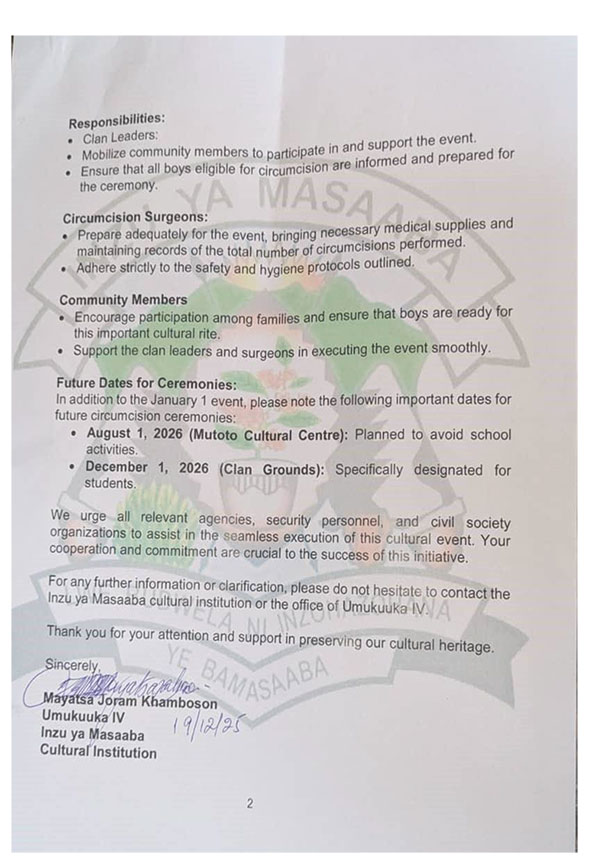
Mayatsa’s position is even superfluous
Mayatsa has for the time being no legal authority to speak for Bagisu, let alone for the Babukusu or other Luhya. In my view, the IYM does exist but either as a Non-Governmental Organisation (NGO) or a Company Limited by Trust and has every right to elect its leaders, a process through which Mayatsa was elected a few months ago. Records show, though, that IYM started off in the 1990s with every good intention of providing the Bamasaaba with a cultural leadership. Today, while most of the IYM founders, including Umukuuka I Ambassador Wilson Weasa Wamimbi, are dead, extremely few others, such as former Makerere University poetry luminary Timothy Wangusa and former Constituency Assembly (CA) Representative Engineer Darlington Sakwa still survive and have also given personal testimonies of their good intentions. However, again in my view – in spite Engineer Sakwa who, along with Prof Wangusa I so much respect, reminding me otherwise on enough occasions – the IYM good intentions were overtaken by events when the Parliament of Uganda in 2011 enacted the Institution of Traditional or Cultural Leaders (ITCL) Act. Under the law, the cultural leaderships were referenced to the title of the leader and the national geographical and administrative areas rather than to cross-boundary ethnic jurisdictions and nomenclatures.
By leaving little such room for a trans-boundary ethnic referencing, the ITCL Act 2011 also sought to promote and preserve the cultural values, norms and practices (language, music, dance, food, rituals and environment) which enhance the dignity and well-being of the people where he or she is recognised but not exactly in the way Wamimbi, Wangusa and Sakwa had wished. Then Uganda’s Gender, Labour and Social Development Minister Betty Amongi did not make matters any better when she early this year signed The Uganda Gazette Vol. CXVIII No. 29 – General Notice No 966) which clarified the officially recognised referencing to Kabaka wa Buganda, Kyabazinga wa Busoga, Omukama wa Tooro, Omukama wa Bunyoro, Umukuuka wa Bugisu, Wan Nyac me Lango, etc.
To that extent, therefore, there is no such recognised leader as Umukuuka uwa IYM as Mayatsa, who also happens to be an uncle, claims to be, with authority to mobilise communities in Uganda, Kenya and the Diaspora into forcefully circumcising any Umumasaaba or other member of the community – let alone, inadvertently into performing FMG. But there is Umukuuka wa Bugisu, Sir Jude Mike Mudoma, who took office in August 2023 and still has three years to the end of his five-year non-renewable term of office. Nevertheless, because there was a two-year delay between when Umukuuka Mudoma was elected and when he took office, Mayatsa and his supporters woke up in August this year and claimed that Umukuuka Mudoma’s term had expired and then they elected themselves into office. Government of Uganda (GoU) has since ignored the development, anyway, despite their repeatedly petitioning for recognition. Meanwhile, in court that tenure issue is still under contestation and, as law abiding citizens, we await due process. So, until conclusion of the process, Uncle Mayatsa’s claim to any authority is at best superfluous and at worst also even illegal.
Need for regional protocol on trans-boundary cultural oversight
Under the ITCL Act 2011, however, the Bamasaaba outside Bugisu (especially in Kenya) were sort of sidelined and it may take protracted negotiations in the development of a protocol within the EAC framework to streamline their full participation in the governance structures of Umukuuka wa Bugisu. Yes, those Kenyans and other non-Ugandans hold positions in the Cabinet of Umukuuka wa Bugisu. For instance, Dr Sylvester Wakooli Bifoori is one of the deputy prime ministers in the Umukuuka wa Bugisu cabinet. Prof Bonaventure Kerre, Engineer Agnes Wache, Rtd. Col. Tom Lihru Wanambisi as well as Hons Metrine Nangila Wilson, Bernard Nyongesa Mureke and Phillip Wanyonyi Wekesa all hold very sensitive portfolios in the cabinet. Among the other non-Ugandans, Welshman Dr. Geoff LIyod is Ambassador Extra Ordinary to Wales and the Pont Organisation. Everybody I have named here is a heavy weight in their own capacities. Col Wanambisi, for instance, is the army officer who in the early morning of Saturday August 2,1982 commanded a rescue force from Nanyuki to reverse a military coup that had been staged by sections of the Kenya Airforce against then President Daniel Arap Moi. But they cannot, for instance, take up the top position in their own cultural institution because currently the Umukuuka is elected from only among the three main lineages of Masaaba (original man who is believed to have popped out of the volcanic creator on Mt Elgon). The lineages are of Mwambu, Wanale and Mubuya, all in Uganda. Yet I do not see why we cannot successfully work out a governance structure under which the Kenyans, too, qualify to contest for the top position in the institution.
So, instead of us just sitting in Mbale, the cultural centre of Umukuuka wa Bugisu, and commanding by letter what those non-Ugandans should do in their countries, we should engage in the delicate processes aimed at how they are fully accommodated in the cultural institution. And until such consensus is arrived at, such utterances by Uncle Mayatsa and his ilk asserting their right to associate freely are as well unhelpful.
Nevertheless, I wish my Uncle Mayatsa a Happy New Year
As the New Year begins, Umukuuka wa Bugisu’s legal advisor and attorney general Richard Masereje (whom Engineer Sakwa has previously referred to as “very confused”), has nevertheless advised me that there are a number of international and national legal safeguards and human rights oversight systems that militate against the utterances by Uncle Mayatsa.
First and foremost, says Masereje, a Kampala city advocate, Ugandan law prohibits any form of coercion or forced participation in circumcision or other cultural practices that are not consistent with fundamental human rights.
“Building on this legal foundation, His Royal Highness (HRH) Jude Mike Mudoma, Umukuuka III, has strengthened safeguards in accordance with Objective XXIV, Article 24 of the 1995 Constitution and the mandate under Section 8 of the ITCL Act Cap 242.
“It should, however, be appreciated that Imbalu, like many other cultural practices has evolved over time and many practices, some of which may not originally have been consistent with fundamental human rights but have now evolved to be aligned with the law and the fundamental human rights.
“Yet the times, for instance, when people could be grabbed in the streets with impunity under the cover of culture are over. Instead, the so called “defaulters” have to just be convinced to go through the process,” said Masereje.
Given the above, I wish to in turn advise Uncle Mayatsa to find something better to preoccupy himself with in 2026 as I, in good faith, wish him, all other Bamasaaba and, indeed, everybody else in the World, a Prosperous New Year.
*****
Alfred Geresom Musamali is the director of Vicnam International Communications Ltd, a private firm of communications, public relations and information management consultants. He specialises in Proofreading and General Editing (PAGE) of literary, journalistic, technical and scientific documents. Musamali is also the Information, Media and Communications Minister in the Cabinet of Umukuuka wa Bugisu. He can be contacted on Tel: (+256)752-649519 and email: agmusamali@hotmail.com.