The Independent Uganda: You get the Truth we Pay the Price


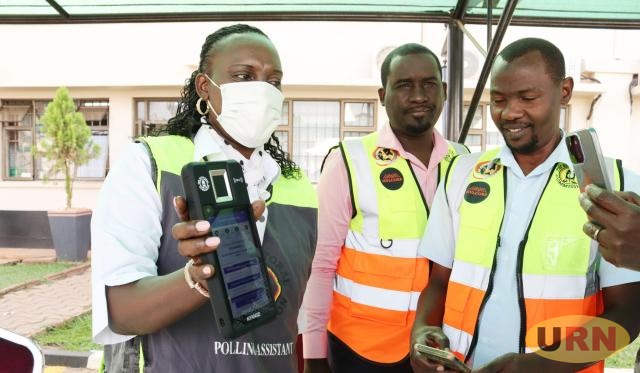
Kampala, Uganda | THE INDEPENDENT | There were disagreements at several polling stations in Kampala and other parts of the country after Biometric Voter Verification Machines (BVVK) rejected some cast ballots during vote counting.
The BVVK machines, which are being used for the first time in the 2026 election cycle, were deployed during the just-concluded municipal and division chairperson and councillors’ elections and worked successfully in many areas. However, technical and procedural challenges emerged at some polling stations.
In Kampala Central, disagreements were reported at three out of four polling stations at Hormisdallen School in Kifumbira II after machines rejected ballots during counting.
In one incident, an agent was escorted out of the polling centre after slapping an agent of a rival candidate following a dispute over a ballot that had been declared invalid. Police officers intervened to calm tensions during the counting of votes for female councillors.
Aggrieved agents and supporters questioned how ballot papers that had been successfully scanned when issued to voters could later be rejected by the same machines during the counting process.
Polling officials were unable to give a definitive explanation, stating instead that their terms of reference required them to declare a ballot invalid whenever the machine displayed a red signal.
Across several polling stations visited, officials spent additional time explaining the distinction between valid and invalid votes, slowing down the tallying process.
Tensions were also reported at Treasure Life Centre (TLC) in Church Zone, where supporters and agents of NRM woman councillor candidate Goreti Katana disputed an invalid vote set aside by polling officials.
The disagreement led to a heated exchange between supporters of Goreti Katana (NRM) and Teddy Nabwami (NUP), temporarily halting the tallying exercise.
Security personnel intervened to restore order and dispersed crowds from the polling station. Presiding official Tugume Robert explained to supporters and agents that a vote is considered invalid if the tick mark extends beyond one candidate’s box into another’s.
“The vote is invalid. The person ticked beyond. How can we determine her choice? The thumbprint and tick must be in one candidate’s box,” he said.
However, Electoral Commission guidelines state that a vote remains valid as long as the origin of the tick or thumbprint is clearly identifiable, even if it extends into another candidate’s box.
Voter turnout in Kampala Central was slightly higher than during the recent mayoral election, with most voters arriving in the afternoon. Joseph Jjujo Magezi, the Kamwokya parish publicity secretary, attributed the improved turnout to the councillor candidates deploying teams to mobilise voters through house-to-house campaigns.
“Some contestants, especially councillors, asked their teams to go into the ghettos and mobilise voters. People turned out — not in huge numbers — but it was better than the last election,” Jjujo said.
He added that overall turnout remained low due to the frequent movement of non-permanent residents in search of employment opportunities.
Kampala Central Division comprises 12 parishes, each electing two councillors. A closely watched contest is between NRM’s Salim Uhuru and NUP’s Moses Katabu. Uhuru, the incumbent, had earlier expressed confidence in his victory, saying he was only waiting to proceed to Kololo for his declaration.
In Nakawa Division, polling stations closed without disruption. Voters arrived steadily throughout the day and cast their ballots calmly and in an orderly manner as the Electoral Commission implemented the BVVK system.
At polling stations in Mutungo, Mbuya, Kyambogo, and Ntinda, the majority of people present were candidate agents and presiding officers.
Unlike previous elections, where members of the public stayed to observe vote counting, stations visited during this exercise were largely occupied only by officials and agents.
Abdulaziz Ssenyonga, encountered near the Naguru KCCA Division offices, said he had lost interest in remaining at polling stations during counting.
He explained that candidates he previously believed would win elections were not declared victors, leading to public disillusionment. Security personnel from the Uganda Police Force and Uganda Prisons Service remained deployed at polling stations to ensure the process concluded smoothly.
Final results will be announced by the Electoral Commission after the completion of counting and verification.
The Nakawa Division mayoral race features NUP’s Ali Bukeni, popularly known as Nubian Li; incumbent Paul Mugambe, now contesting as an independent; and NRM’s Susan Zawedde, among others.
At Kawempe Muslim Primary School polling centre in Kawempe Division, the BVVK machine at one polling station failed to scan ballot papers during vote counting. Polling assistants, who requested anonymity, said the machine was unable to scan all ballots and that they were advised to proceed with manual counting at that station.
In Mukono District, the BVVK machines were used consistently throughout the voting process in several polling stations in Mukono Municipality, with no reported technical failures. At the close of voting, polling officials scanned ballot papers to verify that serial numbers corresponded with those captured during the morning voter verification exercise.
This process was conducted in the presence of candidates’ agents and observers. To enhance transparency, agents were allowed to photograph verified results as displayed on the BVVK machines.
At polling stations visited in Mukono during counting, no disputes were reported regarding ballot validity. In Arua City, rainfall that began in the morning disrupted both voting and vote counting.
At Bibia Mukutari polling station, the counting of votes for Central Division mayoral candidates was temporarily suspended to allow the rain to subside.
Similar interruptions were reported at Muru Rahuman, Oyooze, Ojulua, and Azia-Zebra polling stations, all within Arua Central Division.
Vote counting resumed gradually as weather conditions improved. Meanwhile, vote counting proceeded smoothly at polling stations in Kamwokya, where officials were observed using machines to scan ballots.
In Kumi Municipality, the election process progressed smoothly, with biometric machines functioning effectively for voter verification and post-voting ballot scanning.
At polling stations visited by our reporter, vote counting continued without major incidents. However, as observed in many parts of the country, voter turnout remained low despite the peaceful exercise, prompting candidates to transport voters to polling stations.
In Jinja City, a standoff was reported at Spire Road polling station in the Southern Division after the BVVK machine failed to scan ballot papers following the close of voting. According to Electoral Commission guidelines, ballot papers should be scanned when issued to voters, with the same procedure repeated during vote counting at polling stations.
Although voting ended at exactly 4:00 p.m., the BVVK machine failed to repeat the scanning process during counting, raising suspicion among voters who had gathered to witness the exercise.
The BVVK machine operator, who spoke on condition of anonymity, said records indicated that 200 voters cast their ballots. He added that attempts to scan the ballots resulted in the rejection of more than 53 papers, despite them appearing visibly correct.
Officials resolved to suspend the process and seek guidance from their superiors. However, the two-hour wait triggered anger among voters. Kasim Bakaki said the technical failure raised suspicions of foul play, noting that the machines functioned properly at other polling stations.
He added that BVVK machines should be equipped with backup systems to address technical faults promptly. Lovisa Nabirye, another voter, said the introduction of BVVK machines was intended to promote transparency by ensuring that only scanned votes are recorded on declaration of results forms.
She argued that the Electoral Commission’s technical teams should respond swiftly to breakdowns to maintain public confidence.
“Spire Road polling station is about 400 metres from the Electoral Commission offices, yet we waited for two hours without any response. This has created anxiety and suspicion of vote rigging among residents eager to witness vote counting,” she said.
Jinja City Returning Officer Flavia Nakasi later authorised polling officials to proceed with manual counting. She said the BVVK machines had generally performed well across most polling stations and credited Electoral Commission technical teams for supporting operators throughout the process.
In Kabale District, voting proceeded peacefully across all polling stations in Kabale Municipality. The contest involved NRM flag bearer Sam Arineitwe, incumbent mayor Emmanuel Sentaro Byamugisha running as an independent, Kabale District Deputy Speaker Ian Ronald Mugisha, also an independent candidate, and an FDC flag bearer who is a boda boda rider.
Moments before tallying began, Sheikh Kassim Kamugisha, a former Wakiso Deputy Resident District Commissioner, exchanged words with security officials at Kakabano polling station in Upper Bugongi Ward, Northern Division.
Kamugisha was accused of causing disturbances at various polling stations while acting as an agent for Byamugisha. However, no disruptions were reported during the tallying process. By press time, supporters were seen celebrating Byamugisha’s early lead.
***
URN