The Independent Uganda: You get the Truth we Pay the Price


Fourth EITI report reveals companies still dodge key disclosures as beneficial ownership data remains thin and contract transparency has barely moved
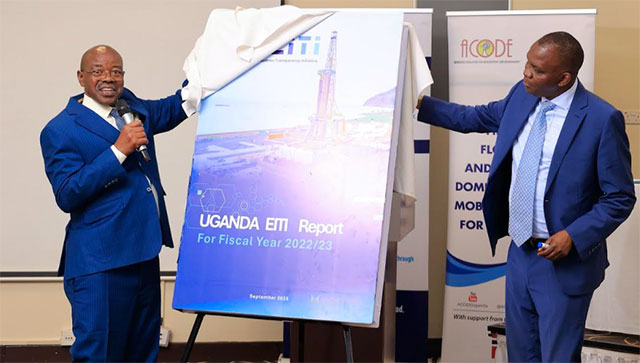
NEWS ANALYSIS | RONALD MUSOKE | When Uganda’s fourth Extractive Industries Transparency Initiative (EITI) Report was released in Kampala on Nov.20, the message that threaded through Protea Hotel’s ground floor conference room was both blunt and familiar: the East African country’s extractive sector is becoming more transparent, but it is still unable to give a full, reliable picture of what happens beneath its soil and within its books of accounts.
The report, covering the 2022–2023 financial year, shows noticeable improvements in revenue collection, information systems and sector coordination. But it also exposes deep, recurring weaknesses; missing company data, inconsistent figures across government agencies, incomplete beneficial ownership information, and a stubbornly large gap between what should be known and what is actually verifiable.
Across the ample conference room; the tone from government officials, civil society actors, sector regulators and mining representatives, was not celebratory. It was sober. The experts in the room agreed that the extractive sector, which involves the exploitation of natural resources such as oil, gas and minerals, is moving forward but it is doing so with one foot still stuck in opaqueness.
Opaque mining sector
The Extractive Industries Transparency Initiative (EITI) is a voluntary mechanism whose secretariat is headquartered in the Norwegian capital, Oslo. It aims at strengthening the governance of public revenues derived from oil, gas, and mining resources in resource-rich countries like Uganda. The EITI Standard which Uganda joined in August, 2020, requires the public disclosure of all significant payments made by extractive companies to governments, as well as the corresponding revenues received by governments.
In accordance with “Requirement 4.1 of the 2023 EITI Standard,” extractive companies and government entities, including public administrations and state-owned enterprises, are required to disclose their payments and revenues. Reporting entities are also required to provide contextual information, including production and export volumes, employment data, social contributions, and other relevant information as stipulated in the Standard.
However, the day’s most candid technical assessment came from Rached Maleej, the Independent Administrator from Moore Insight—the firm contracted to compile and reconcile the report. Maleej who spoke virtually explained that although several government agencies and mining companies had made “considerable improvements,” the dataset for the year still could not be considered complete.
Of the 20 companies required to submit reporting templates for reconciliation, for instance, only 10 complied. The remaining half, including companies still operating, did not provide their information. Two firms, DGR Energy Turaco Uganda-SMC Limited and Armour Energy Uganda had expired licences and were unreachable, but the rest simply failed to participate.
The outcome was a significant Shs 143 billion discrepancy between company declarations and what government recorded as revenues received. “We cannot state with reasonable assurance that the EITI dataset captures all significant revenues and payments for the reporting period,” Maleej said. His tone was calm, but the implication was serious: Uganda is disclosing a little more data, but it still cannot tell the entire story of how much is earned, who earns it, and where the money goes.
Maleej recommended stronger enforcement mechanisms and enhanced data assurance if Uganda is to meet the expectations of the EITI Standard—especially under the more demanding 2023 framework, which prioritises reliability and verifiability over volume.
Despite the gaps, government officials insisted that progress is undeniable. Saul Ongaria, Uganda’s EITI National Coordinator, argued that the initiative has already changed the culture of data within the extractives sector.
“EITI has given us clearer tools to track what is happening,” he said. “The extractive sector has always been technically complex and not very open. But transparency is no longer optional. Investment follows openness.”
Ongaria’s point was that by publishing increasingly detailed reports, Uganda signals to investors that it is committed, at least in principle, to predictable governance. That confidence, in turn, can translate into exploration interest and long-term capital.
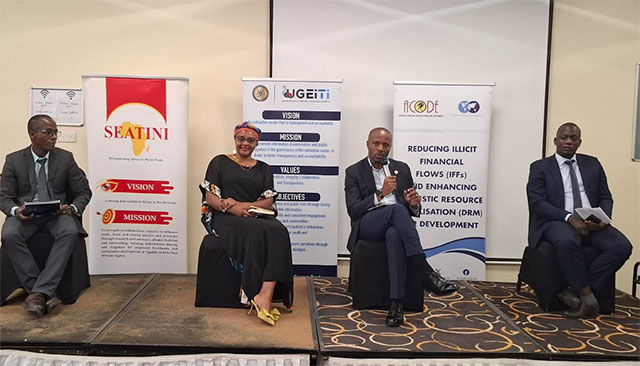
Moses Kaggwa, the Chair of the Multi-Stakeholder Group (MSG) of the country’s chapter of EITI and the Director of Economic Affairs at the Ministry of Finance, delivered a similar message but with an acknowledgment that Uganda must now move from intent to action. He cited Uganda’s 78.5% score in the 2023 EITI validation as proof that the country is on a “credible path” but warned against complacency.
“When you are transparent, you attract investments everywhere,” Kaggwa said. “Citizens trust that revenues are well-managed. That trust is part of economic growth. But we must address the areas where the report shows we are still lagging.”
The performance numbers in the report reveal a sector whose economic footprint is still small, but whose fiscal contribution is growing. According to the report, total mineral production value increased by 23%, reaching Shs 248.5 billion. Volcanic ash, marble and Syenitic aggregate recorded the highest rise, while five companies; Sino Minerals, Hima Cement, Tororo Cement, Namekara Mining and Great Lakes Iron and Steel accounted for nearly 90% of the production value.
Government collected Shs 530 billion from extractive-related revenues which is a 29% increase from the previous period. Mining contributed Shs 300 billion, and the fossil-fuel sector Shs 230.23 billion. But national impact remained modest with the extractives contributing just 1.47% to GDP, less than 0.03% to employment, and a tiny 0.001% to exports, reflecting constrained mineral export policies.
These figures, officials said, underline that transparency is important not only for accountability, but for improving performance in a sector whose potential remains largely unrealised. Where the discussion became more pointed was around beneficial ownership, contract transparency and the persistent unwillingness of companies to report.
Gloria Mugambe, the Head of the Uganda EITI Secretariat, told the audience that these challenges were not new but the patience for them is wearing thin. “Beneficial ownership is a requirement, but every year we are seeing gaps,” she said. “Companies continue to ask why they should report, whether the law compels them (to do so). On the mining side, the submission rate is still low, even when directives come from the Minister.”
Beneficial Ownership data
She added that Uganda’s beneficial ownership weaknesses had cost the country points during the EITI validation, and they continue to undermine public trust. Mugambe called for the establishment of specialised technical groups within the MSG to focus exclusively on these persistent issues rather than revisit them year after year.
Contract transparency is another area where Uganda continues to falter. Mugambe said confusion persists about which entity holds authority to release mining and petroleum agreements, resulting in no meaningful progress on this requirement. “We need clarity. Who must approve? Which contracts can be published? Without answers, we remain stuck,” she said.
From the civil society side, the message was sharper and anchored in history. Winnie Ngabire, the Executive Director of Global Rights Alert, a Kampala-based civil society organisation, reminded participants that EITI itself was born out of civil society pressure—not government benevolence. She traced the initiative’s roots to Global Witness’s 1999 investigative report, “A Crude Awakening,” which exposed the paradox of resource-rich but impoverished countries and ignited the global “Publish What You Pay” movement.
“If it was not for NGOs, we would not be having EITI today,” Ngabire said. “Communities asked why their regions were producing wealth, yet they remained poor. That question shaped the entire transparency agenda.”
She emphasised that civil society also pushed EITI to become more gender-responsive and youth-inclusive, adding that extractive industries governance cannot be driven only from the top. Ngabire warned that Uganda risks focusing too narrowly on revenue transparency while neglecting environmental, social and community-level concerns. “Transparency must speak to people’s real lives,” she said.
Incentivizing mining companies
But perhaps the bluntest voice in the room belonged to Kenneth Asiimwe, the CEO of the Uganda Association of Artisanal Miners. He argued that artisanal and small-scale miners are unlikely to prioritise transparency or reporting unless the government links compliance to tangible benefits.
“Compliance is a cost,” Asiimwe said. “People comply when they see value. If, following the rules helps them access markets, finance or government support, they will do it. If it only exposes them to penalties, they won’t.”
He argued that for most artisanal miners across the country, regulatory enforcement still feels punitive rather than developmental, and Uganda’s transparency initiatives risk excluding the very communities producing much of the country’s gold.
Interestingly, the government’s own explanations for data inconsistencies, particularly around gold, came from David Ssebagala, the senior inspector of mines at the Directorate of Geological Survey and Mines (DGSM). He acknowledged that official production figures differ sharply from those of the Uganda Revenue Authority export figures, but he attributed this to the scale of illegal artisanal gold mining.
“Eighty percent of artisanal mining operations are illegal,” Ssebagala said. “We cannot record production from mines that have no licences. That is why URA export data looks different from DGSM production figures.”
He warned that these discrepancies may create serious challenges under the International Conference of the Great Lakes Region’s (ICGLR) certification mechanism, which demands traceability for all gold exports. Without accurate production data, Uganda risks questions about the origin of its gold on the international market.
Ssebagala also revealed that the long-planned data-sharing “single window” between DGSM and URA, which is meant to harmonise production and export data, remains non-functional four years after discussions began. “We talk about data integration, but we’re not yet there,” he said.
EFRIS for miners
On the revenue side, the Uganda Revenue Authority highlighted new technology aimed at tightening oversight.
Lawrence Muwonge, URA’s extractives sector manager, said the authority is rolling out a digital fiscal regime management platform for both mining and petroleum. URA is also expanding the Electronic Fiscal Receipting and Invoicing Solution (EFRIS) use and conducting digital mapping of mineral taxpayers based on licence areas.
“These tools will help reduce discrepancies and identify non-compliance faster,” he said. But he acknowledged that digital systems alone won’t solve the wider problem of inconsistent reporting across institutions.
Beyond the numbers and institutional explanations, the fourth EITI report captured one central truth: Uganda has made genuine progress, but its transparency agenda remains incomplete and fragile. The report documents clear gains including; rising revenues, improved mineral production reporting, better documentation of environmental and social expenditures, stronger fiscal management in petroleum, and enhanced coordination within the MSG.
Entrenched systemic weakness
But the systemic weaknesses remain deeply entrenched. Too many companies still ignore reporting obligations; beneficial ownership disclosures lack completeness and contract transparency has not advanced. In addition, government agencies continue to produce inconsistent figures while illegal artisanal mining continues at scale. And many recommendations from previous years remain unimplemented.
These recurring weaknesses explain why sector actors at Protea Hotel described Uganda’s progress as “real but reversible.” Without stronger enforcement, the transparency gains of recent years could stall or even recede.
Still, the conference room held a sense of cautious determination. Uganda’s government says it wants to reach full compliance. Civil society insisted that communities must be at the centre of the transparency agenda. Regulators said they need better coordination and technology. Artisanal miners called for incentives, not punishment. And the Independent Administrator insisted that Uganda must urgently close information gaps to meet the expectations of the 2023 EITI Standard.
All these voices agreed on one thing: Uganda has begun to open the extractives sector to public scrutiny, but it has not yet confronted the structural issues that prevent the country from telling the whole story of its mineral and petroleum wealth.
Whether Uganda can meet those expectations before the next validation round scheduled for the middle of 2026 depends on the actions taken in the year ahead, especially on enforcement, data harmonisation, and full company participation. Until then, Uganda’s extractive sector will continue to move forward, but at a pace slowed by the opaque corners it has not yet illuminated.