The Independent Uganda: You get the Truth we Pay the Price


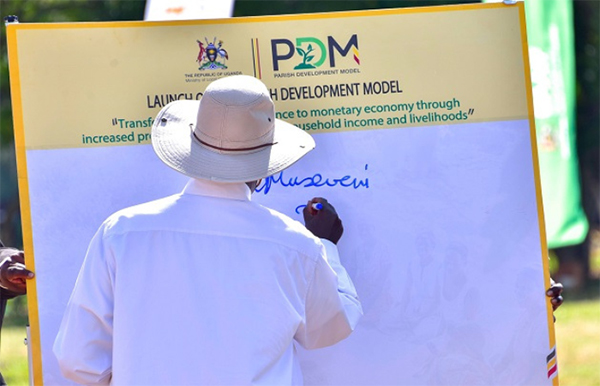
Kampala, Uganda | THE INDEPENDENT | Habits of multiple loan access and deceptive practices by some beneficiaries have been identified as serious impediments to the successful implementation of the Parish Development Model (PDM), the government’s latest strategy for transforming households from subsistence to a money economy.
Launched in 2022, the PDM targets income-generating enterprises at the parish level—the lowest planning and development unit in the country. Under the program, beneficiaries are mobilized into multipurpose parish Cooperative and Credit Organizations (SACCOs), which are directly capitalized by the government with UGX 100 million as a revolving fund for household-level enterprise groups.
However, the 2025 annual audit report by Auditor General Edward Akol revealed that the program is already riddled with administrative inconsistencies that undermine its poverty eradication objectives. The report notes that, of the 108 local governments sampled, 34 had a total of 2,336 households across 506 PDM SACCOs receiving parish development funds multiple times, contrary to program guidelines.
In 42 local governments, 109 beneficiaries in 86 PDM SACCOs had non-existent projects despite receiving funds. Additionally, 328 households in 52 local governments did not procure the items required for their funded projects, resulting in UGX 263.8 million being diverted for other uses. According to program guidelines, PDM loans are intended for capital inputs and operational expenditures, including seeds, fertilizers, acaricides, and veterinary drugs.
The audit further established that in 55 local governments, 619 households in 267 PDM SACCOs implemented ineligible projects. In 62 SACCOs, UGX 106.29 million could not be accounted for, despite having been withdrawn from accounts but not disbursed to beneficiaries. Akol noted that accounting officers attributed the problems to technical challenges with the PDM information management system, data inconsistencies, missing beneficiary information, limited capacity and compliance issues among SACCO leaders, and procedural bottlenecks in beneficiary verification and preparation processes.
However, Peter Ssenkungu, the Masaka District councillor for workers, says the audit points to a bigger problem threatening the program, citing collusion between program monitors and technical teams responsible for selecting eligible beneficiaries. He highlights instances in Masaka District where unscrupulous individuals manipulated the system to create ghost beneficiaries, embezzling part of the funds. Ssenkungu has challenged implementing agencies to take tough action against syndicates abusing the program, which he says is capable of transforming many livelihoods.
Ssenkungu also called on the government to adjust the PDM implementation by increasing capital allocations to beneficiaries to enhance the value of their enterprises.
Cumulatively, the government has disbursed UGX 3.25 trillion to 10,589 PDM SACCOs across the country.
****
URN