The Independent Uganda: You get the Truth we Pay the Price


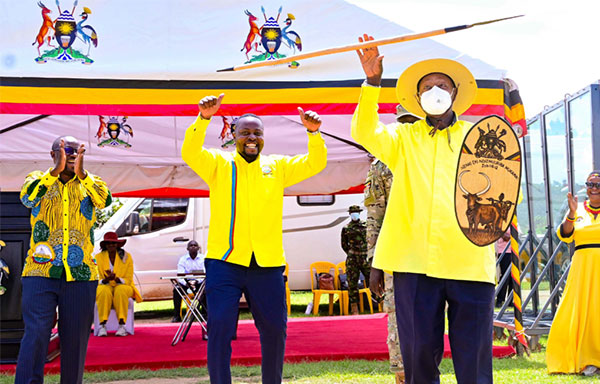
Museveni bounces back with a decisive 71% victory, his highest since 1996, amid NUP’s protest vote
COVER STORY | IAN KATUSIIME | In his seventh election and at the ripe old age of 81 years, President Yoweri Tibuhaburwa Kaguta Museveni appears to have set a new record in his 40-year reign when he was declared winner of the 2026 presidential election with a 71% victory over main opponent Robert Kyagulanyi aka Bobi Wine.
The Jan 15 election saw Museveni of the National Resistance Movement (NRM) score 7.9 million votes—his highest vote tally ever—according to the Electoral Commission. At around 4:30pm two days after the election, Justice Simon Byabakama, the chairman of the EC, made the highly anticipated declaration designating President Museveni as the president-elect in a scenario that has played out in similar fashion for the last thirty years.
Museveni increased his vote tally by almost two million votes in an election that was fraught with the usual irregularities: jailing of opposition candidates, police dispersal of opposition rallies, and denomination of those standing against MPs of the ruling party.
Kyagulanyi of the National Unity Platform (NUP) scored 24%, representing 2.7 million votes. In a video after the election, Kyagulanyi said the EC declarations were inconsistent with the tallies on the Declaration of Results (DR) adding that his agents were arrested and beaten not to mention police cordoning off his residence.
The opposition presidential candidate was yet to make a formal statement amid a four-day internet shutdown that effectively left the country off grid. The only way of gathering updates about the election was through television channels.
The Electoral Commission came under fire for the malfunctioning of the biometric voter verification kits (BVVKs) on voting day, compounding the environment of distrust surrounding the electoral process. The EC was also lambasted for its actions seen as favouring the NRM.
In what was an unprecedented move by the EC, the NRM had 17 unopposed MPs just before the election, meaning the party that captured power in 1986 had a significant advantage as it sought to extend its rule in Uganda.
For NUP, which was taking part in its second election, it had to contend with routine arrests of candidates, security blocking movements of Kyagulanyi and its supporters hailing teargas at every other encounter. In his victory speech held at his country home in Rwakitura on Jan 18, President Museveni boasted that he could have bagged 10 million votes had more of his supporters turned up to vote.
It was a yellow jamboree attended by Vice President Jessica Alupo, NRM first vice chairman Moses Kigongo, second chairman Anita Among who is also Speaker of Parliament, and other party top shots and supporters.

Museveni used the occasion to warn NUP; singling out Butambala County MP Muwanga Kivumbi, NUP deputy president for Buganda, involved in a scuffle with police where eight people were killed in his constituency a day after voting. Kivumbi lost the election to Eriasa Mukiibi, a journalist-turned-politician who ran as an independent.
Museveni vowed to deal with “traitors” and “terrorists,” while referring to the Butambala incident in statements that spoke to the political tensions in the country. Museveni’s reference to Uganda as a land of martyrs also sent chills on the true meaning of his statements.
The military has abducted many NUP supporters, some of whom remain unaccounted for five years later. During the campaign, Kyagulanyi said over 700 comrades remain in jail without trial. Opposition strongman Dr Kizza Besigye has spent more than a year in jail alongside Obeid Lutale, an aide. Dr Besigye surprised many when he contributed financially to Kyagulanyi’s campaign days to the election.
NRM bounces back
President Museveni polled highly in western, northern and eastern parts of the country to bounce back after what was a total wipeout in the central part of the country where Kyagulanyi in his first election beat the incumbent.
Analysts said Parish Development Model, an anti-poverty program, which was launched in the last term, was the reason for Museveni’s comeback as it brought services closer to the people in a country that is largely dependent on agriculture. NRM made in-roads in the central region and was able to win three seats in the highly contested Kampala district which is traditionally an opposition stronghold.
Museveni tussled it out with Kyagulanyi in Buganda netting 49% each in a sub region that voted overwhelmingly for the latter in 2021. NRM MPs made comebacks in a highly contested region that has been characterized by state brutality through abductions, illegal detention, torture.
NRM’s Minsa Kabanda won Kampala Central defeating NUP’s secretary general Lewis Rubongoya; Madina Nsereko defeated Nyanzi Ssentamu, a brother to Kyagulanyi in Kawempe South; and Freddie Ruhindi won back his old seat of Nakawa East beating the incarcerated Waiswa Mufumbiro, deputy spokesperson of NUP.
In 2021, NUP romped to victory in Kampala Metropolitan area that includes Wakiso and Mukono, and Greater Buganda pushing the ruling party out of an enclave it had its grip on but has now regained some of the areas. Some NRM stalwarts like Amelia Kyambadde bounced back in their constituencies after five years out.
President Museveni scored his highest in Karamoja with 92%; a region where he has averaged his performance at that level. This was followed by Ankole his home area with 91% and in another stronghold of his, Tooro, 88%.
In the Teso sub-region, Museveni trounced his opponents by winning 85% thanks to groundwork and campaign mobilization by key personalities. The vice president and speaker of parliament hail from the Teso subregion, which ensured key victories for the president.
In Acholi, Museveni garnered 84% to stamp his foot on an electoral map that he has dictated for decades. He got the same score in Lango – in a stark reminder of twenty years ago when these areas voted for the FDC as they protested the LRA war which claimed countless lives.
West Nile also turned out in droves for the president to ensure the northern part of the country remains in a yellow column.
Museveni also performed well in Bugisu sub region where he beat Kyagulanyi in many districts. A son of the soil, Nandala Mafabi who ran for president, appears to have been a calculated move to split the Bobi Wine vote and hand Museveni an advantage after the singer-turned-politician showed signs of enriching his vote from the region in the last election.
Mafabi of the Forum for Democratic Change (FDC) came third in the race with 200,000 votes barely 1% of the votes cast. According to insiders, his candidacy was meant to neuter the influence of Dr Besigye who was in FDC until recently when he and other key figures in the party jumped ship to form the People’s Front for Freedom (PFF). FDC now enjoys a close working relationship with the NRM.
In effect, Mafabi was a factor in the 2026 election just as he was a factor in the division and intrigue that caused the breakaway of founder members of the FDC.
The landslide victory put Museveni on the path to possibly ruling Uganda for fifty years. With every term come whispers of it being Museveni’s last, only for him to run again for what has now become a life presidency.
Youthful population and protest vote
For Kyagulanyi channeling the energies of Uganda’s youthful population under a campaign dubbed a “protest vote” after being initiated into what challenging Museveni means, it was another run at a job that has eluded Museveni opponents for the umpteenth time.
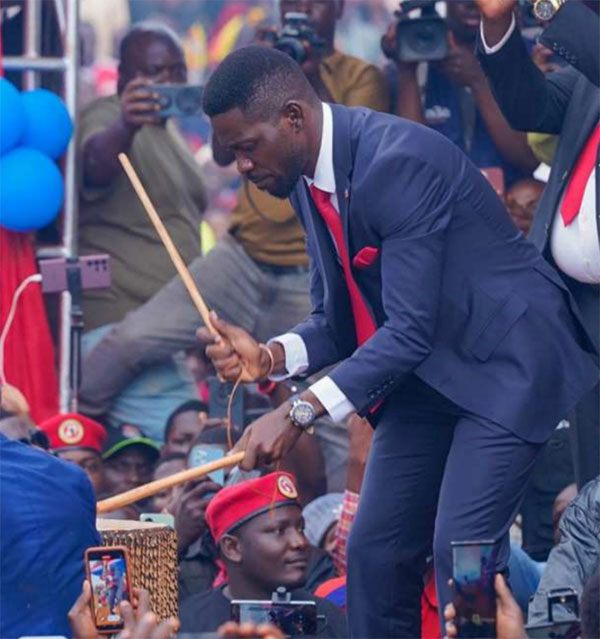
He had adoring crowds receive him wherever he went, staged mammoth rallies bathed in red and supporters showered him with gifts and love in person and on social media.
But it was the octogenarian leader that ultimately triumphed with his sea of yellow crowds across the country. Police, the army, government officials, and RDCs, make up a large contingent of the state machinery that makes Museveni virtually impossible to defeat in a presidential election.
Museveni captured power in 1986 and with his band of guerillas set about making Uganda in their image. He stood for elections in 1996 and won with a 75% margin against Kawanga Ssemogerere in a single party era defined by the Movement.
In the four elections held from 2001-2016 Museveni contested with his former comrade Kizza Besigye and emerged victorious but at a price for Besigye: trials, exile and persecution of his family and associates. Kyagulanyi whom Besigye handed the baton to has got the same share of treatment.
The introduction of multiparty politics in 2005 made Ugandan presidential elections a zero-sum game and turned opposition politicians and all their affiliations enemies of the state.
In 2021, Kyagulanyi made his debut under NUP and has just had his second stab at the presidency. His 2026 election campaign was an electric affair with the national flag being the symbol of NUP’s quest for change amid a tired decadent regime.
The 43-year-old promised “a new Uganda” vowing to release political prisoners, tackle corruption and revive crumbling education and healthcare services. Although Kyagulanyi won massively in Kampala and Mukono and areas of Busoga, it was not the same euphoria with which he swept those areas in the last election, where he garnered 3.6 million votes.
NUP had a savvy social media machine that galvanized the digital space with Kyagulanyi’s images and the party’s paraphernalia. It was this hostile online presence by the opposition that compelled the government to shut down the internet two days to voting day to keep the opposition and an agitated public in lock and key.
NUP candidates also established strong ground presence in local councils, sub-counties and had strong mobilization across the country. The party held rallies and tours across Uganda in the last five years and cemented itself as the largest opposition party in the country.